
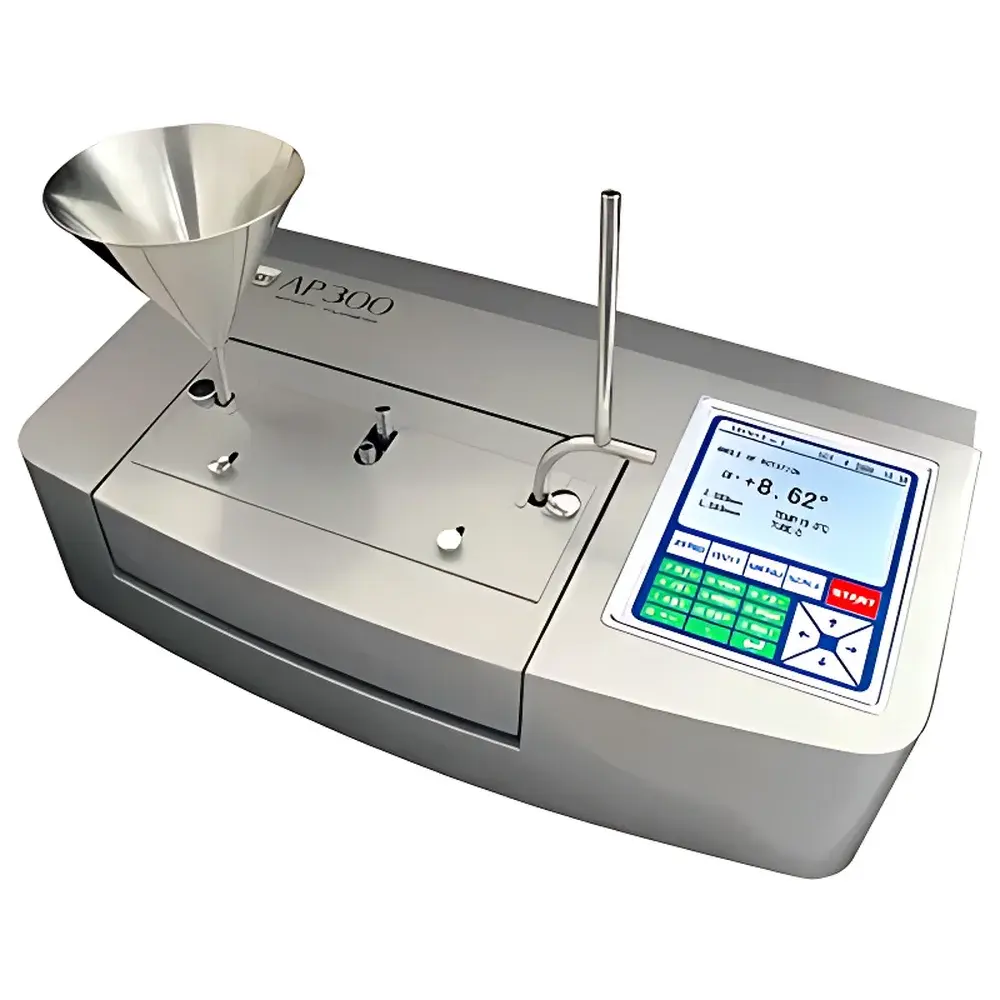
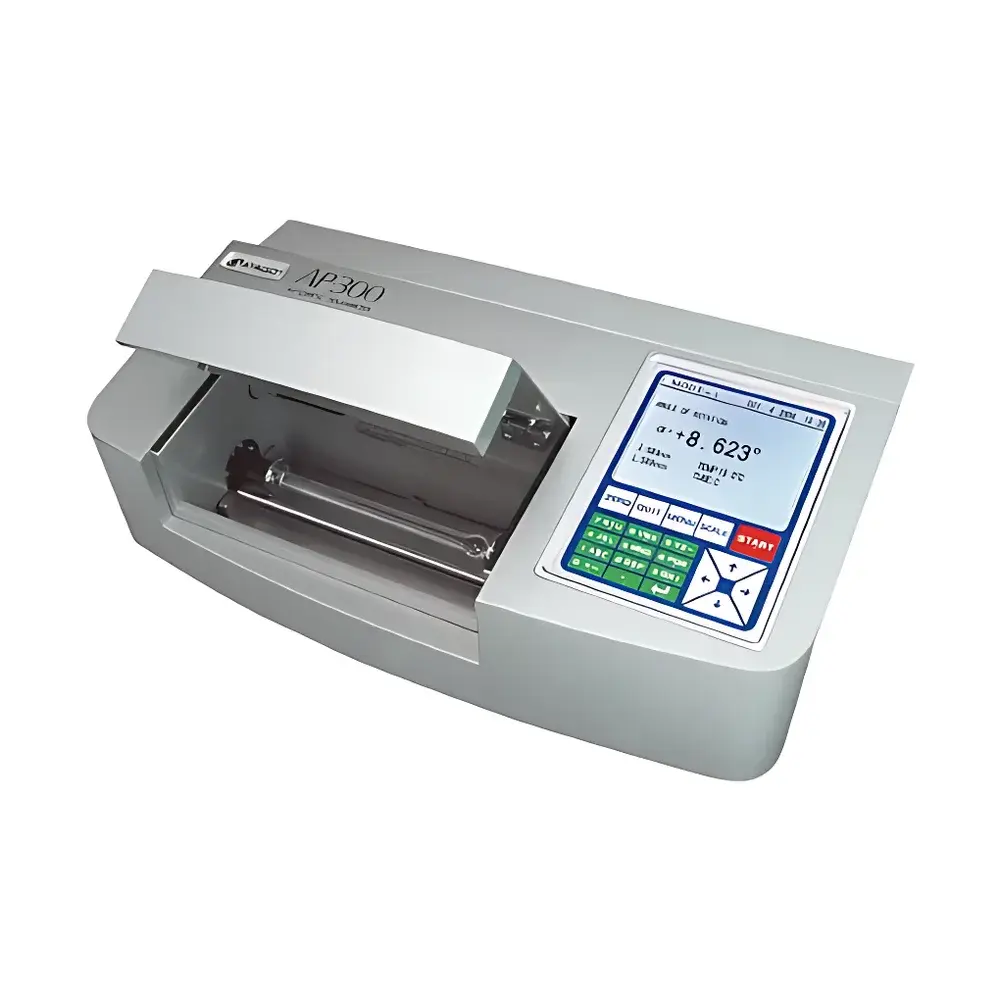
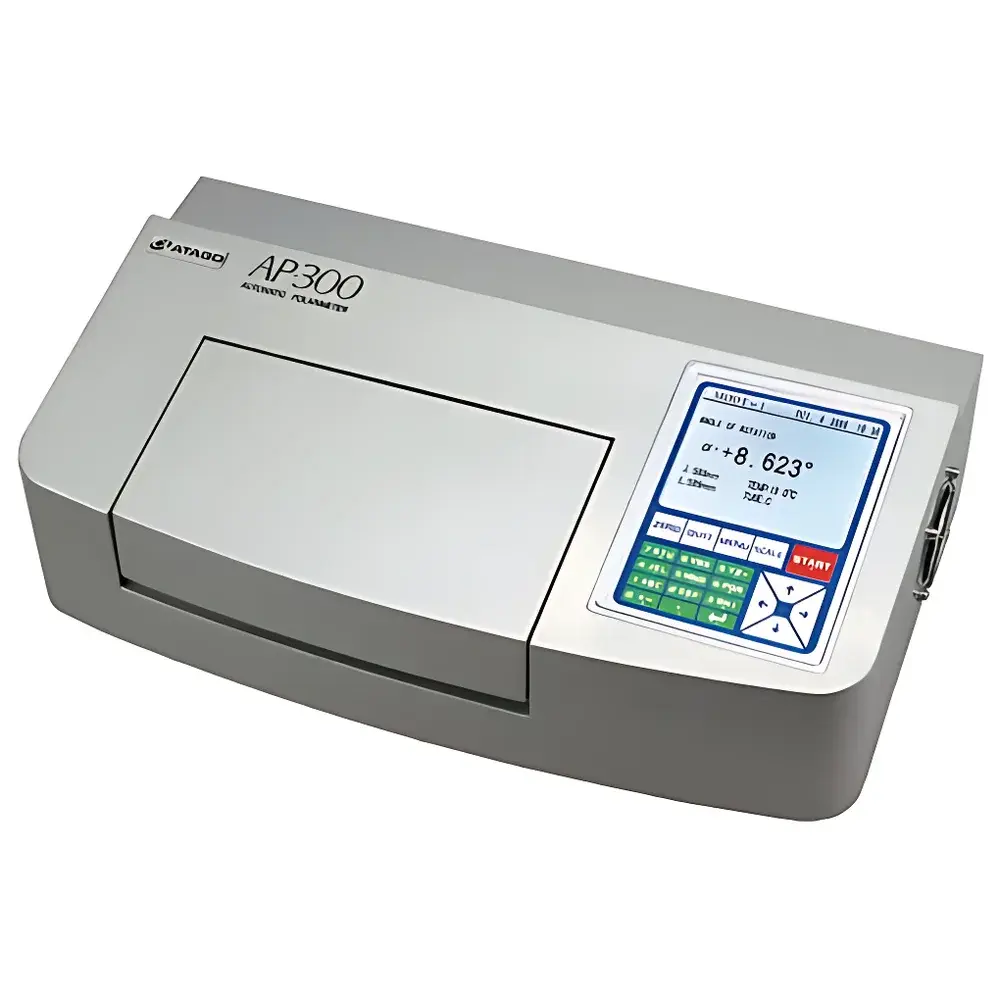
ATAGO AP-300 Automated Polarimeter for Sugar Industry
| Brand | ATAGO |
|---|---|
| Origin | Japan |
| Model | AP-300 Sugar Industry Kit (A or B Configuration) |
| Temperature Control | Yes (A Kit, with external circulating water bath) / No (B Kit, with automatic temperature compensation 18–30°C) |
| Display | Digital LCD |
| Light Source | LED |
| Measurement Range | Optical Rotation –89.99 to +89.99° |
| Accuracy | Optical Rotation ±0.01° (–35.00 to +35.00°), ±0.2% relative (outside that range) |
| Resolution | 0.01° and 0.01°Z |
| Compliance | FDA 21 CFR Part 11 (audit trail, user authentication, electronic signature support), ICUMSA Method GS4/3-11 (2021), ISO 5725 (accuracy & precision), GLP/GMP-ready data handling |
Overview
The ATAGO AP-300 Automated Polarimeter is a purpose-engineered optical measurement instrument designed specifically for high-precision, routine analysis in sugar refining, cane/beet processing, syrup production, and quality control laboratories. It operates on the fundamental principle of optical rotation—measuring the angular deviation of plane-polarized light as it passes through optically active substances, primarily sucrose solutions. The instrument reports results in both conventional optical rotation (degrees) and the internationally standardized ICUMSA sucrose scale (°Z), enabling direct traceability to ICUMSA Method GS4/3-11 (2021). Its dual-mode architecture supports two operational configurations: the A-kit integrates with an external circulating water bath (e.g., ATAGO 60-C5) to maintain sample temperature at 20.0 °C—critical for compliance with ICUMSA’s reference temperature requirement—while the B-kit employs built-in automatic temperature compensation across 18–30 °C, allowing rapid measurements under ambient lab conditions without external thermal hardware.
Key Features
- LED light source with stable spectral output and >10,000-hour service life—eliminates lamp replacement cycles and ensures long-term photometric consistency.
- Dual-scale measurement capability: simultaneous display of optical rotation (°) and ICUMSA-standardized sucrose concentration (°Z), with real-time unit conversion and selectable reporting formats.
- High-resolution digital readout: 0.01° and 0.01°Z resolution, with accuracy validated against certified quartz calibration standards traceable to NIST and JIS Z 8015.
- Configurable measurement protocol: user-defined repeat count (1–9), automatic averaging, standard deviation calculation, and pass/fail tolerance thresholds for QC release decisions.
- Integrated data storage: 30 measurement records retained onboard with timestamp, operator ID, sample ID, temperature, and result—exportable via USB to CSV or PDF for audit review.
- GLP/GMP-aligned firmware: full 21 CFR Part 11 compliance including role-based access control, electronic signatures, immutable audit trails, and secure password-protected method locking.
Sample Compatibility & Compliance
The AP-300 accommodates standard 200 mm path-length sample cells (15 mL capacity), supplied with precision-machined glass tubes, threaded end caps, and dedicated filling funnels to minimize air bubble entrapment and cross-contamination. Both A- and B-kits include calibrated 200 mm tubes with matching inner caps. The A-kit utilizes a jacketed cell compatible with external recirculating baths (e.g., ATAGO 60-C5), ensuring thermal equilibrium at 20.0 ±0.1 °C per ICUMSA requirements. The B-kit leverages a thermistor-coupled optical path and algorithmic correction per ICUMSA GS4/3-11 Annex C, delivering valid °Z values across 18–30 °C without manual correction. All measurements conform to ISO 5725-2 (repeatability and reproducibility), ICUMSA GS4/3-11 (sucrose quantification), and AOAC Official Method 951.02 (polarimetric sugar analysis).
Software & Data Management
Data integrity is maintained through embedded firmware compliant with FDA 21 CFR Part 11 Subpart B. Each measurement event logs operator identity, date/time stamp, environmental temperature, method version, and raw detector signal—not just final values. Audit trails are non-erasable and exportable in tamper-evident format. Optional PC connectivity enables integration into LIMS environments via RS-232 or USB virtual COM port. No proprietary software installation is required: exported CSV files are directly importable into Excel, JMP, or statistical process control (SPC) platforms. Method templates—including preconfigured limits for refinery-grade molasses, white sugar, and inverted syrup—are factory-loaded and editable only by authorized administrators.
Applications
- Raw juice and clarified juice analysis in cane sugar mills—monitoring polarization loss during clarification and carbonation.
- Final product certification of refined white sugar (ICUMSA 45 or lower) and specialty sugars (e.g., demerara, turbinado).
- Quality assurance of liquid sucrose syrups, invert sugar, and high-fructose corn syrup blends where optical rotation correlates with dextrose-equivalent profiles.
- In-process verification in starch hydrolysis and fermentation facilities—tracking chiral purity of intermediates like D-glucose and L-lactic acid.
- Regulatory submission support: generating auditable, CFR Part 11-compliant reports for USDA, EU Commission Regulation (EC) No 1234/2007, and China GB/T 10498-2018 compliance documentation.
FAQ
What temperature standard does the AP-300 follow for ICUMSA reporting?
The A-kit measures strictly at 20.0 °C using external water bath control, satisfying ICUMSA GS4/3-11 Section 4.1. The B-kit applies algorithmic compensation per Annex C, enabling valid °Z output across 18–30 °C.
Is the AP-300 suitable for non-sugar chiral compounds?
Yes—it provides raw optical rotation data (°) applicable to pharmaceuticals, amino acids, and organic synthetics; however, °Z scaling and ICUMSA compliance apply exclusively to sucrose solutions.
How is calibration verified on-site?
Using included ATAGO-certified quartz control plates (–45°, 0°, +45°), traceable to JIS Z 8015 and NIST SRM 8010, with documented recalibration intervals aligned with ISO/IEC 17025.
Can measurement data be integrated into a centralized QA database?
Yes—via USB mass storage mode (CSV) or serial interface (RS-232), supporting automated ingestion into LIMS, SAP QM, or custom SPC dashboards without middleware.
Does the AP-300 require annual factory recalibration?
No—its solid-state LED source and drift-compensated detector array eliminate routine recalibration; users perform daily verification with quartz standards per ICUMSA GS4/3-11 Section 5.2.





