
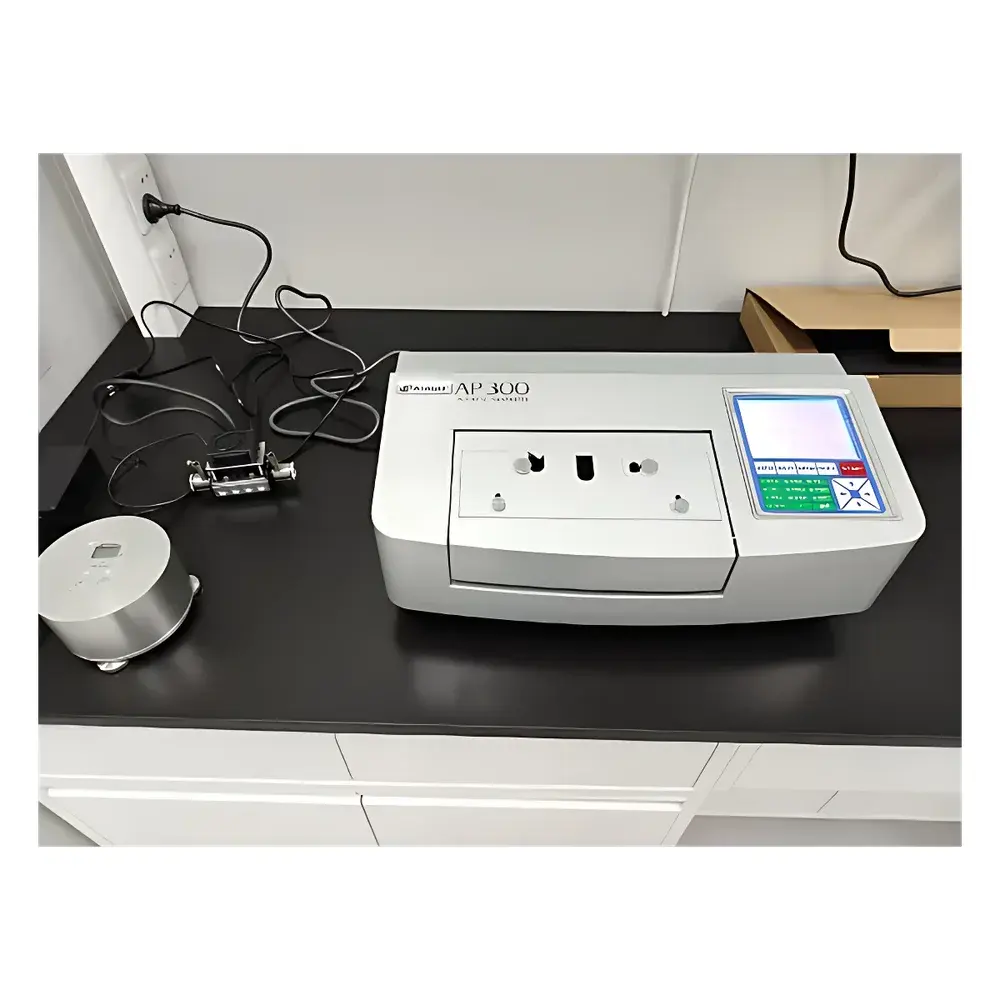
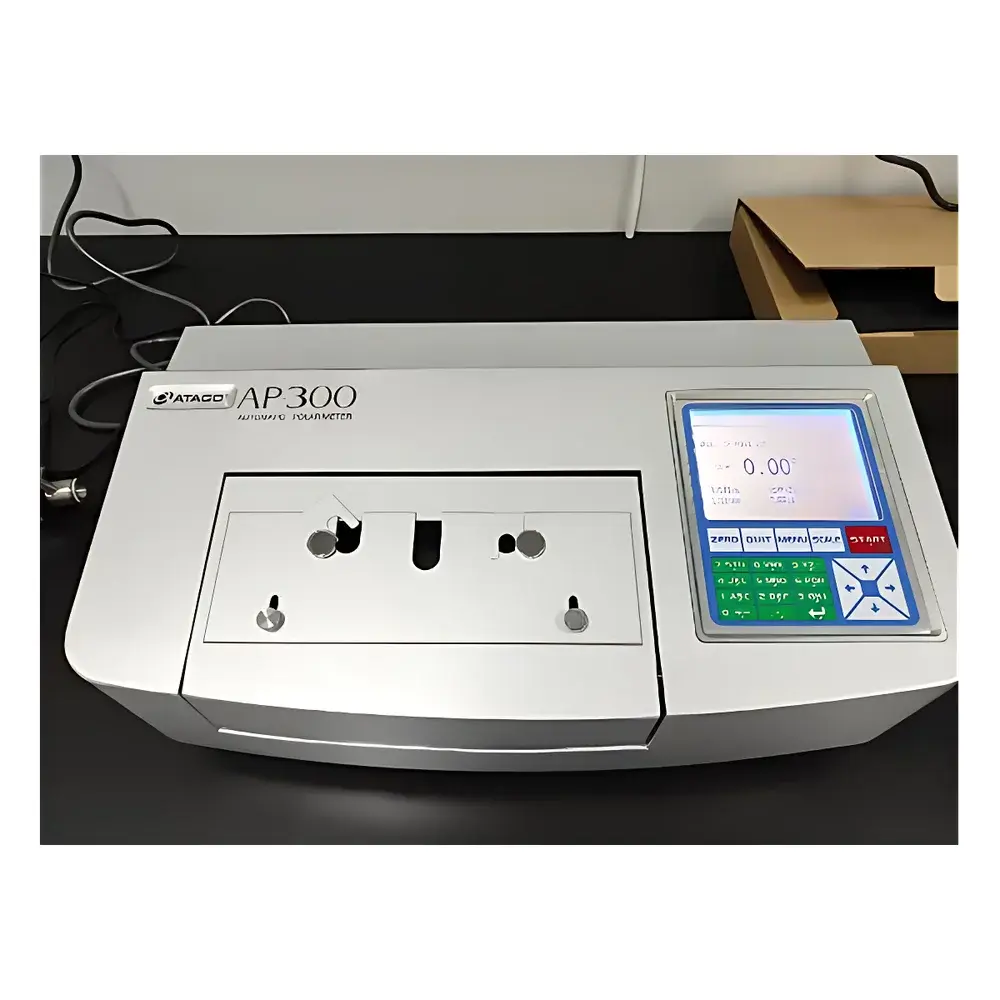
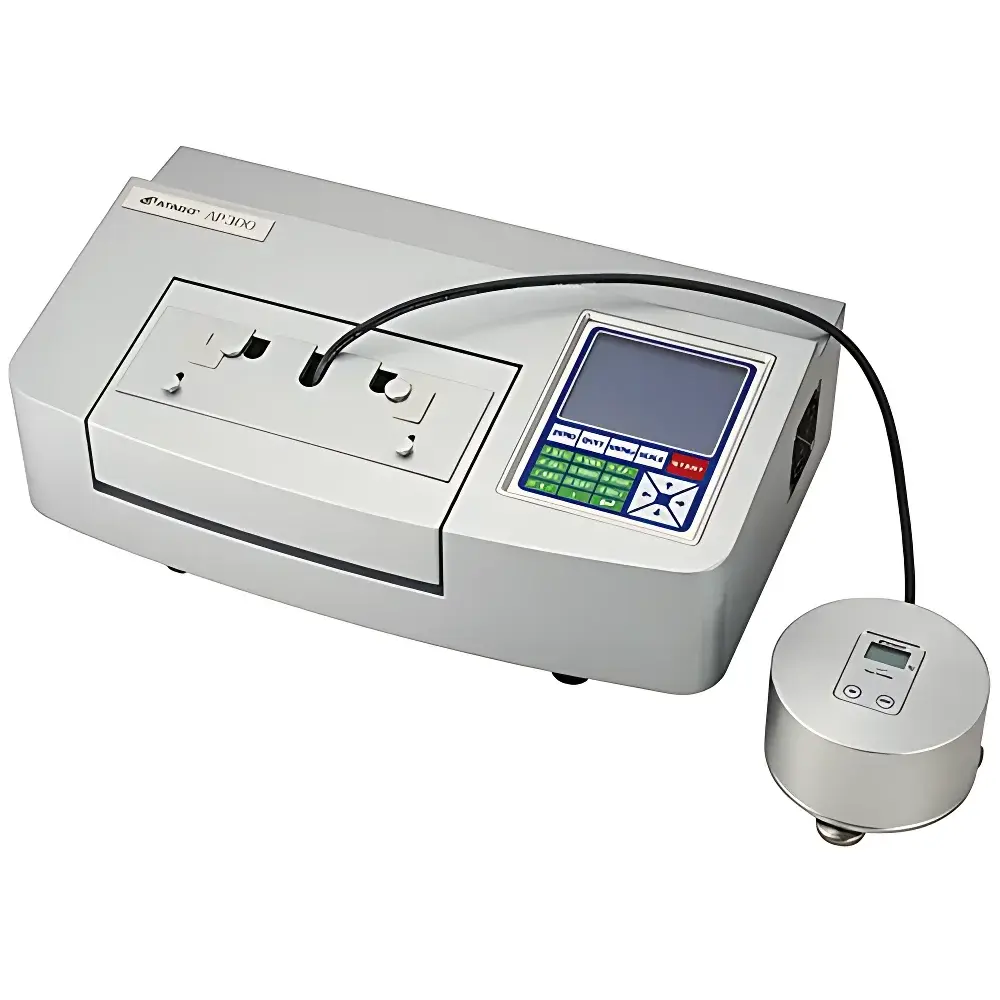
ATAGO AP-300 Temperature-Controlled Standard Polarimeter for International Sugar Scale
| Brand | ATAGO |
|---|---|
| Origin | Japan |
| Model | AP-300 |
| Type | Automatic Polarimeter |
| Temperature Control | Yes (5–90 °C) |
| Display | Color LCD with backlight |
| Light Source | LED (589 nm, approx. sodium D-line) |
| Measurement Range | AR: −89.999° to +89.999° |
| ISS | −130.000°Z to +130.000°Z |
| Accuracy | AR: ±0.01° (−35.00° to +35.00°), ±0.2% rel. (outside range) |
| ISS | ±0.03°Z (−101.00°Z to +101.00°Z), ±0.2% rel. (outside range) |
| Resolution | AR/ISS: 0.001°/0.001°Z (selectable) |
| Temp. Range (for measurement) | 10.0–30.0 °C |
| Temp. Accuracy | ±0.5 °C |
| Temp. Compensation Range (ISS) | 18.0–30.0 °C |
| Interface | RS-232C |
| Power | AC 100–240 V, 50/60 Hz, 140 VA |
| Dimensions | 48.5 × 28.5 × 17.5 cm |
| Weight | 14.4 kg (host only) |
Overview
The ATAGO AP-300 Temperature-Controlled Standard Polarimeter is a high-precision, fully automated optical instrument engineered for quantitative determination of optical rotation in chiral substances. It operates on the fundamental principle of polarimetry—measuring the angular rotation of plane-polarized light as it passes through an optically active sample—using a stabilized 589 nm LED source approximating the sodium D-line, the internationally accepted reference wavelength for polarimetric standardization. Designed to meet stringent requirements in regulated industries, the AP-300 delivers traceable, reproducible measurements of specific rotation ([α]), international standard sugar scale (ISS), concentration, and purity—particularly critical in pharmaceutical quality control, food ingredient verification, and fine chemical synthesis. Its integrated temperature-controlled sample compartment enables precise thermal stabilization (5–90 °C), mitigating thermally induced refractive index drift and ensuring compliance with ISO 8539, USP , and ASTM E1254 for polarimetric analysis.
Key Features
- Automated measurement cycle: One-touch operation initiates full sequence—including auto-zeroing, sample reading, and result calculation—reducing operator dependency and inter-user variability.
- Dual-mode precision optics: Simultaneous support for angular rotation (AR) and International Sugar Scale (ISS) reporting, with selectable resolution down to 0.001° or 0.001°Z for high-fidelity data capture.
- Integrated Peltier-based temperature control: Maintains sample temperature within ±0.5 °C across a 5–90 °C range; enables standardized ISS measurements with automatic temperature compensation between 18.0–30.0 °C per ICUMSA Method GS4/3-11.
- Calibration traceability: Manual calibration using certified quartz control plates ensures long-term accuracy alignment with NIST-traceable standards; supports GLP/GMP audit readiness via password-protected calibration logs.
- High-contrast color LCD interface: Intuitive menu navigation with real-time graphical display of measurement progress, temperature status, and error diagnostics—designed for glove-compatible operation in cleanroom and production environments.
- Robust data integrity architecture: Built-in averaging function (2–99 readings), timestamped storage of up to 1,000 results, and RS-232C output compatible with LIMS integration and FDA 21 CFR Part 11-compliant electronic record systems.
Sample Compatibility & Compliance
The AP-300 accommodates standard 100 mm (5 mL) and 200 mm (10 mL) glass polarimeter tubes, enabling analysis of low-volume pharmaceutical intermediates, viscous syrups, essential oils, and aqueous sugar solutions without dilution artifacts. Its measurement methodology conforms to pharmacopeial standards including USP “Optical Rotation”, EP 2.2.7 “Optical Rotation”, and JP 2.07 “Optical Rotation”, supporting regulatory submissions for APIs and excipients. For sugar industry applications, the instrument implements ICUMSA-defined ISS calculations with built-in temperature correction algorithms aligned with GS4/3-11 and GS4/7-11 methodologies—ensuring equivalence to reference saccharimeters used in cane and beet sugar certification. All hardware and firmware comply with IEC 61010-1 safety standards and electromagnetic compatibility (EMC) directives EN 61326-1.
Software & Data Management
While the AP-300 operates autonomously via its embedded firmware, its RS-232C serial interface provides bidirectional communication with external PCs running validated laboratory software (e.g., LabX, Empower, or custom Python/Excel-based parsers). Measurement data exports include raw angle values, compensated ISS, temperature metadata, operator ID (if enabled), and timestamp—all formatted as ASCII-delimited records. The system supports configurable audit trails: each calibration event, parameter change, or user login is logged with date/time stamp and operator code, satisfying ALCOA+ principles (Attributable, Legible, Contemporaneous, Original, Accurate) required under GxP frameworks. No proprietary software installation is required for basic data retrieval; terminal emulators (e.g., Tera Term) suffice for direct log extraction.
Applications
- Pharmaceutical QC: Quantification of enantiomeric excess (ee) in chiral drug substances; identity testing of L-ascorbic acid, D-glucose, and other stereospecific actives per USP monographs.
- Sugar & Sweetener Production: Determination of sucrose concentration in raw juice, molasses, and refined syrups per ICUMSA standards; validation of inversion kinetics during hydrolysis.
- Flavor & Fragrance Analysis: Verification of natural vs. synthetic origin in limonene, menthol, and camphor via specific rotation profiling.
- Biotechnology: Monitoring optical purity during enzymatic resolution processes and biocatalytic asymmetric synthesis.
- Academic Research: Teaching polarimetric theory and experimental validation in undergraduate physical chemistry laboratories.
FAQ
Does the AP-300 meet FDA 21 CFR Part 11 requirements for electronic records?
The instrument supports core Part 11 elements—including user authentication, audit trail generation, and electronic signature capability—when deployed with compliant third-party software. Its native firmware does not include digital signature modules but provides all necessary metadata for integration into validated enterprise systems.
Can the AP-300 measure samples below 10 °C?
The measurement specification is validated at 10.0–30.0 °C. While the temperature chamber can cool to 5 °C, accuracy outside the certified range requires user-established correlation protocols and is not covered by ATAGO’s factory calibration certificate.
Is the 589 nm LED source stable enough for long-term calibration stability?
Yes. The LED incorporates thermal feedback control and intensity monitoring, achieving <0.1% intensity drift over 8 hours—exceeding the stability requirements defined in ISO 8539 Annex B for primary polarimeters.
What is the maximum viscosity limit for reliable measurement?
Samples with kinematic viscosity up to 100 cSt (e.g., 60% w/w glucose syrup at 20 °C) may be measured without bubble formation or flow distortion, provided the tube is filled slowly and degassed prior to insertion.
How frequently should manual calibration with quartz plates be performed?
ATAGO recommends daily verification before first use when operating in regulated environments; weekly calibration is acceptable for routine R&D applications. Calibration frequency must be justified in the lab’s SOPs based on risk assessment and historical performance data.






