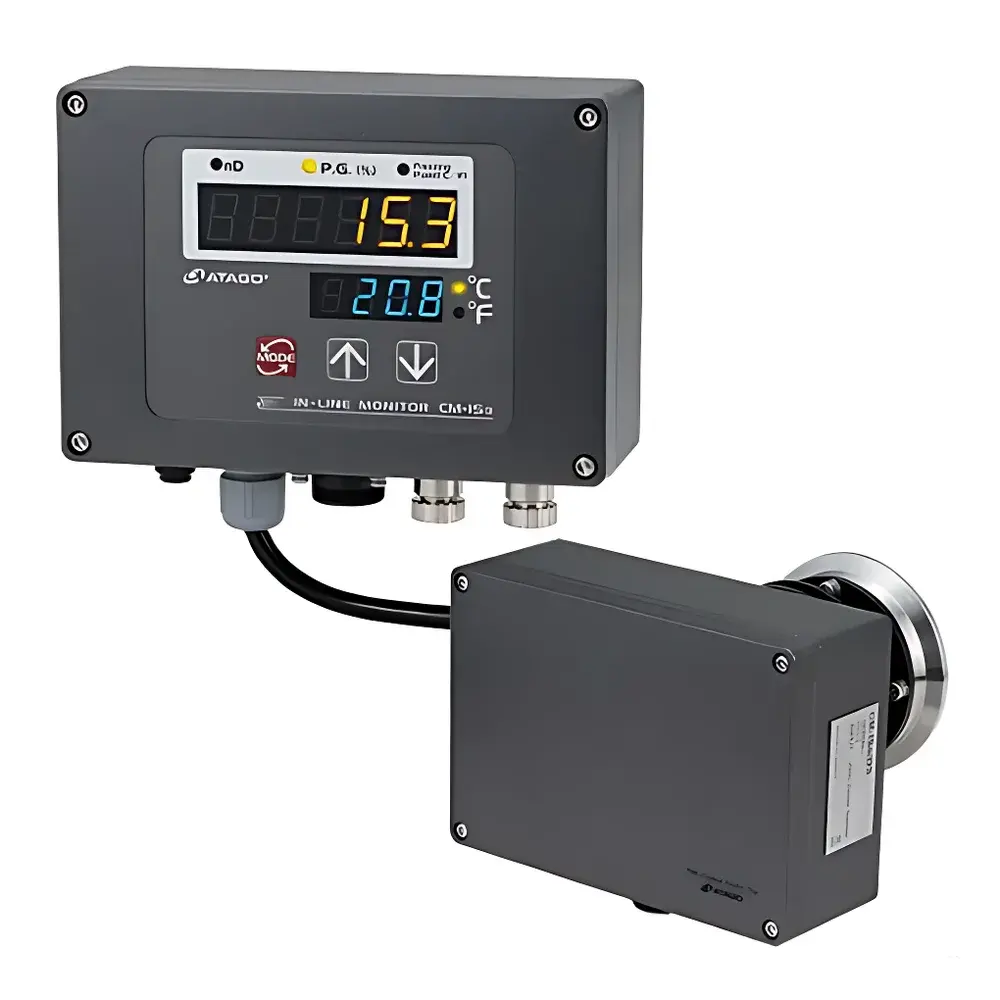
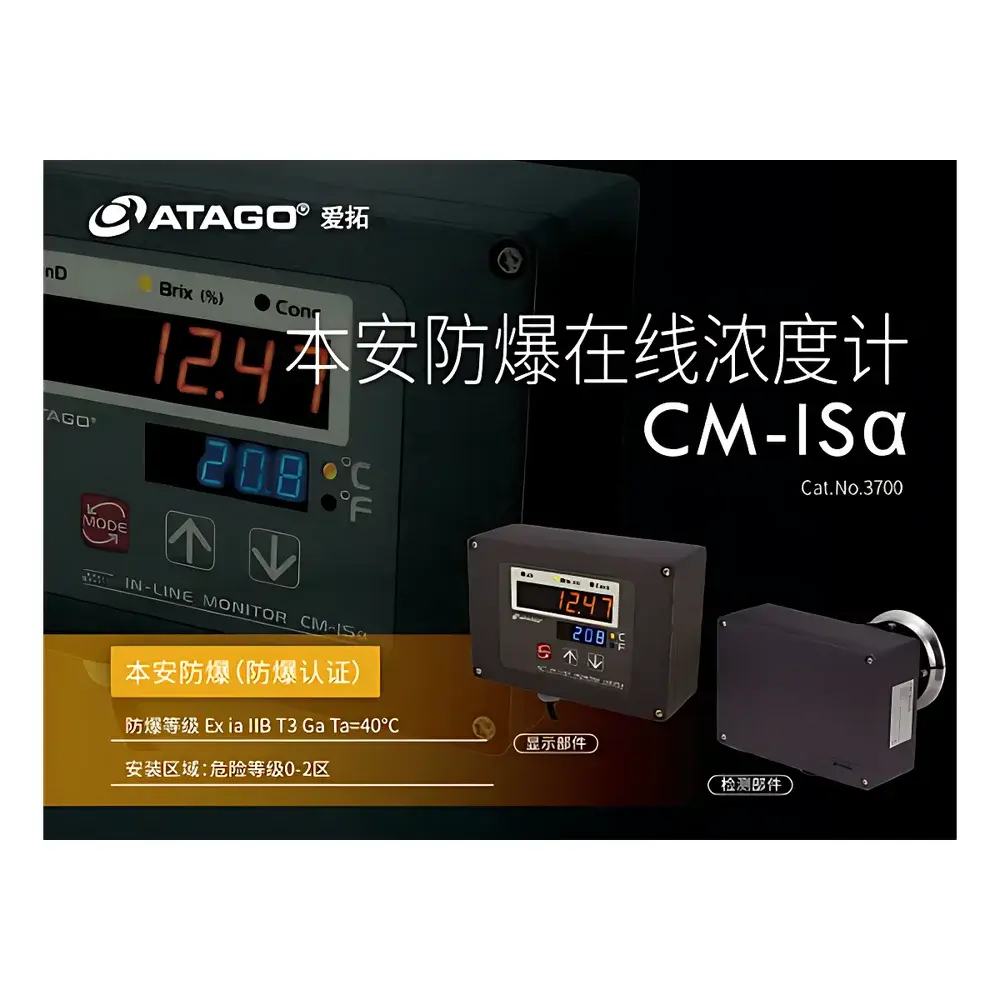
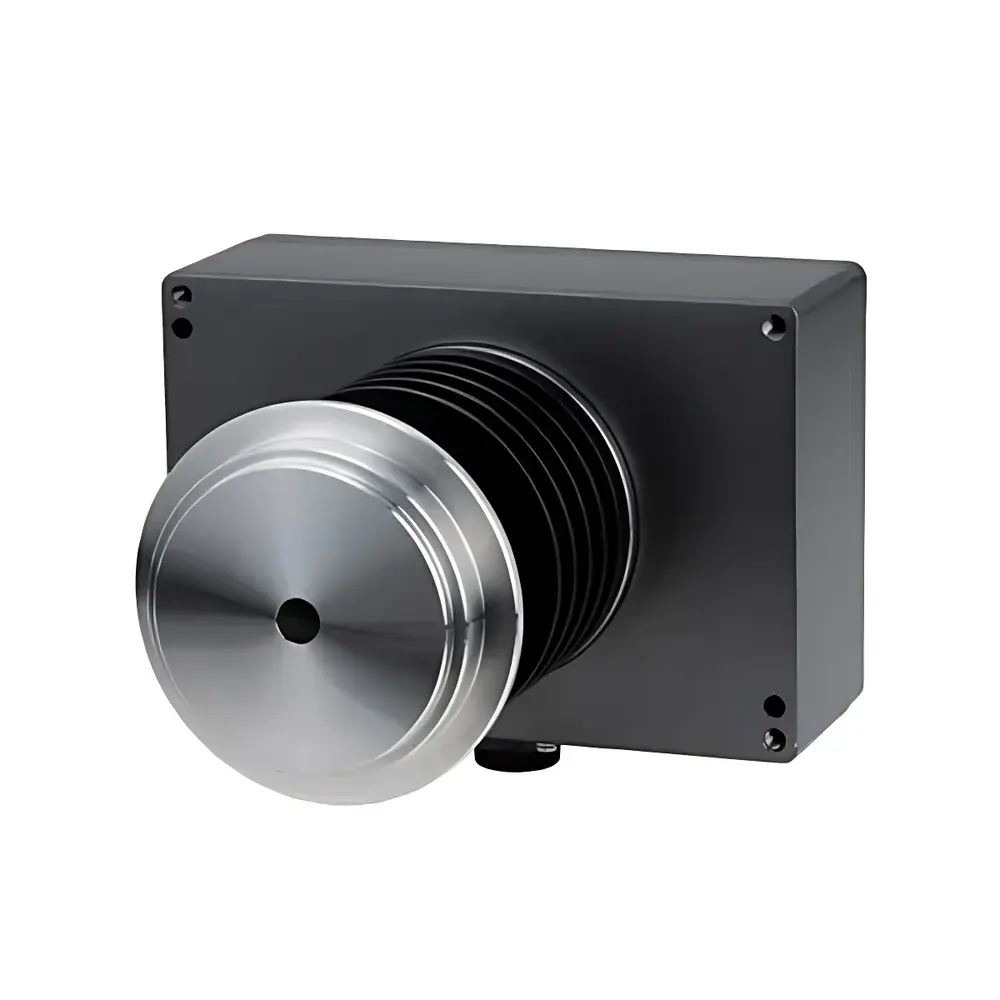
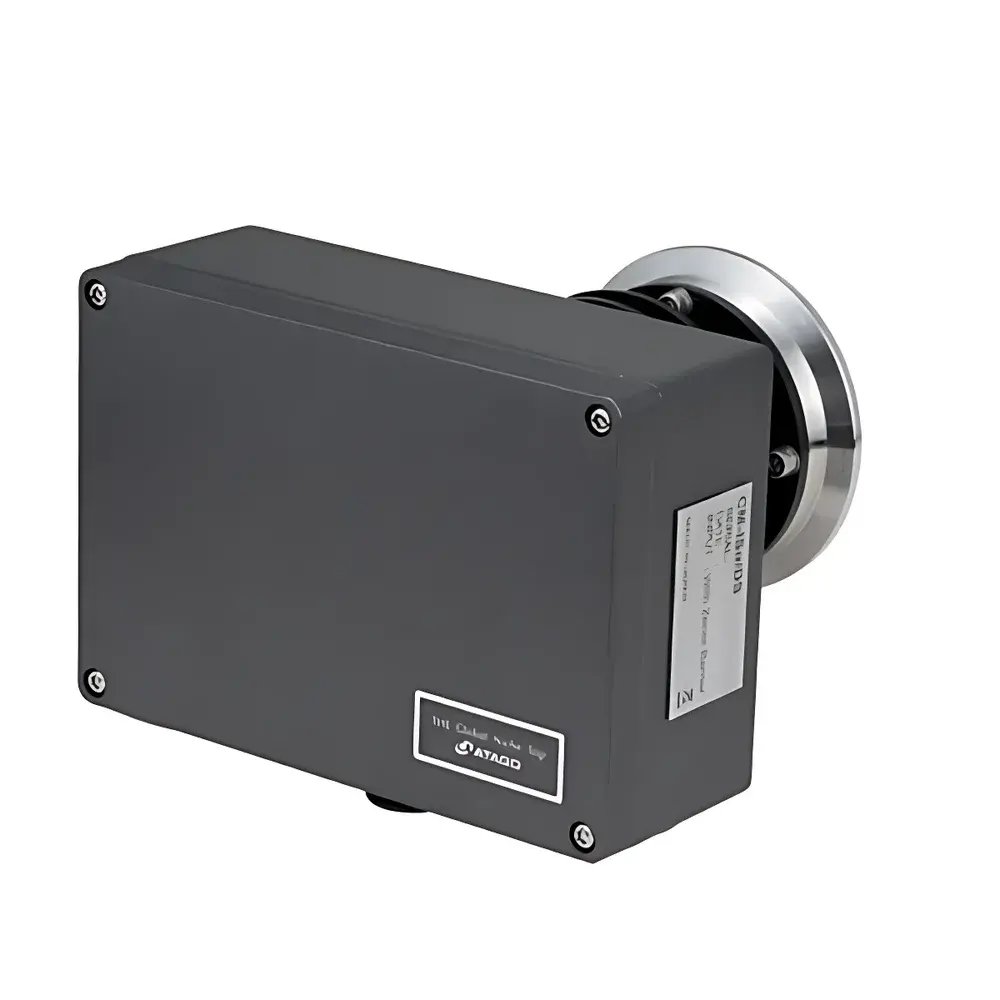
ATAGO CM-Isα-PG Intrinsically Safe Online Refractometer for Propylene Glycol Concentration Monitoring
| Brand | ATAGO |
|---|---|
| Origin | Japan |
| Model | CM-Isα-PG |
| Explosion Protection Rating | Ex ia IIB T3 Ga TA |
| Measurement Principle | Total Internal Reflection Refractometry |
| Output Signal | 4–20 mA / RS-485 (Modbus RTU) |
| Process Connection | DN25/DN40 Flange or Clamp |
| Operating Temperature | −10 to 70 °C (Process Fluid) |
| IP Rating | IP67 |
| Material | 316L Stainless Steel Housing & Sapphire Prism |
| Calibration Range | 0–100 wt% Propylene Glycol (refractive index 1.333–1.432) |
| Accuracy | ±0.1 wt% PG (typical, with temperature compensation) |
| Response Time | < 3 s (90% step change) |
Overview
The ATAGO CM-Isα-PG is an intrinsically safe, industrial-grade online refractometer engineered specifically for continuous, real-time concentration monitoring of propylene glycol (PG) aqueous solutions in hazardous process environments. Based on the physical principle of total internal reflection at the interface between a sapphire prism and the process fluid, the instrument measures the solution’s refractive index and converts it—via factory-calibrated polynomial algorithms—into mass concentration (wt%) with high reproducibility. Unlike offline sampling or laboratory-based titration, the CM-Isα-PG eliminates manual intervention, sample degradation, and time lag, enabling closed-loop feedback control in heat transfer fluid systems, pharmaceutical freeze-drying cycles, HVAC antifreeze management, and chemical synthesis reactors where precise PG concentration directly governs thermal performance, viscosity, freezing point depression, and regulatory compliance.
Key Features
- Intrinsically safe design certified to Ex ia IIB T3 Ga TA per IEC 60079-0/11, suitable for Zone 0/1 gas group IIB (e.g., solvent-laden atmospheres) without requiring additional barriers or purging systems.
- Sapphire prism (Mohs hardness 9) ensures long-term optical stability, abrasion resistance, and immunity to chemical attack from PG, glycols, alcohols, and mild organic solvents.
- Integrated Peltier-controlled temperature sensor (±0.1 °C accuracy) enables real-time refractive index compensation, critical for maintaining measurement integrity across dynamic process temperatures (−10 to 70 °C).
- Robust 316L stainless steel body with IP67-rated enclosure withstands washdown, vibration, and ambient humidity in demanding production floors and outdoor skids.
- Dual-output interface: isolated 4–20 mA analog signal for PLC/DCS integration and RS-485 Modbus RTU digital communication for configuration, diagnostics, and multi-parameter logging.
- Zero-drift optical path design with automatic baseline validation reduces recalibration frequency; typical calibration interval exceeds 6 months under stable operating conditions.
Sample Compatibility & Compliance
The CM-Isα-PG is validated for homogeneous, non-particulate, non-opalescent propylene glycol–water mixtures. It is not intended for slurries, emulsions, or solutions containing suspended solids >5 µm or air bubbles, which may scatter incident light and compromise refractive index resolution. The instrument complies with international safety and electromagnetic compatibility standards including IEC 60079-26 (Equipment for use in potentially explosive atmospheres), EN 61326-1 (EMC for industrial environments), and RoHS 2011/65/EU. Its measurement traceability aligns with ISO 5725 (accuracy and precision of measurement methods) and supports GLP/GMP documentation requirements when paired with audit-trail-enabled SCADA systems.
Software & Data Management
Configuration and diagnostics are performed via ATAGO’s dedicated PC software (CM-Config Tool), supporting firmware updates, span/zero calibration, temperature coefficient adjustment, and alarm threshold setting. All parameter changes are timestamped and logged locally within the device memory. When integrated into Modbus-enabled supervisory systems, the CM-Isα-PG provides live streaming of concentration (% wt), temperature (°C), refractive index (nD), and diagnostic status (e.g., prism contamination warning, sensor fault). Data export supports CSV format for trend analysis in statistical process control (SPC) platforms. For regulated industries, optional Modbus TCP gateway modules enable 21 CFR Part 11–compliant electronic records with user authentication and operation audit trails.
Applications
- Real-time concentration control in propylene glycol–based heat transfer fluids used in pharmaceutical clean steam generators and bioreactor jacket cooling loops.
- Automated dosing verification during antifreeze preparation for HVAC chillers and district heating networks.
- In-line quality assurance of PG content in cosmetic formulations (e.g., humectant blends) prior to filling.
- Monitoring glycol depletion in natural gas dehydration units (TEG/DEG/PG tri-systems) where PG serves as co-solvent or corrosion inhibitor carrier.
- Validation support for ASTM D1120 (boiling point of engine coolant) and ISO 2592 (flash point) test preparations requiring precise PG dilution ratios.
FAQ
What is the maximum allowable flow velocity for accurate measurement?
For optimal optical coupling and minimal boundary layer disturbance, recommended flow velocity is 0.3–3 m/s; laminar flow (<1000 Re) is acceptable with proper upstream straight-pipe run (≥10× pipe diameter).
Can the CM-Isα-PG be calibrated for other glycols such as ethylene glycol or glycerol?
Yes—custom calibration curves can be loaded via CM-Config Tool using user-provided reference data traceable to NIST-certified standards; however, factory warranty and Ex certification apply only to the shipped PG-specific curve.
Does the device require periodic prism cleaning?
Under normal operation with clean PG solutions, no routine cleaning is needed; however, if fouling is observed (e.g., in recycled coolant streams), the prism surface may be wiped with lint-free cloth and isopropyl alcohol during scheduled maintenance windows—no disassembly required.
Is temperature compensation fully automatic?
Yes—the built-in Pt1000 RTD measures fluid temperature at the prism interface in real time, and the microprocessor applies dynamic compensation using the Sellmeier equation-derived coefficients embedded in the calibration model.
Related Products