
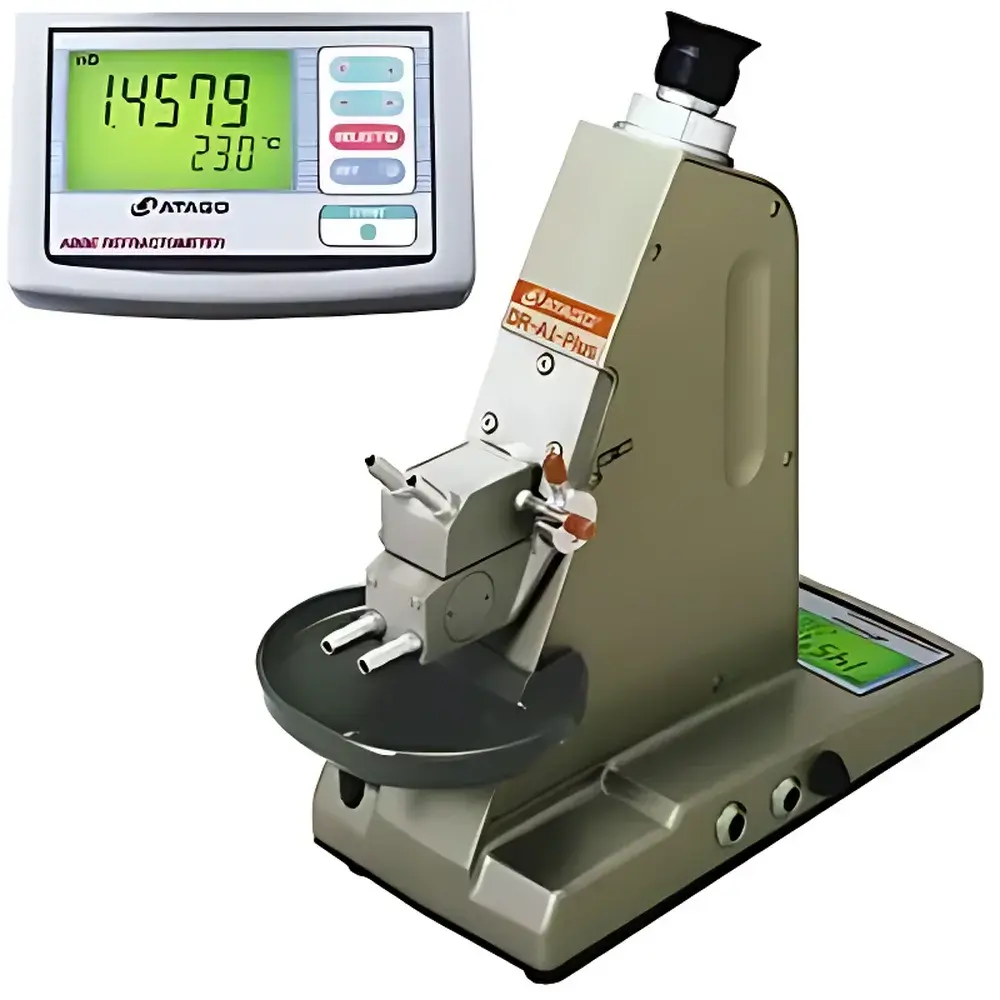
ATAGO DR-A1-Plus Desktop Abbe Refractometer for Dairy Applications
| Origin | Japan |
|---|---|
| Manufacturer Type | Authorized Distributor |
| Origin Category | Imported |
| Model | DR-A1-Plus |
| Price | Upon Request |
| Measurement Range | nD 1.3000–1.7100 |
| Temperature Compensation | 5–50°C |
| Resolution | nD 0.0001, Brix 0.1% |
| Accuracy | ±0.0002 (nD), ±0.1% (Brix) |
| Operating Temp | 5–50°C (0.1°C resolution) |
| Power Consumption | 16 VA |
| Input | AC adapter (100–240 V, 50/60 Hz) |
| Dimensions (Refractometer) | 13 × 29 × 31 cm, 6.0 kg |
| Dimensions (Adapter) | 10.5 × 17.5 × 4 cm, 0.7 kg |
| Interface | RS-232C (optional) |
| Optional Printer | DP-22(C) |
| Calibration Standards | Certified sucrose solutions (10–60%, ±0.03–0.05% tolerance) |
| Accessories | Polarizing eyepiece (RE-1146), prism set (RE-1501), desiccant (RE-1592), calibration kit (RE-1195) |
Overview
The ATAGO DR-A1-Plus is a precision desktop Abbe refractometer engineered specifically for dairy quality control laboratories and milk processing facilities. It operates on the fundamental optical principle of critical angle refraction: when a collimated light beam passes from a high-refractive-index medium (e.g., sample solution) into a lower-index medium (e.g., glass prism), the angle at which total internal reflection occurs is directly related to the sample’s refractive index (nD). This instrument integrates a high-stability sodium-D line (589.3 nm) light source and a precisely ground double-Abbe prism system to deliver traceable, repeatable measurements compliant with ISO 2173, AOAC 932.12, and IDF Standard 14C for dairy product analysis. Its primary function is the rapid, non-destructive quantification of soluble solids—expressed as Brix (%)—in raw milk, pasteurized milk, whey, cream, condensed milk, and reconstituted dairy powders. The built-in Peltier-assisted temperature sensor enables automatic temperature compensation (ATC) across 5–50°C, eliminating manual correction and ensuring measurement integrity under variable ambient or sample-conditioning conditions.
Key Features
- Optimized optical path design with dual Abbe prisms for enhanced signal-to-noise ratio and reduced chromatic aberration in dairy matrices
- Real-time ATC algorithm compliant with the ICUMSA Brix–temperature conversion model (15–30°C reference range)
- Dual-scale digital display showing both refractive index (nD) and Brix (%) simultaneously, with 0.0001 nD and 0.1% Brix resolution
- High-accuracy thermistor integrated into the prism block, calibrated to NIST-traceable standards with ±0.1°C repeatability
- Rugged anodized aluminum housing and vibration-damped base plate for stable operation on production-floor lab benches
- Low-power AC adapter (16 VA) supporting global voltage input (100–240 V, 50/60 Hz), suitable for GLP-compliant environments requiring uninterrupted power stability
Sample Compatibility & Compliance
The DR-A1-Plus is validated for use with opaque, viscous, and fat-containing dairy liquids—including homogenized whole milk, skim milk, ultrafiltered whey, and acidified buttermilk—without requiring filtration or dilution. Its prism surface geometry and illumination intensity minimize scattering artifacts caused by suspended casein micelles or fat globules. All measurements adhere to the metrological requirements of ISO/IEC 17025:2017 for testing laboratories, and the instrument supports documented calibration procedures per ASTM D1218 and USP . Traceability is maintained through certified sucrose reference standards (RE-110010 to RE-110060), each supplied with individual CoA specifying nominal concentration and expanded uncertainty (k=2). Routine verification follows a three-point check (10%, 40%, 60% Brix) aligned with FDA Guidance for Industry: Analytical Procedures and Methods Validation for Drugs and Biologics.
Software & Data Management
While the DR-A1-Plus operates as a standalone benchtop instrument, its RS-232C interface (optional RE-15305 cable) enables bidirectional communication with LIMS or QC data platforms. When connected to compliant software (e.g., LabWare LIMS, Thermo Fisher SampleManager), it transmits timestamped readings—including nD, Brix, sample temperature, operator ID, and instrument serial number—with full audit trail capability. The interface supports 21 CFR Part 11–compliant electronic signatures when paired with validated middleware, allowing secure archiving of raw refractometer data within GMP-regulated dairy manufacturing sites. No proprietary software is required; ASCII-based command protocols ensure interoperability with custom Python or LabVIEW acquisition scripts.
Applications
- Determination of lactose content and total solids in raw milk receipt testing
- Monitoring Brix drift during evaporation and concentration steps in condensed milk production
- Verification of reconstitution ratios for non-fat dry milk (NFDM) and whey protein concentrate (WPC)
- Batch release testing of UHT-treated dairy beverages against specification limits (e.g., 8.5–9.2% Brix for standardized whole milk)
- Stability assessment of emulsified dairy products via refractive index trending over shelf-life studies
- Supporting HACCP critical control point (CCP) monitoring at pasteurization and homogenization stages
FAQ
Is the DR-A1-Plus suitable for measuring samples with high fat content, such as cream or butter oil?
Yes—the instrument’s optimized prism geometry and high-intensity illumination mitigate scattering effects from lipid droplets, enabling reliable Brix readings up to 45% fat content without pre-treatment.
Does the unit meet regulatory requirements for pharmaceutical-grade excipient testing?
While designed for dairy, its nD accuracy (±0.0002) and traceable calibration satisfy USP criteria for refractive index measurement of purified water, glycerin, and propylene glycol used in oral liquid formulations.
Can the RS-232C output be configured for continuous streaming mode?
No—the interface operates in query-response mode only; each measurement must be explicitly triggered via host command to ensure data integrity and prevent buffer overflow in regulated environments.
What is the recommended recalibration frequency for routine QC use?
Per ISO 5725-2, daily verification using two certified sucrose standards (e.g., 10% and 40%) is required; full calibration with three-point verification every 72 operational hours or per shift change in 24/7 production settings.
Are prism cleaning solvents included in the standard package?
No—users must supply ethanol (≥99.5%), isopropanol, or lens-grade acetone; ATAGO recommends avoiding chlorinated solvents to preserve prism coating longevity and optical fidelity.




