
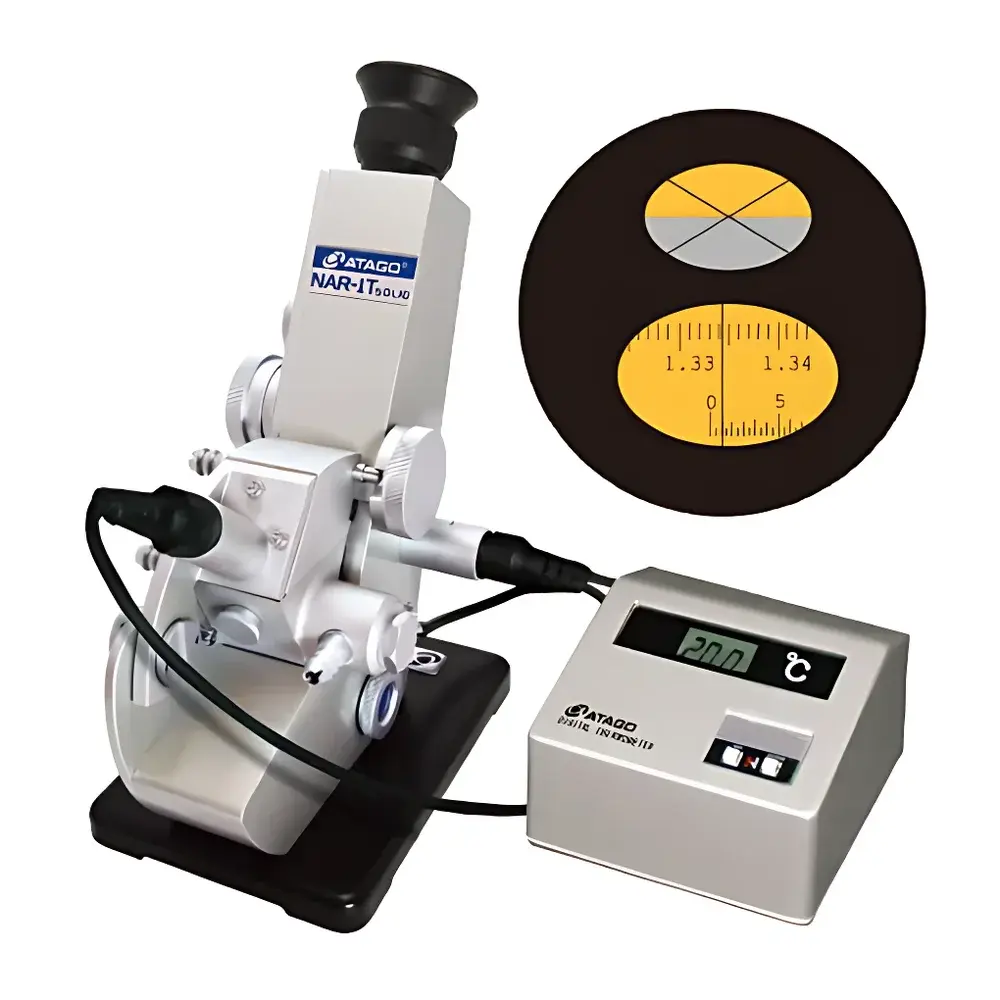
ATAGO NAR-1T SOLID Abbe Refractometer
| Brand | ATAGO |
|---|---|
| Origin | Japan |
| Model | NAR-1T SOLID |
| Type | Benchtop Abbe Refractometer |
| Measurement Range | Refractive Index (nD) 1.3000–1.7000 |
| Brix | 0.0–95.0% |
| Accuracy | ±0.0002 (nD), ±0.1% (Brix) |
| Resolution | 0.001 (nD), 0.5% (Brix) |
| Light Source | LED (589 nm equivalent to sodium D-line) |
| Operating Temperature | 0.0–50.0 °C |
| Power Supply | AC 100–240 V, 50/60 Hz |
| Dispersion Calculation | nF–nC via standardized conversion table |
| Compliance | Designed per ISO 21147:2022 (Abbe refractometers — Requirements and test methods) |
Overview
The ATAGO NAR-1T SOLID Abbe Refractometer is a precision optical instrument engineered for high-accuracy measurement of refractive index (nD) across both transparent solid and liquid samples. Based on the classical Abbe principle—utilizing collimated monochromatic light incident at the critical angle on a sample-prism interface—the instrument determines nD by detecting the position of the shadow line in the viewing field. Its integrated 589 nm LED light source replicates the spectral output of the sodium D-line with superior stability, intensity consistency, and lifetime compared to traditional sodium vapor lamps or halogen sources. This eliminates spectral drift and thermal instability inherent in conventional illumination systems, ensuring measurements conform rigorously to the fundamental definition of nD as specified in ISO 21147:2022. Unlike portable or analog handheld units, the NAR-1T SOLID features a rigid optical bench architecture, precision-ground glass prisms, and calibrated mechanical focusing mechanisms—enabling traceable, repeatable determinations essential for R&D laboratories, QC departments, and materials characterization workflows.
Key Features
- Monochromatic 589 nm LED illumination system compliant with ASTM D1218 and ISO 21147 requirements for nD definition
- Benchtop design optimized for stable thermal equilibrium during extended measurement sessions
- Dual-mode capability: validated for both solid specimens (e.g., optical glasses, polymer sheets, semiconductor wafers) and homogeneous liquids (e.g., solvents, resins, electrolyte solutions)
- Mechanical vernier scale with fine-adjustment focusing knob for precise shadow-line alignment
- Integrated temperature reference scale enabling manual correlation of measured nD values to standard 20 °C conditions per ISO 17025 calibration practices
- No electronic display or digital interface—designed for operator-controlled visual interpolation, minimizing electronic drift and supporting GLP-compliant manual data recording
Sample Compatibility & Compliance
The NAR-1T SOLID accommodates flat, polished solid samples ≥15 mm × 15 mm × 1 mm thickness, as well as liquids requiring ≥0.5 mL volume for full prism coverage. It is routinely employed in the characterization of optical polymers (PMMA, PC, COP), display substrates (LCD cover glass, OLED encapsulation layers), conductive adhesives, and transparent thermoplastics where birefringence assessment informs stress analysis and molding process validation. The instrument meets mechanical and optical performance criteria outlined in ISO 21147:2022 and supports compliance with USP (Refractometry) and Ph. Eur. 2.2.2. for pharmaceutical excipient identity testing. While it does not incorporate active temperature control, its operating range (0.0–50.0 °C) permits ambient-condition measurements under climate-stabilized laboratory environments meeting ISO/IEC 17025 clause 5.3 requirements.
Software & Data Management
The NAR-1T SOLID operates without embedded firmware, microprocessors, or proprietary software. All readings are manually recorded from the engraved vernier scale, ensuring full auditability and eliminating risks associated with electronic data corruption or non-compliant software validation. Laboratories implementing 21 CFR Part 11 requirements may integrate manual entries into validated LIMS or ELN platforms using documented SOPs for observer qualification, scale reading procedures, and uncertainty estimation (based on ±0.0002 nD accuracy and operator repeatability studies). Calibration verification is performed using certified reference standards (e.g., distilled water at 20 °C: nD = 1.3330; bromonaphthalene: nD = 1.6580), with traceability documented per ISO/IEC 17025 Annex A.2.
Applications
- Quality control of optical-grade plastics and laminated safety glass
- Identity verification and purity assessment of organic solvents and monomers
- Process monitoring of adhesive formulations, including conductive silver-filled epoxies
- Material homogeneity screening for injection-molded optical components
- Research-level birefringence mapping when coupled with polarized light accessories (external)
- Pharmaceutical raw material qualification per USP monographs requiring refractive index limits
FAQ
Does the NAR-1T SOLID support automatic temperature compensation (ATC)?
No. It requires external temperature monitoring using a calibrated contact thermometer placed adjacent to the prism surface. Users must apply correction factors based on published temperature coefficients or reference tables.
Can it measure highly viscous or non-Newtonian liquids?
Yes—provided the sample forms a continuous, bubble-free film over the prism surface. High-viscosity fluids should be applied carefully and allowed to equilibrate thermally before measurement.
Is this instrument suitable for measuring colored or turbid samples?
It is limited to optically transparent and homogeneous media. Strongly absorbing or scattering samples will obstruct the shadow-line formation and invalidate nD determination.
What calibration standards are recommended?
Certified reference materials including distilled water (nD = 1.3330 at 20 °C), benzene (nD = 1.5011), and bromonaphthalene (nD = 1.6580) are traceable to NIST or PTB standards.
How is dispersion (nF–nC) calculated?
Using the built-in dispersion conversion table provided in the operation manual, users input the measured nD value to derive approximate nF–nC for optical glass classification per ISO 10110-2.




