
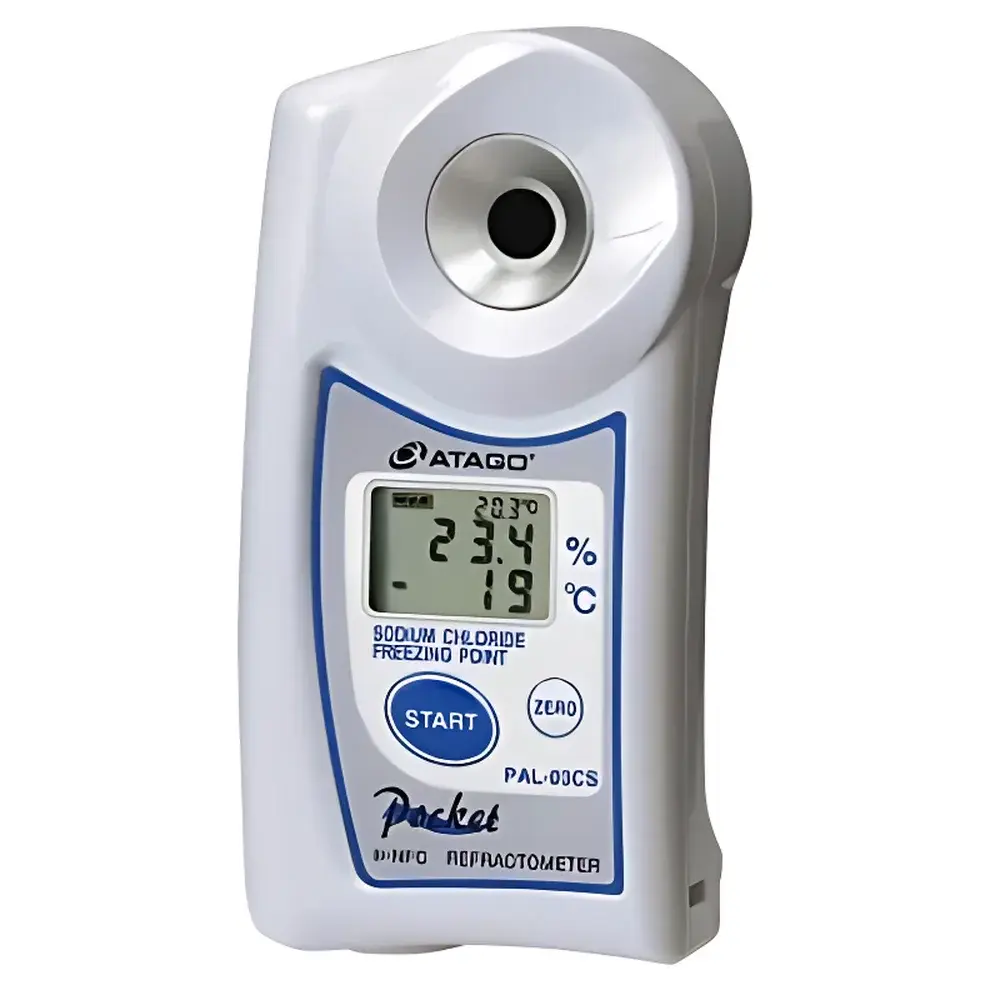
ATAGO PAL-03CS Digital Handheld Sodium Chloride Freezing Point Refractometer
| Brand | ATAGO |
|---|---|
| Origin | Japan |
| Model | PAL-03CS |
| Measuring Range | NaCl 0.0–28.0 g/100g, Freezing Point 0 to –22 °C |
| Accuracy | ±0.2% for NaCl, ±1 °C for freezing point |
| Temperature Compensation | Automatic (ATC), 10–40 °C |
| Measurement Principle | Total Refractive Index-Based Calibration for Aqueous NaCl Solutions |
Overview
The ATAGO PAL-03CS Digital Handheld Sodium Chloride Freezing Point Refractometer is a precision optical instrument engineered for rapid, field-deployable quantification of sodium chloride concentration and corresponding freezing point depression in aqueous salt solutions. It operates on the fundamental principle of refractometry—measuring the total refractive index of a sample, which correlates linearly with solute concentration in standardized NaCl–water systems under controlled temperature conditions. The device applies built-in calibration curves traceable to NIST-referenced NaCl standards to convert refractive index readings into two concurrent, directly actionable outputs: mass concentration (g NaCl / 100 g solution) and thermodynamic freezing point (°C). This dual-parameter capability enables real-time decision-making in applications where both compositional control and phase-change behavior are critical—particularly in winter road maintenance, brine formulation, and de-icing fluid quality assurance.
Key Features
- Simultaneous dual-scale display: NaCl concentration (0.0–28.0 g/100g) and freezing point (0 to –22 °C) on a single high-contrast LCD screen.
- Integrated automatic temperature compensation (ATC) across 10–40 °C, eliminating manual correction and ensuring measurement stability across ambient field conditions.
- Optical system optimized for aqueous NaCl solutions: uses a high-stability LED light source and Abbe-type prism assembly with sapphire contact surface for scratch resistance and long-term refractive index fidelity.
- Compact, ergonomic handheld design (135 × 65 × 40 mm; ~150 g) with IP65-rated enclosure for dust and water resistance—suitable for outdoor, roadside, or industrial floor use.
- No reagents, no consumables, no warm-up time: single-drop measurement in <2 seconds with reproducibility ≤±0.2% RSD (n=10, 10–25 °C).
- Battery-powered operation (2× AAA alkaline, >10,000 measurements per set) with low-power auto-shutdown after 3 minutes of inactivity.
Sample Compatibility & Compliance
The PAL-03CS is validated exclusively for homogeneous, non-viscous, non-turbid aqueous sodium chloride solutions—including road de-icing brines, seawater dilutions, food-grade pickling brines, and industrial coolant mixtures. It is not intended for solutions containing significant concentrations of other electrolytes (e.g., CaCl₂, MgCl₂), organic solvents, suspended solids, or polymers, as these alter refractive index–concentration relationships beyond its factory calibration domain. While the instrument itself does not carry CE or UKCA marking for medical or pharmaceutical use, its measurement methodology aligns with ASTM D1141 (Standard Practice for Marine Water Simulated) and ISO 8502-9 (Surface cleanliness — Field test methods for soluble salts) for comparative salinity assessment. For regulated environments requiring audit trails (e.g., municipal DOT quality control), users may document results manually per GLP-aligned SOPs; the device supports no electronic data export or 21 CFR Part 11 compliance features.
Software & Data Management
The PAL-03CS is a standalone optical instrument with no embedded firmware update capability, USB interface, Bluetooth connectivity, or software integration. All measurements are displayed in real time and retained only visually—no internal memory, no data logging, and no export functionality. This design prioritizes operational simplicity, mechanical robustness, and immunity to cybersecurity or software obsolescence risks. For laboratories or agencies requiring digital recordkeeping, external documentation via photographic capture or manual transcription into LIMS or Excel-based QA logs is standard practice. ATAGO provides printable calibration verification checklists and traceable reference solution recommendations (e.g., certified NaCl standards from VWR or Fisher Scientific) to support routine performance verification per ISO/IEC 17025 Clause 6.5.
Applications
- Roadway winter maintenance: On-the-spot verification of pre-wetted salt brine concentration prior to application; correlation of measured freezing point with local pavement temperature forecasts to optimize anti-icing efficacy.
- Food processing: Monitoring NaCl content in fermentation brines, canned seafood solutions, and cured meat marinades where precise ionic strength affects microbial inhibition and texture development.
- Aquaculture & marine research: Rapid estimation of salinity in hatchery tanks or coastal sampling sites when calibrated against conductivity-based reference measurements.
- Industrial cooling & heat transfer: Verification of glycol–NaCl hybrid coolant formulations where freezing point depression must be maintained within narrow operational thresholds.
- Educational labs: Demonstrating colligative properties—freezing point depression as a function of molal concentration—in undergraduate physical chemistry or materials science curricula.
FAQ
Can the PAL-03CS measure potassium chloride (KCl) or calcium chloride (CaCl₂) solutions?
No. Its calibration is specific to NaCl–H₂O systems. Using it for other salts introduces systematic bias due to differing partial molar refractions and activity coefficients.
Is calibration verification required before each use?
Daily verification with a certified 10.0 g/100g NaCl reference solution is recommended for critical applications; full recalibration is performed only by authorized ATAGO service centers.
Does the instrument require user adjustment for altitude or atmospheric pressure?
No. Freezing point output is thermodynamically referenced to standard pressure (101.325 kPa); minor barometric variations have negligible effect on NaCl solution behavior within the specified range.
How should the prism surface be cleaned between samples?
Rinse thoroughly with distilled or deionized water, then gently wipe with lens tissue—never use acetone, ethanol, or abrasive cloths, as they may damage the sapphire coating.
What is the expected service life under routine field use?
With proper handling and prism care, typical operational lifespan exceeds 8 years; ATAGO offers 2-year limited warranty covering material and workmanship defects.






