
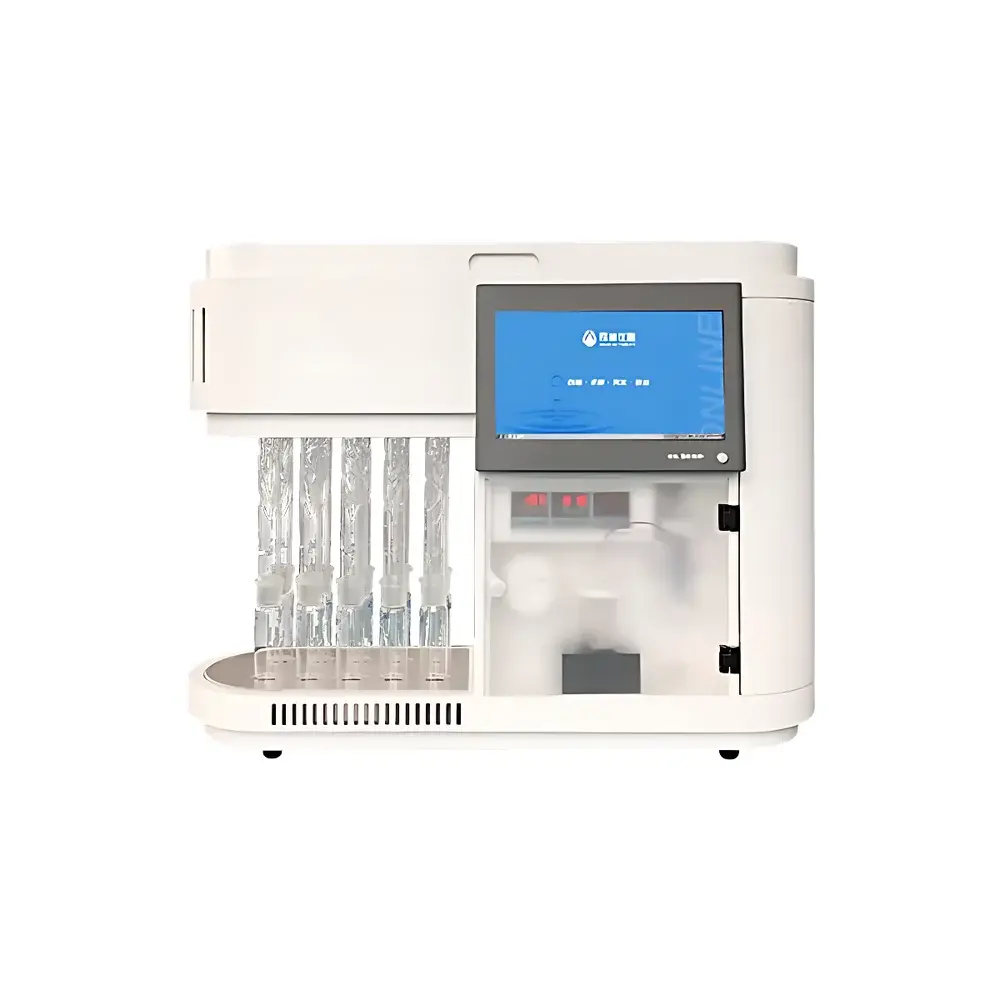
Online Instrument OL3010 Automated COD Analyzer
| Brand | Online Instrument |
|---|---|
| Origin | Shanghai, China |
| Manufacturer Type | Manufacturer |
| Region of Origin | Domestic (China) |
| Model | OL3010 |
| Instrument Type | Laboratory Benchtop Analyzer |
| Measurement Principle | 2-Hour Closed-Reflex Digestion Followed by Potentiometric or Colorimetric Endpoint Titration |
| Measurement Range | 0–70,000 mg/L COD |
| Accuracy | ≤5% |
| Repeatability | RSD ≤3% |
| Limit of Detection | 4 mg/L |
| Titration Time | <4 minutes |
| Sample Capacity | 10 positions for sample loading |
| Digestion Capacity | 10 parallel digestion vessels |
| Titration Channels | 1 |
Overview
The Online Instrument OL3010 Automated COD Analyzer is a fully integrated laboratory-grade system engineered for precise, reproducible, and compliant determination of Chemical Oxygen Demand (COD) in water and wastewater samples. It implements the standardized closed-reflux digestion method—aligned with ISO 6060, ASTM D1252, and HJ 828–2017—followed by automated titration with endpoint detection via high-sensitivity colorimetric analysis. Unlike manual or semi-automated systems, the OL3010 executes the entire analytical workflow—including reagent dispensing, temperature-controlled digestion (15–350 °C), post-digestion cooling (via configurable air or water cooling), dilution of high-concentration samples, potentiometric/colorimetric endpoint recognition, and volumetric titration—without operator intervention. Its sealed reaction architecture prevents vapor leakage, minimizes exposure to hazardous reagents (e.g., potassium dichromate and sulfuric acid), and eliminates ambient interference during measurement—ensuring metrological integrity across diverse matrix types.
Key Features
- Fully automated analytical sequence: auto-sampling (10-position carousel), auto-dosing of digestion reagents and titrants, programmable digestion ramp/hold profiles, and intelligent endpoint detection based on real-time absorbance shift at defined wavelengths
- Integrated dilution module: automatically identifies out-of-range samples (>70,000 mg/L) and performs up to 10-fold serial dilution using calibrated peristaltic or syringe-pump delivery
- Robust thermal management: dual-mode heating (constant temperature or multi-step program) with PID-controlled ceramic heating blocks and active cooling (fan- or water-based) to achieve rapid cooldown (<15 min from 150 °C to 60 °C)
- Contamination-free fluidics: self-cleaning protocol for digestion vials, titration cells, and all wetted pathways using deionized water or solvent rinse cycles (user-definable frequency and volume)
- Compliant data handling: audit-trail-enabled operation logs, electronic signatures, and timestamped raw data storage meeting GLP/GMP and FDA 21 CFR Part 11 requirements
- Remote operational interface: web-based dashboard accessible via desktop or mobile browser; supports real-time status monitoring, method parameter adjustment, and result retrieval from any internet-connected device
Sample Compatibility & Compliance
The OL3010 accommodates a broad spectrum of aqueous matrices without pre-filtration, including raw and treated municipal wastewater, industrial effluents (e.g., textile, pharmaceutical, food processing), surface water, and groundwater. Its 10-position sample carousel accepts standard 16 mm × 100 mm borosilicate glass digestion tubes and 50 mL polypropylene sample vials. All digestion and titration steps conform to internationally recognized protocols: ISO 6060:2023 (Water quality — Determination of chemical oxygen demand), ASTM D1252–22 (Standard Test Methods for Chemical Oxygen Demand of Water), and China’s HJ 828–2017 (Determination of Chemical Oxygen Demand in Water—Dichromate Method). The system’s closed-loop design satisfies occupational safety requirements under OSHA 29 CFR 1910.1200 and EU CLP Regulation (EC) No 1272/2008 for handling corrosive and oxidizing chemicals.
Software & Data Management
The OL3010 operates under proprietary Windows-based control software featuring intuitive touchscreen navigation and role-based user access levels (Operator, Supervisor, Administrator). Raw absorbance/time curves, titration curves, and digestion temperature profiles are stored in encrypted SQLite databases with automatic daily backup. Export options include CSV, Excel (.xlsx), and PDF reports—with customizable templates supporting lab-specific headers, QA/QC flags, and regulatory metadata (e.g., analyst ID, instrument ID, calibration certificate numbers). LIMS integration is achieved via HL7 v2.x or ASTM E1384-compliant API, enabling bidirectional synchronization of sample IDs, test requests, and final results. All data modifications generate immutable audit trails compliant with ISO/IEC 17025:2017 clause 7.5.2.
Applications
- Regulatory compliance monitoring for municipal wastewater treatment plants (WWTPs) reporting to national discharge permits
- Process control in industrial facilities subject to environmental discharge licensing (e.g., electroplating, pulp & paper, chemical manufacturing)
- Research and development of advanced oxidation processes (AOPs) and biological treatment efficiency studies
- Environmental impact assessments (EIAs) requiring high-throughput COD screening of field-collected surface water and sediment porewater
- Method validation and interlaboratory comparison studies under ISO/IEC 17043-accredited proficiency testing schemes
FAQ
Does the OL3010 support unattended overnight operation?
Yes—the system includes hardware-level watchdog timers, low-reagent alerts, and automatic shutdown upon completion or error detection, enabling secure 24/7 batch processing.
Can it analyze samples with high chloride interference?
The OL3010 incorporates optional mercury sulfate masking reagent delivery and chloride correction algorithms per ISO 6060 Annex B, allowing reliable quantification in chloride-rich matrices up to 2,000 mg/L.
Is method validation documentation provided?
Each unit ships with a Factory Acceptance Test (FAT) report, IQ/OQ documentation templates, and a traceable calibration certificate for digestion temperature and titrant delivery volume.
What maintenance is required for long-term reliability?
Scheduled maintenance includes quarterly verification of digestion block uniformity (±1 °C), annual photometric sensor calibration, and biannual replacement of peristaltic pump tubing and injection valve seals—documented in the built-in preventive maintenance scheduler.
How is data security ensured during remote access?
All remote sessions use TLS 1.2+ encryption, mandatory two-factor authentication (2FA), and session timeout after 15 minutes of inactivity—fully aligned with NIST SP 800-53 Rev. 5 AC-17 and IA-2 controls.







