
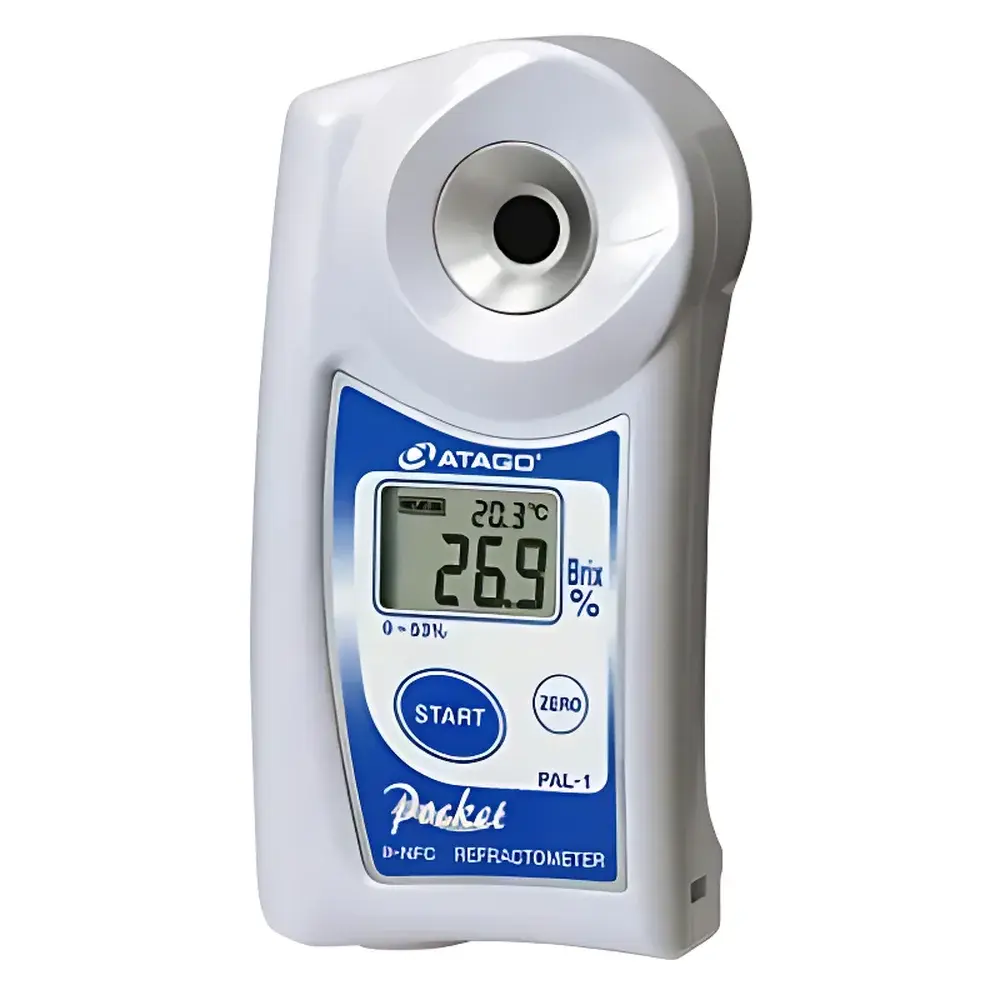
ATAGO PAL-1 Portable Digital Refractometer
| Brand | ATAGO |
|---|---|
| Origin | Japan |
| Model | PAL-1 |
| Measurement Range | 0.0–53.0% Brix |
| Temperature Compensation | Automatic (ATC) |
| Display | LCD with digital readout |
| Sample Volume | Approx. 0.3 mL |
| Measurement Time | ~3 seconds |
| Calibration | Single-point using distilled water or standard sucrose solution |
| Compliance | Designed per JIS K 0064 and ISO 2173 for refractometric Brix determination |
Overview
The ATAGO PAL-1 Portable Digital Refractometer is an optical precision instrument engineered for rapid, field-deployable quantification of soluble solids concentration—expressed as % Brix—in liquid and semi-liquid samples. It operates on the fundamental principle of critical-angle refractometry: incident light passing through a prism-sample interface undergoes total internal reflection at an angle inversely proportional to the sample’s refractive index. Since the refractive index of aqueous sucrose solutions correlates linearly with concentration under controlled temperature conditions, the PAL-1 converts measured critical angle into a calibrated % Brix value. Its integrated thermistor enables real-time Automatic Temperature Compensation (ATC) across 10–40 °C, referencing the standard 20 °C Brix scale defined in ISO 2173 and JIS K 0064. Designed for rugged daily use, the PAL-1 features a compact magnesium-alloy body, IP65-rated ingress protection, and battery-powered operation—making it suitable for lab bench, production floor, orchard, or mobile quality assurance environments.
Key Features
- High-precision optical system with sapphire-coated prism for scratch resistance and long-term calibration stability
- Automatic Temperature Compensation (ATC) algorithm compliant with ISO 2173 Annex A, eliminating manual correction errors
- Digital LCD display with 0.1% Brix resolution and backlight for low-light conditions
- Single-button operation and auto-power-off after 3 minutes of inactivity to extend battery life
- Minimal sample requirement: only 0.3 mL ensures non-destructive testing of high-value or limited-volume specimens
- Calibration traceable to NIST-traceable sucrose standards; factory calibration certificate available upon request
- No moving parts or consumables—maintenance-free operation over extended service intervals
Sample Compatibility & Compliance
The PAL-1 is validated for homogeneous, transparent to slightly turbid aqueous solutions where sucrose is the dominant solute (e.g., fruit juices, soft drinks, syrups, brines, glycol-based coolants). It is not intended for highly viscous, opaque, or strongly colored samples without prior dilution or filtration. The instrument conforms to international refractometry standards including ISO 2173:2003 (“Fruit and vegetable products — Determination of soluble solids content — Refractometric method”) and JIS K 0064:2018 (“General rules for refractometers”). While not FDA 21 CFR Part 11–compliant as a standalone device, its measurement data may be recorded manually or via external logging systems meeting GLP/GMP documentation requirements. Routine verification using certified reference standards is recommended per ASTM D1218 for laboratory quality control.
Software & Data Management
The PAL-1 operates as a stand-alone analog-to-digital measurement platform with no embedded firmware update capability or direct computer interface. Data output is exclusively visual via the LCD screen. For regulated environments requiring audit trails, users integrate the PAL-1 into documented workflows: measurements are manually transcribed into electronic lab notebooks (ELN), LIMS, or paper-based batch records. Optional accessories include a portable printer adapter (PAL-PRINT) for immediate hard-copy generation of results, supporting ISO/IEC 17025 clause 7.7 on result reporting. Calibration history, operator ID, and environmental temperature can be logged externally to satisfy traceability requirements under ISO 9001 and ICH Q7.
Applications
- Food & Beverage: In-line Brix verification during juice blending, post-pasteurization syrup concentration checks, and harvest-readiness assessment of apples, grapes, and citrus in orchards
- Agriculture: On-site ripeness screening of horticultural produce to inform picking schedules and post-harvest sorting protocols
- Industrial Fluids: Monitoring concentration of water-glycol antifreeze mixtures, alkaline cleaning solutions, and metalworking emulsions to maintain corrosion inhibition and lubricity
- Pharmaceutical Manufacturing: Verification of excipient solution strength (e.g., dextrose IV bags, oral rehydration salts) during formulation and packaging QC
- Education: Undergraduate physical chemistry labs demonstrating colligative properties, refractive index-concentration relationships, and calibration curve methodology
- Biotechnology: Rapid estimation of cell culture media osmolality proxies and fermentation broth sugar depletion kinetics
FAQ
What is the measurement principle of the PAL-1?
It uses critical-angle refractometry to determine the refractive index of a sample, which is converted to % Brix using a sucrose-specific calibration curve.
Does the PAL-1 require periodic recalibration?
Yes—daily verification with distilled water (0.0% Brix) before use is recommended; full recalibration with a certified sucrose standard is advised every 30 days or after exposure to extreme temperatures.
Can the PAL-1 measure non-sucrose solutions accurately?
It provides reliable results for glucose, fructose, and invert sugar solutions within ±0.2% Brix deviation; for non-carbohydrate solutes (e.g., NaCl, ethylene glycol), a custom calibration curve must be established.
Is the PAL-1 suitable for GMP-regulated environments?
Yes—as a Class II metrological device, it supports GMP compliance when used within a documented procedure that includes calibration logs, operator training records, and environmental monitoring.
How is temperature compensation implemented?
An integrated thermistor measures sample temperature in real time and applies a polynomial correction based on the ISO 2173 temperature coefficient for sucrose solutions.



