
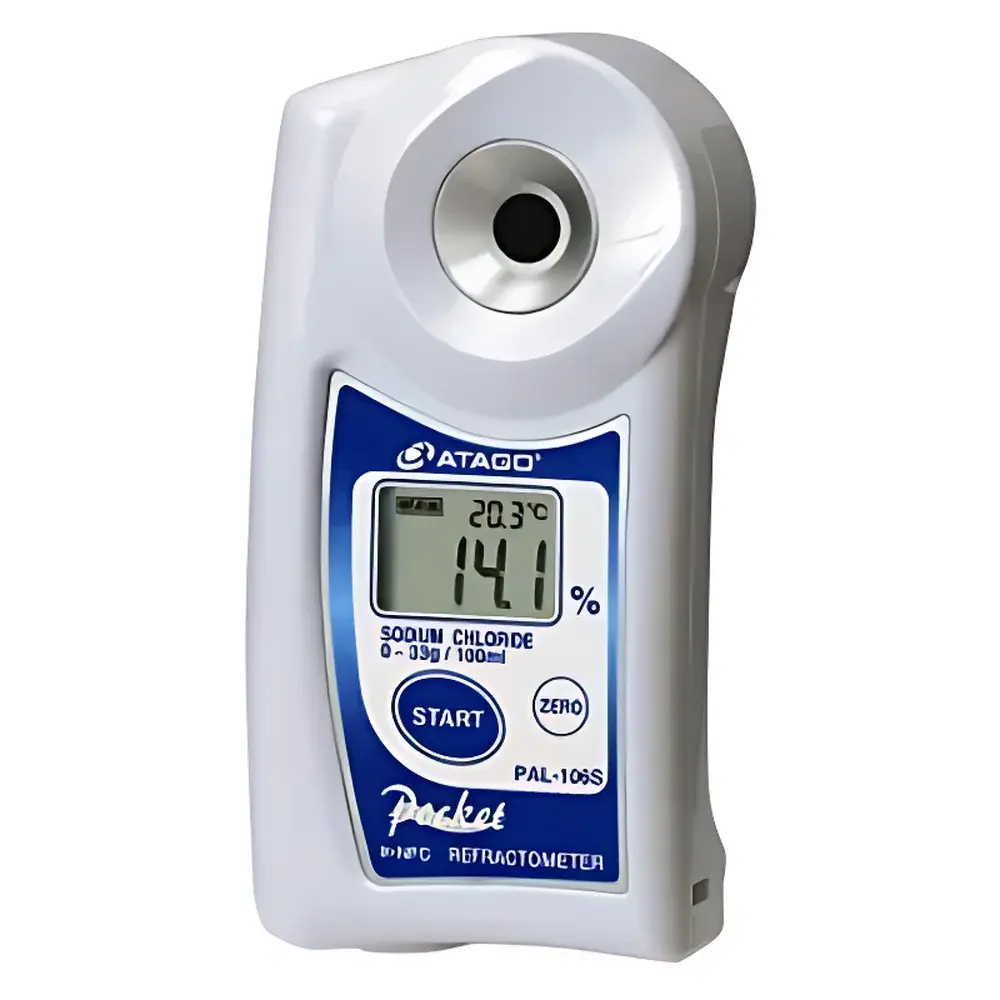
ATAGO PAL-106S Portable Digital Refractometer for Seawater Salinity Measurement
| Brand | ATAGO |
|---|---|
| Origin | Japan |
| Model | PAL-106S |
| Measurement Range | 0.0–33.0% NaCl (w/w) |
| Accuracy | ±0.2% NaCl |
| Response Time | ≤3 seconds |
| Temperature Compensation | Automatic, 10–40°C |
| Power | 2×AAA batteries |
| Auto-off | Yes |
| Prism Material | Optical glass |
| Compliance | ISO 2173, ASTM D1152 (refractometric principles), JIS K 0068 |
Overview
The ATAGO PAL-106S is a handheld digital refractometer engineered specifically for rapid, field-deployable measurement of sodium chloride concentration in seawater and saline solutions. It operates on the principle of critical-angle refractometry: light passing through a prism-sample interface undergoes refraction proportional to the solution’s refractive index, which correlates directly with NaCl mass fraction under standardized conditions. Calibrated against certified NaCl reference standards traceable to NIST-equivalent metrology, the PAL-106S delivers quantitative salinity data compliant with marine environmental monitoring protocols and industrial process control requirements. Its optical architecture features a high-stability Abbe-type prism assembly and temperature-compensated photodiode array detection, enabling reproducible measurements across variable ambient conditions without external calibration drift.
Key Features
- Optimized optical path design ensures minimal sample volume requirement (0.3 mL) and eliminates parallax error via LCD digital display with 0.1% resolution
- Integrated thermistor-based temperature compensation algorithm conforms to the empirical NaCl–refractive index–temperature relationship defined in ISO 2173 Annex B, maintaining accuracy across 10–40°C operating range
- Ruggedized housing (IP65-rated against dust and water jets) supports continuous use in coastal aquaculture facilities, food processing lines, and offshore platforms
- Prism and cover plate are detachable via tool-free latch mechanism, facilitating thorough cleaning with deionized water or ethanol—critical for preventing cross-contamination between high-salinity and low-salinity samples
- Low-power consumption architecture extends battery life to ≥10,000 measurements per set of two AAA alkaline cells; auto-shutdown activates after 3 minutes of inactivity
- No moving parts or consumables—designed for long-term stability with annual verification against ATAGO-certified reference fluids (e.g., PAL-106S Calibration Kit, Cat. No. 3821)
Sample Compatibility & Compliance
The PAL-106S is validated for aqueous NaCl solutions only. It is not suitable for non-ionic solutes (e.g., sucrose, glycerol), organic solvents, or turbid suspensions. Measurements comply with ISO 2173:2003 “Fruit and vegetable products — Determination of soluble solids content — Refractometric method” (adapted for NaCl via ATAGO’s proprietary calibration curve), and aligns with ASTM D1152–19 “Standard Test Method for Hydrochloric Acid (Hydrogen Chloride Solution)” for refractive index correlation. For regulated environments—including GLP-compliant aquaculture QA labs and FDA-regulated seafood processing—users may document instrument verification per SOP using ATAGO’s optional Traceable Certificate of Calibration (NIST-traceable reference points at 5.0%, 15.0%, and 25.0% NaCl).
Software & Data Management
The PAL-106S operates as a standalone instrument with no embedded software or connectivity interfaces. All measurement data remain local to the device display. For laboratory integration, users may manually record readings into LIMS or ELN systems following 21 CFR Part 11–aligned documentation practices. ATAGO provides downloadable PDF templates for calibration logs, maintenance records, and uncertainty budgets (available via ATAGO Global Support Portal). Firmware updates are not applicable—the optical-electronic architecture is fixed at manufacture to ensure metrological integrity over the instrument’s service life (>10 years typical).
Applications
- Marine aquaculture: Real-time monitoring of salinity in hatcheries, recirculating aquaculture systems (RAS), and coral propagation tanks to maintain osmotic stability for larval development
- Seafood processing: Verification of brine concentration during curing, marinating, and thermal stabilization of fishery products per HACCP Critical Control Point requirements
- Environmental fieldwork: Rapid assessment of estuarine mixing zones, desalination plant intake/discharge points, and coastal groundwater intrusion studies
- Industrial water treatment: Routine checks of regeneration brine strength in ion-exchange softening systems and reverse osmosis pre-treatment monitoring
- Educational laboratories: Undergraduate physical chemistry and marine science courses demonstrating colligative property relationships and refractometric quantification principles
FAQ
Is the PAL-106S suitable for measuring salinity in natural seawater containing dissolved organics or suspended solids?
No. The instrument assumes a binary NaCl–water system. Organic matter, plankton, or silt alters refractive index non-linearly and invalidates the calibration. Pre-filtration (0.45 µm) is mandatory for field-collected samples.
Does temperature compensation eliminate the need for sample equilibration?
Compensation corrects for thermal expansion effects on refractive index—but extreme thermal gradients (>5°C difference between prism and sample) cause transient measurement artifacts. Allow 30 seconds of prism-sample thermal contact before measurement.
Can the PAL-106S be recalibrated by the user?
Yes, using ATAGO’s certified NaCl standard solutions (e.g., 0.0% and 25.0% w/w). Full recalibration requires the PAL-106S Adjustment Tool (Cat. No. 3820) and adherence to ATAGO Technical Bulletin TB-REF-07.
What is the measurement uncertainty budget for the PAL-106S at 20°C?
Expanded uncertainty (k=2) is ±0.32% NaCl, combining contributions from repeatability (±0.15%), calibration standard uncertainty (±0.08%), temperature compensation residual (±0.07%), and operator parallax (±0.02%).
Is the prism surface scratch-resistant?
The optical glass prism (BK7 grade) has a Mohs hardness of ~5.5. Avoid contact with abrasive particles or metal tools; clean exclusively with lens tissue and reagent-grade isopropanol.






