
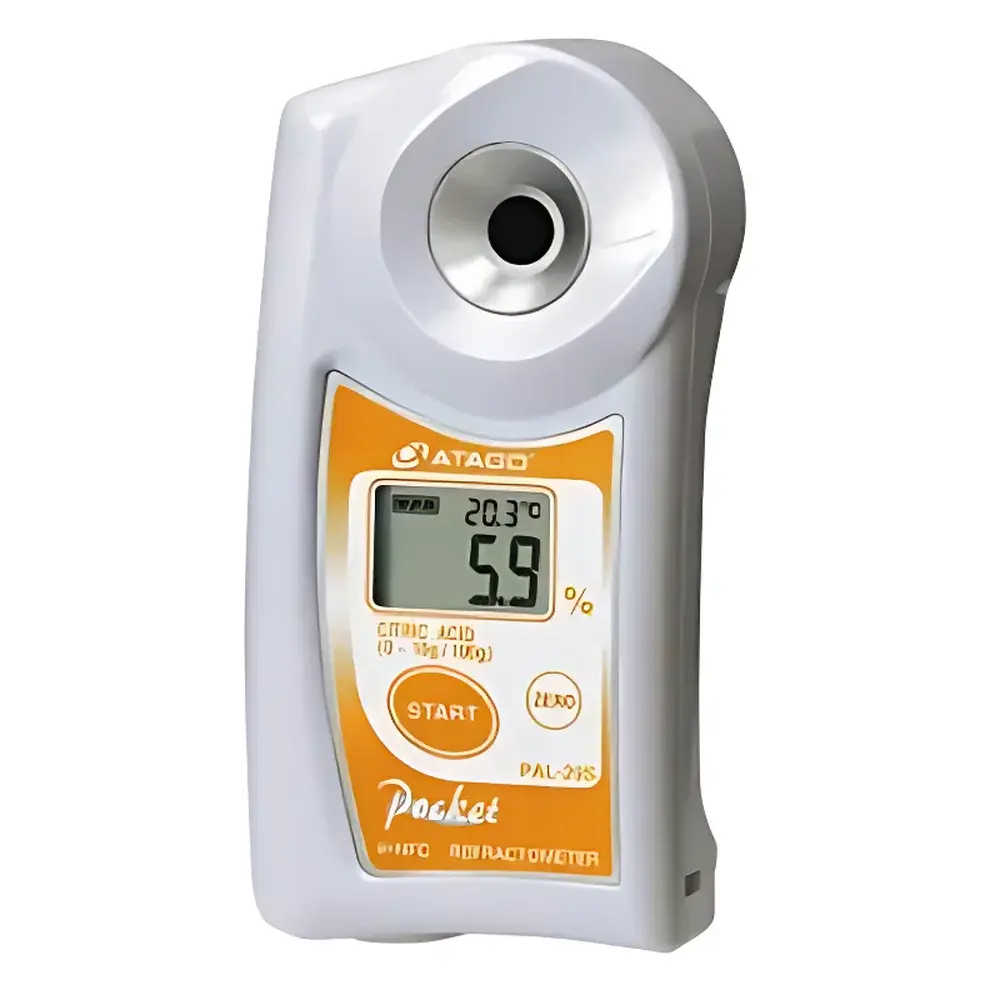
ATAGO PAL-29S Citric Acid Refractometer
| Brand | ATAGO |
|---|---|
| Origin | Japan |
| Product Type | Handheld Digital Refractometer |
| Temperature Control | Yes (Automatic Temperature Compensation) |
| Display | Digital LCD |
| Measurement Range | 0.0 to 10.0 % (w/w, g/100g citric acid) |
| Resolution | 0.1 % (citric acid), 0.1 °C (temperature) |
| Accuracy | ±0.2 % (citric acid), ±1.0 °C (temperature) |
| Sample Volume | 0.3 mL |
| Measurement Time | 3 seconds |
| Operating Temperature | 10–40 °C |
| IP Rating | IP65 |
| Power Supply | 2 × AAA batteries |
| Dimensions | 55(W) × 31(D) × 109(H) mm |
| Weight | 100 g (instrument only) |
Overview
The ATAGO PAL-29S Citric Acid Refractometer is a precision handheld optical instrument engineered for rapid, reliable quantification of citric acid concentration in aqueous solutions—primarily in food and beverage formulation, quality control, and R&D laboratories. It operates on the principle of total internal reflection, measuring the refractive index (RI) of a sample and converting it to citric acid concentration (% w/w, g/100g) using a factory-calibrated, matrix-matched algorithm optimized specifically for citric acid–water systems. Unlike generic Brix or generic acid refractometers, the PAL-29S employs a chemically validated calibration curve that accounts for the non-linear relationship between RI and citric acid concentration across the 0.0–10.0% range, minimizing cross-sensitivity to co-dissolved sugars, salts, or organic acids commonly present in juice concentrates, soft drink syrups, and functional beverage bases. Its built-in thermistor enables real-time automatic temperature compensation (ATC) from 10–40 °C, eliminating manual correction and ensuring measurement stability under variable ambient conditions.
Key Features
- Optimized optical path with high-stability LED light source and precision-ground sapphire prism for long-term repeatability and resistance to scratching or chemical degradation.
- Digital LCD display with backlight for clear readability in low-light production or lab environments.
- IP65-rated enclosure—dust-tight and protected against low-pressure water jets—enabling safe use in humid processing areas or near washdown zones.
- 3-second measurement cycle with auto-hold function, supporting high-throughput batch verification without operator fatigue.
- Integrated ATC system compliant with ISO 21748:2017 guidelines for temperature-dependent measurement uncertainty management.
- Calibration verification mode with built-in reference standard (distilled water) and optional NIST-traceable citric acid standards for routine performance checks.
Sample Compatibility & Compliance
The PAL-29S is validated for use with clarified, low-viscosity aqueous citric acid solutions—such as fruit juice extracts, beverage concentrates, cleaning solution formulations, and pharmaceutical excipient preparations. It is not intended for turbid, emulsified, or highly viscous samples (e.g., puree, pulp, or syrup >500 cP), which require centrifugation or filtration prior to analysis. The instrument complies with IEC 61010-1:2010 for electrical safety in laboratory equipment and meets CE marking requirements for electromagnetic compatibility (EMC). While not FDA 21 CFR Part 11–compliant as a standalone device (lacking audit trail or electronic signature capability), its measurement data may be integrated into validated LIMS or QC documentation workflows under GLP/GMP frameworks when used with controlled SOPs and periodic calibration records.
Software & Data Management
The PAL-29S operates as a self-contained, firmware-driven instrument with no onboard data logging or USB connectivity. However, its consistent output format (numeric % w/w value + temperature reading) facilitates seamless manual transcription into electronic lab notebooks (ELNs), Excel-based QC dashboards, or enterprise quality management systems (QMS). For traceable recordkeeping, users are advised to pair measurements with standardized log sheets including operator ID, sample ID, time/date stamp, ambient temperature, and instrument serial number. Optional ATAGO data transfer accessories (e.g., PAL-AC adapter with RS-232 output) enable integration with legacy SCADA or MES platforms where analog/digital signal input is supported.
Applications
- Real-time adjustment of citric acid dosing during beverage blending to maintain target tartness and pH stability.
- In-process verification of citric acid content in frozen concentrate reconstitution protocols per USDA-FSIS guidance.
- Raw material incoming inspection for citric acid monohydrate or anhydrous grades used in nutraceutical tablet manufacturing.
- Stability testing of acidic preservative systems in cosmetic toners and hair care formulations (ISO 18844-compliant).
- Educational labs demonstrating colligative property relationships and refractive index–concentration correlations in physical chemistry curricula.
FAQ
Is the PAL-29S suitable for measuring citric acid in orange juice with pulp?
No. Pulp particles scatter light and invalidate the refractive index reading. Samples must be filtered (e.g., through 0.45 µm nylon membrane) or centrifuged before measurement.
Can this refractometer measure other organic acids like malic or acetic acid?
No. Its calibration is specific to citric acid. Using it for other acids introduces significant systematic error due to differing molar refraction coefficients.
How often should the instrument be calibrated?
Perform zero calibration with distilled water before each measurement session. Full verification with a certified citric acid standard (e.g., 5.00 ± 0.02 % w/w) is recommended daily in regulated environments or per ISO/IEC 17025 internal calibration schedules.
Does the PAL-29S meet ASTM D1218 or AOAC 955.04 method requirements?
It is not a primary method instrument per those standards but serves as a validated rapid screening tool aligned with AOAC Official Method 955.04 Annex B (refractometric estimation of organic acids in beverages) when operated within defined scope and uncertainty limits.
What maintenance is required beyond cleaning the prism?
Wipe the sapphire prism with lens tissue and acetone after each use; avoid abrasive cleaners. Store in the supplied protective case with desiccant. Battery replacement every 6–12 months under typical usage (≈500 measurements/week).





