
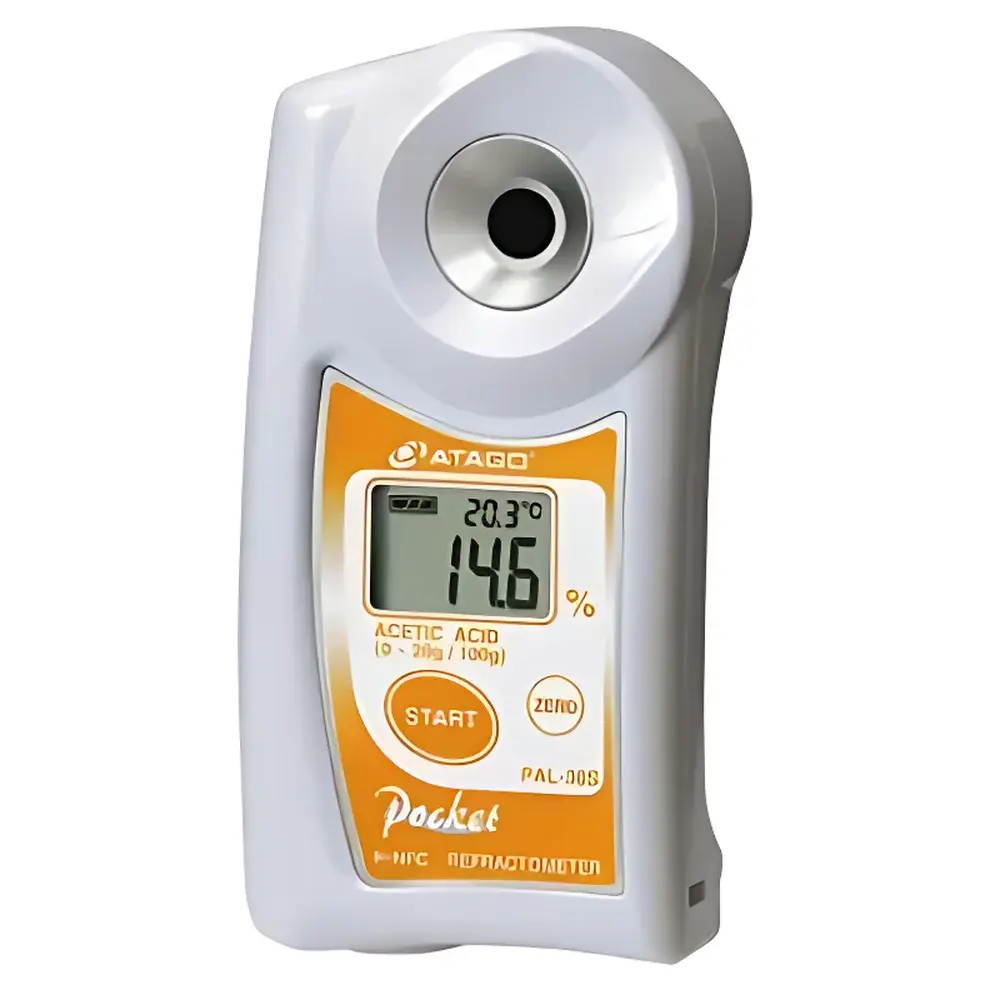
ATAGO PAL-30S Portable Digital Acetic Acid Refractometer
| Brand | ATAGO |
|---|---|
| Origin | Japan |
| Model | PAL-30S |
| Product Type | Handheld Refractometer |
| Measurement Range | 0.0–20.0% (w/w) Acetic Acid |
| Accuracy | ±0.6% |
| Temperature Range | 10–40°C (ATC-compensated) |
| Resolution | 0.1% |
| Display | Digital LCD |
| Power Supply | 2× AAA batteries |
| IP Rating | IP65 |
| Dimensions | 5.5 × 3.1 × 10.9 cm |
| Weight | 100 g (instrument only) |
Overview
The ATAGO PAL-30S is a compact, field-deployable digital refractometer engineered specifically for rapid, on-site quantification of acetic acid concentration in aqueous solutions—primarily targeting food-grade vinegar, fermentation intermediates, and industrial cleaning formulations. It operates on the principle of critical-angle refractometry: light passing through a prism-sample interface undergoes total internal reflection at an angle inversely proportional to the solution’s refractive index, which correlates linearly with acetic acid mass fraction within the calibrated range. Unlike generic Brix or salinity refractometers, the PAL-30S employs a chemically optimized optical calibration curve traceable to NIST-traceable acetic acid reference standards, ensuring metrological validity across its full 0.0–20.0% (w/w) measurement span. Its built-in Automatic Temperature Compensation (ATC) algorithm dynamically corrects refractive index readings across 10–40°C using integrated thermistor feedback, eliminating manual correction tables and minimizing operator-induced variability.
Key Features
- Optimized optical path design with high-stability sapphire prism for long-term refractive index fidelity and chemical resistance to acidic media
- Digital LCD display with 0.1% resolution and real-time temperature readout (°C)
- ATC compensation compliant with ISO 21748:2017 guidelines for temperature-dependent measurement uncertainty reduction
- Rugged, sealed housing rated IP65 per IEC 60529—dust-tight and protected against low-pressure water jets from any direction
- Low sample volume requirement: ≤0.3 mL per measurement, minimizing waste and enabling analysis of precious or limited batches
- Battery-powered operation (2× AAA) supports >5,000 measurements per set; auto-power-off after 3 minutes of inactivity
Sample Compatibility & Compliance
The PAL-30S is validated for use with clear, non-turbid, homogeneous aqueous acetic acid solutions. It is not suitable for emulsions, suspensions, or highly viscous matrices (e.g., undiluted glacial acetic acid or thickened vinegars), as particulate scattering or viscosity-induced meniscus distortion compromises optical interface integrity. For regulatory environments, the instrument supports GLP-compliant documentation workflows when paired with ATAGO’s optional data logging accessories (e.g., PAL-Log software). While the device itself does not embed FDA 21 CFR Part 11 electronic signature functionality, its measurement output meets foundational requirements for auditability under ISO/IEC 17025-accredited testing laboratories performing routine QC checks on food acidulants per Codex Alimentarius STAN 262–2008 and JIS K 0061:2018.
Software & Data Management
The PAL-30S operates as a standalone measurement unit without embedded Bluetooth or USB connectivity. However, it interfaces seamlessly with ATAGO’s PAL-Log PC application via optional RS-232 cable (PAL-COMM adapter required), enabling batch export of timestamped readings—including measured % acetic acid, ambient temperature, and measurement ID—to CSV or Excel formats. This facilitates integration into LIMS environments for trend analysis, SPC charting, and raw material release documentation. All stored data retain full traceability to instrument serial number and calibration date, satisfying minimum record-keeping expectations under GMP Annex 11 and USP Analytical Instrument Qualification protocols.
Applications
- On-line verification of acetic acid concentration during vinegar blending, dilution, and standardization in food manufacturing
- Process monitoring of acetification stages in traditional rice wine or apple cider vinegar production
- Quality control of industrial acetic acid solutions used in textile dyeing, pharmaceutical excipient preparation, and surface disinfectant formulation
- Field validation of incoming raw material specifications prior to warehouse acceptance
- Educational laboratory instruction in food chemistry and analytical instrumentation principles
FAQ
Does the PAL-30S require periodic recalibration with certified reference standards?
Yes. ATAGO recommends calibration verification before each shift using certified 5.0% and 15.0% (w/w) acetic acid reference solutions (ATAGO part nos. 4431 and 4432), following ISO 8655-6 procedures.
Can the instrument measure other organic acids such as citric or lactic acid?
No. The PAL-30S optical calibration is specific to acetic acid–water systems. Cross-sensitivity to other solutes invalidates concentration output; dedicated models (e.g., PAL-CITRUS for citric acid) are required.
Is cleaning the prism with ethanol acceptable?
Yes—use lint-free tissue moistened with ≥99.5% ethanol or deionized water. Avoid abrasive cleaners, acetone, or prolonged exposure to strong oxidizers that may degrade the prism coating.
How does ATC function without external temperature probes?
An embedded thermistor adjacent to the prism measures thermal equilibrium in real time; compensation uses a polynomial algorithm derived from empirical refractive index vs. temperature data across the 10–40°C operational envelope.
What is the maximum allowable sample temperature for safe measurement?
40°C is the upper thermal limit specified in the user manual. Exceeding this risks permanent prism coating degradation and ATC algorithm divergence.



