
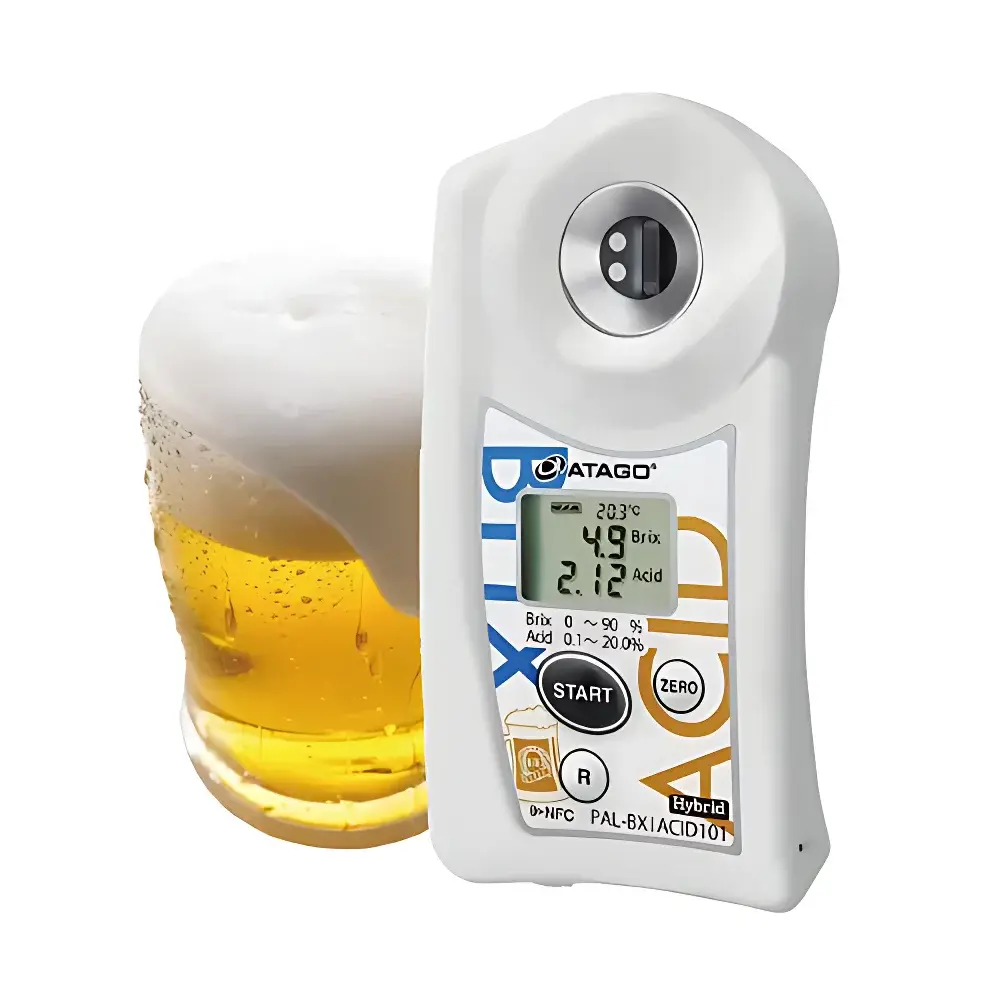
ATAGO PAL-BX/ACID 101 Portable Dual-Parameter Refractometer for Beer Brix and Total Acidity Measurement
| Brand | ATAGO |
|---|---|
| Origin | Japan |
| Model | PAL-BX/ACID 101 |
| Product Type | Handheld Refractometer |
| Measurement Range | Brix: 0.0–90.0% |
| Acid | 0.10–20.00% (as citric acid equivalent) |
| Accuracy | Brix: ±0.2% |
| Acid | ±0.10% (0.10–1.00%), ±10% relative (1.01–8.80%) |
| Temperature Compensation | 10–40°C |
| Resolution | Brix: 0.1% |
| Acid | 0.01% (0.00–9.99%), 0.1% (≥10.0%) |
| Ratio | 0.01 (0–9.99), 0.1 (10.0–99.9), 1 (≥100) |
| IP Rating | IP65 |
| Dimensions | 5.5 × 3.1 × 10.9 cm |
| Weight | 100 g (host only) |
| Power | 2 × AAA alkaline batteries |
Overview
The ATAGO PAL-BX/ACID 101 is a dedicated handheld refractometer engineered for simultaneous, on-site quantification of soluble solids (Brix) and total titratable acidity (expressed as citric acid equivalent) in beer and related malt-based beverages. Unlike conventional benchtop titration systems or multi-step enzymatic assays, this instrument leverages Abbe-type optical refraction principles—calibrated specifically for the refractive index–concentration relationship of sucrose and organic acids in low-viscosity, clarified aqueous matrices. Its dual-parameter architecture eliminates the need for separate instruments or labor-intensive wet chemistry workflows, enabling rapid assessment of fermentation progression, mash efficiency, wort quality, and final product balance. The device operates without external power sources or temperature-controlled cuvettes, relying instead on built-in automatic temperature compensation (ATC) across 10–40°C to maintain measurement integrity under variable field conditions typical of brewhouses, QC labs, and pilot-scale R&D environments.
Key Features
- Integrated dual-mode optical detection: single-sample measurement of Brix (0.0–90.0%) and total acidity (0.10–20.00% as citric acid) via calibrated refractive index algorithms
- One-touch ratio calculation: dedicated “R” key computes and displays real-time Brix-to-Acid ratio with dynamic resolution scaling (0.01 up to 9.99; 0.1 up to 99.9; integer ≥100)
- Robust industrial design: IP65-rated enclosure ensures resistance to dust ingress and water jets—suitable for humid, non-sterile production floor use
- Battery-operated portability: powered by two standard AAA alkaline cells (typical life >10,000 measurements), enabling unrestricted mobility between brewhouse, cellar, and packaging lines
- No reagents or consumables required: acid measurement performed after standardized 1:50 (w/w) dilution with distilled water—eliminating titrant costs, calibration drift, and operator dependency
- Optimized optical path: high-precision prism assembly with anti-fouling surface treatment minimizes residue adhesion from hop oils or residual proteins common in unfiltered beer samples
Sample Compatibility & Compliance
The PAL-BX/ACID 101 is validated for use with clarified or lightly filtered beer, wort, and post-fermentation samples exhibiting low turbidity (<5 NTU) and minimal suspended solids. It is not intended for highly hazy, dry-hopped, or barrel-aged variants containing significant yeast lees, polyphenol complexes, or glycerol-rich matrices. While the instrument does not perform GLP-compliant audit trails or electronic records, its measurement methodology aligns with foundational principles referenced in AOAC Official Method 932.12 (Brix) and ASTM D1613 (acid titration equivalence for organic acid reporting). For regulated quality control applications, users may document manual entries into LIMS or paper-based batch records per internal SOPs aligned with ISO/IEC 17025 traceability requirements.
Software & Data Management
This is a standalone, firmware-based instrument with no USB, Bluetooth, or cloud connectivity. All data remain local and are displayed in real time on the monochrome LCD screen. No proprietary software, drivers, or firmware updates are provided or supported. Users must manually record Brix, Acid, and Ratio values alongside sample identifiers and timestamps. The absence of digital output interfaces reflects ATAGO’s design philosophy for field-deployed tools where operational simplicity, electromagnetic immunity, and long-term hardware stability supersede data automation—particularly in environments subject to RF interference from brewing control systems or variable power quality.
Applications
- Fermentation monitoring: tracking Brix decline and concurrent acid stabilization during primary and secondary fermentation stages
- Mash optimization: evaluating extract yield and diastatic conversion efficiency through pre-boil wort Brix and pH-correlated acidity trends
- Quality gatekeeping: verifying consistency of final gravity, residual sugar, and sourness profile prior to filtration or packaging
- R&D formulation: supporting sensory panel correlation studies by establishing quantitative Brix/Acid boundaries for target flavor profiles (e.g., balanced lager vs. tart Berliner Weisse)
- Supplier verification: rapid screening of adjunct syrups, caramel malts, or acidulated malt batches for compositional conformity
- Educational use: teaching core concepts of carbohydrate metabolism, organic acid kinetics, and refractometric calibration in brewing science curricula
FAQ
Does the PAL-BX/ACID 101 measure pH or individual organic acids (e.g., lactic, acetic)?
No. It reports total acidity as a citric acid equivalent value derived from refractive index deviation—not electrochemical potential or chromatographic separation.
Can it be used for unfiltered or hazy craft beers?
Not recommended. Particulates and colloidal haze induce scattering errors that compromise refractive index accuracy; centrifugation or membrane filtration (0.45 µm) is required prior to measurement.
Is calibration traceable to NIST or other national standards?
ATAGO provides factory calibration using certified sucrose and citric acid reference solutions; however, end-user recalibration requires ATAGO-certified calibration kits (e.g., CAL-BX and CAL-ACID)—not generic lab-grade standards.
What is the expected service life under daily brewery use?
With proper cleaning (distilled water rinse + soft lint-free cloth) after each use and storage in the supplied protective case, the optical system maintains specification compliance for ≥5 years based on ATAGO’s accelerated aging tests.
Does the 1:50 dilution requirement affect measurement uncertainty?
Yes—the dilution step introduces volumetric error; ATAGO specifies ±0.10% absolute accuracy only for undiluted Brix and for Acid concentrations ≤1.00%; above that range, relative accuracy degrades to ±10% due to nonlinear refractive response at higher acid loadings.



