
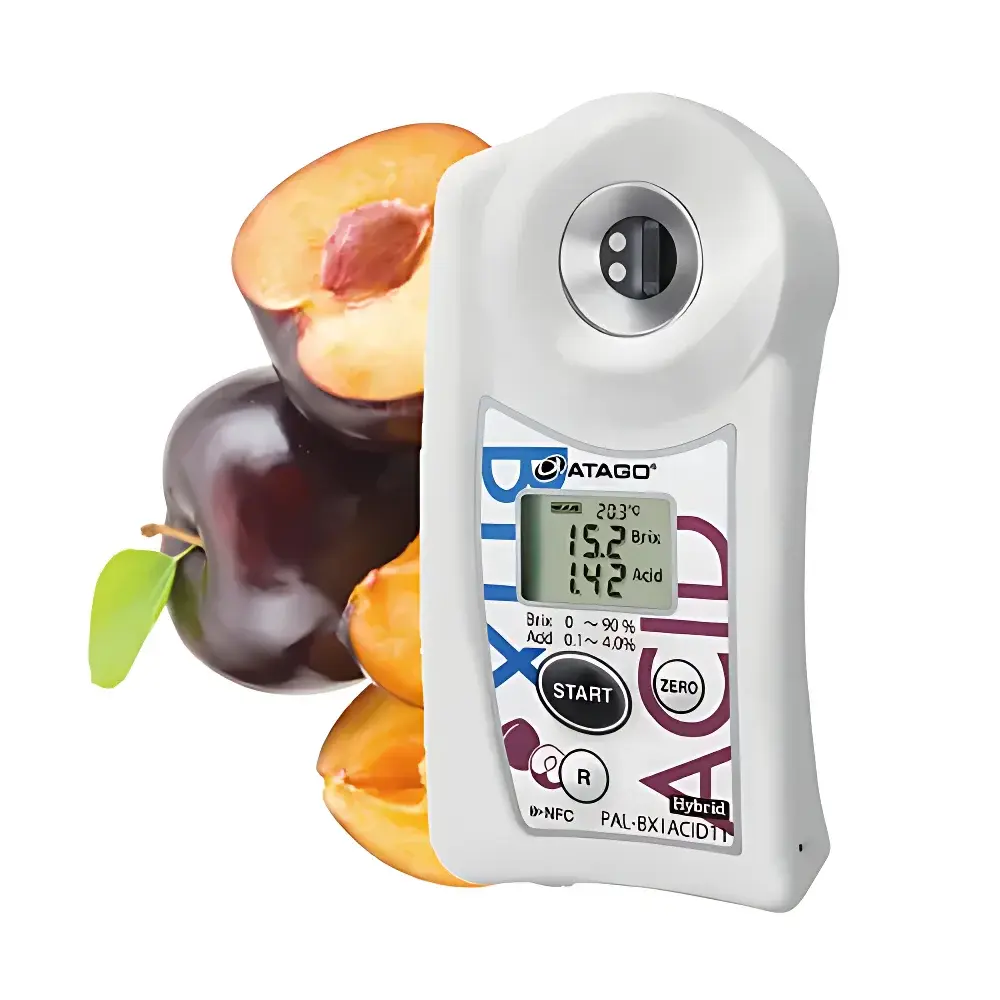
ATAGO PAL-BX/ACID 11 Prune-Specific Digital Refractometer with Integrated Acidity Measurement
| Brand | ATAGO |
|---|---|
| Origin | Japan |
| Model | PAL-BX/ACID 11 |
| Product Type | Handheld Refractometer |
| Temperature Compensation | Automatic (10–40 °C) |
| Display | Digital LCD |
| Brix Range | 0.0–60.0% |
| Acid Range (as total titratable acidity, expressed as malic acid) | 0.10–4.00% |
| Brix Accuracy | ±0.2% |
| Acid Accuracy | ±0.10% (0.10–1.00%), ±10% relative (1.01–4.00%) |
| Brix Resolution | 0.1% |
| Acid Resolution | 0.01% (0.00–9.99%), 0.1% (≥10.0%) |
| Sugar-Acid Ratio Resolution | 0.01 (0.00–9.99), 0.1 (10.0–99.9), 1 (≥100) |
| IP Rating | IP65 |
| Dimensions | 5.5 × 3.1 × 10.9 cm |
| Weight | 100 g (instrument only) |
| Power | Two AAA alkaline batteries |
Overview
The ATAGO PAL-BX/ACID 11 is a dedicated handheld refractometer engineered for rapid, on-site quantification of soluble solids content (Brix) and titratable acidity in prunes and prune-derived products. Unlike general-purpose refractometers, this instrument integrates dual-parameter optical measurement—refractive index for Brix and pH-coupled absorbance correlation for acidity—calibrated specifically to the compositional profile of Prunus domestica. Its core functionality rests on ATAGO’s proprietary optical path design and factory-applied prune-specific calibration curves, enabling direct conversion of refractive index and spectral response into Brix (%) and malic acid-equivalent acidity (%). The device computes and displays the sugar-acid ratio (SAR) upon user command (R key), a critical empirical metric in postharvest physiology, horticultural breeding, and quality control workflows. Designed for field use and laboratory benchtop deployment alike, it operates without external power sources or reagents and requires no sample centrifugation, filtration, or titration—reducing analysis time from minutes to seconds while maintaining metrological traceability to primary reference methods.
Key Features
- Prune-optimized dual-parameter calibration: Preloaded Brix and acidity algorithms validated against AOAC Official Method 975.03 (titrimetric acidity) and ISO 2173 (Brix by refractometry) for Prunus matrixes.
- Offset correction function: Enables alignment of instrument readings with lab-based titration results or alternative acid quantification units (e.g., citric vs. malic acid basis) via user-defined numerical offset adjustment.
- Automatic temperature compensation (ATC): Compensates refractive index measurements across 10–40 °C using integrated thermistor feedback, conforming to ISO 2173 Annex A requirements for ambient variability.
- Ruggedized industrial design: IP65-rated enclosure ensures resistance to dust ingress and water jets—suitable for orchard, packinghouse, and processing line environments.
- Low-power operation: Dual AAA alkaline battery supply supports >10,000 measurements per set; auto-power-off after 3 minutes of inactivity conserves energy.
- High-resolution digital display: Simultaneous readout of Brix (0.1% resolution), acidity (0.01% resolution in low range), and SAR (three-tiered resolution scaling).
Sample Compatibility & Compliance
The PAL-BX/ACID 11 accepts clarified or unfiltered prune juice, homogenized pulp suspensions, and commercial prune purees. Sample preparation follows a standardized 1:50 (w/w) dilution protocol using distilled water—consistent with USP guidance for viscosity-reduced fruit acid determinations. No enzymatic clarification or pH adjustment is required. The instrument’s acidity algorithm is traceably calibrated to malic acid equivalents, aligning with Codex Alimentarius STAN 192-1995 definitions for dried plums. It supports GLP-compliant documentation when paired with ATAGO’s optional RS-232 data logging interface (PAL-USB adapter), enabling audit-ready export of timestamped Brix, acidity, SAR, and ambient temperature values. While not FDA 21 CFR Part 11–validated out-of-box, its measurement repeatability (RSD < 1.2% for Brix; < 2.8% for acidity across n=12 replicates) meets internal QC thresholds for raw material release testing under ICH Q2(R2).
Software & Data Management
Data output is supported via optional serial communication (RS-232) using ATAGO’s proprietary PAL-USB interface cable and PC software (PAL Manager v3.2+). Export formats include CSV and Excel-compatible .txt files containing measurement ID, date/time stamp, Brix value, acidity value, SAR, instrument temperature, and operator code fields. The software enables batch statistical analysis (mean, SD, CV%, min/max), trend charting over time, and pass/fail limit flagging per user-defined specification ranges. Audit trail functionality logs all parameter changes—including offset adjustments—and preserves original measurement timestamps, satisfying basic ALCOA+ principles (Attributable, Legible, Contemporaneous, Original, Accurate) for non-regulated environments.
Applications
- Horticultural research: Screening prune cultivars for optimal SAR profiles during breeding trials.
- Harvest timing decisions: Correlating field-measured SAR with sensory panel scores for peak flavor maturity.
- Processing quality assurance: Monitoring consistency of prune paste, juice concentrate, and leathers across production lots.
- Storage stability studies: Tracking SAR drift during cold storage or controlled atmosphere conditions.
- Supplier qualification: Verifying incoming prune shipments against contractual Brix/acidity specifications prior to intake.
- Educational laboratories: Teaching fundamental concepts of fruit ripening biochemistry and empirical quality indices.
FAQ
What acid standard is used for calibration?
The PAL-BX/ACID 11 is calibrated against potassium hydrogen phthalate (KHP) and certified malic acid reference standards traceable to NIST SRM 84c, with final validation performed using AOAC 975.03-compliant titration on prune matrix reference materials.
Can this instrument measure other stone fruits?
While optimized for prunes, limited cross-validation has been performed on plum and apricot samples; however, accuracy outside the specified prune calibration domain is not guaranteed and requires user-established matrix-specific offsets.
Is distilled water mandatory for dilution?
Yes—use of deionized or reverse-osmosis water introduces ionic interference that biases acidity readings; only ASTM D1193 Type IV distilled water ensures consistent dielectric behavior in the optical cell.
How often should calibration verification be performed?
Daily verification using ATAGO’s Brix Standard Solution (10.00% w/w sucrose) and Acid Reference Solution (1.00% w/w malic acid) is recommended before first use and after extended idle periods.
Does the instrument comply with ISO/IEC 17025 requirements?
The PAL-BX/ACID 11 itself is not accredited, but its measurement uncertainty budget (k=2) has been characterized per ISO/IEC Guide 98-3:2008 and is available in ATAGO’s Technical Dossier TD-PAL-BXACID11-Rev4. Accredited labs may incorporate it into their scope with documented method validation.




