
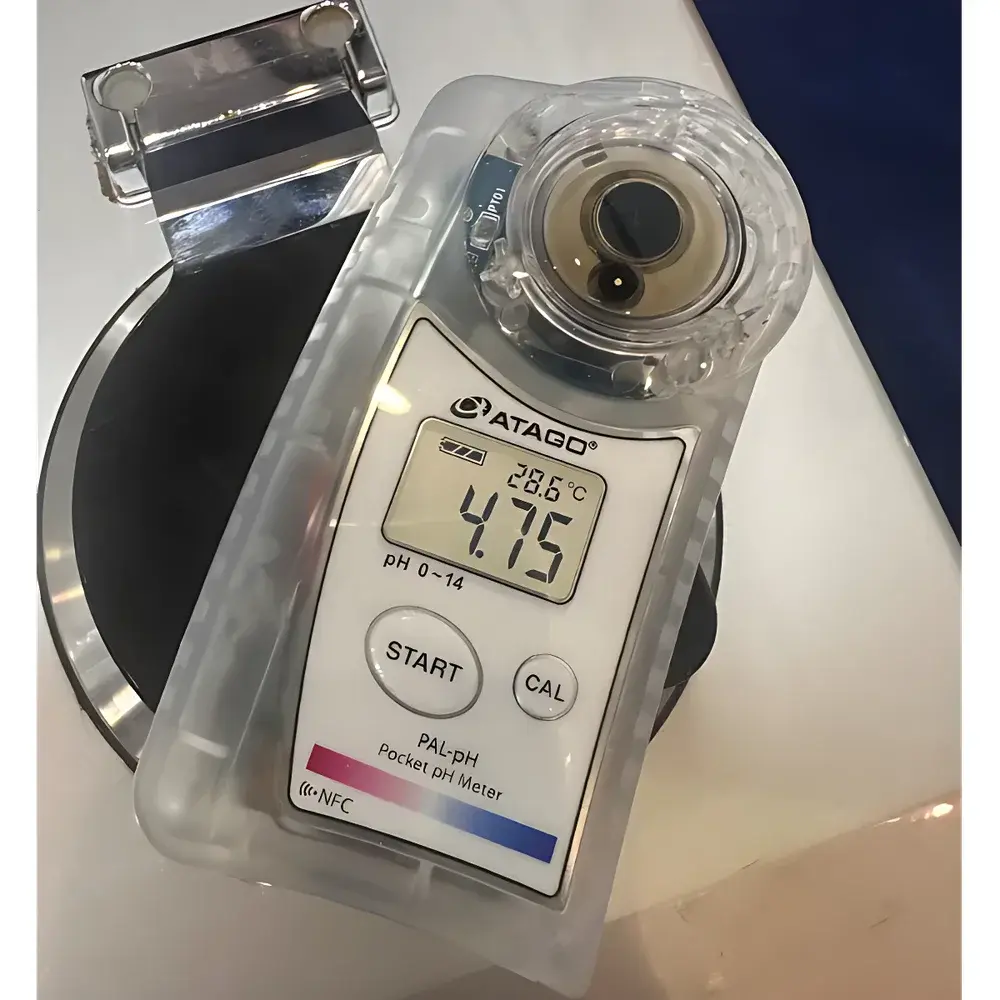
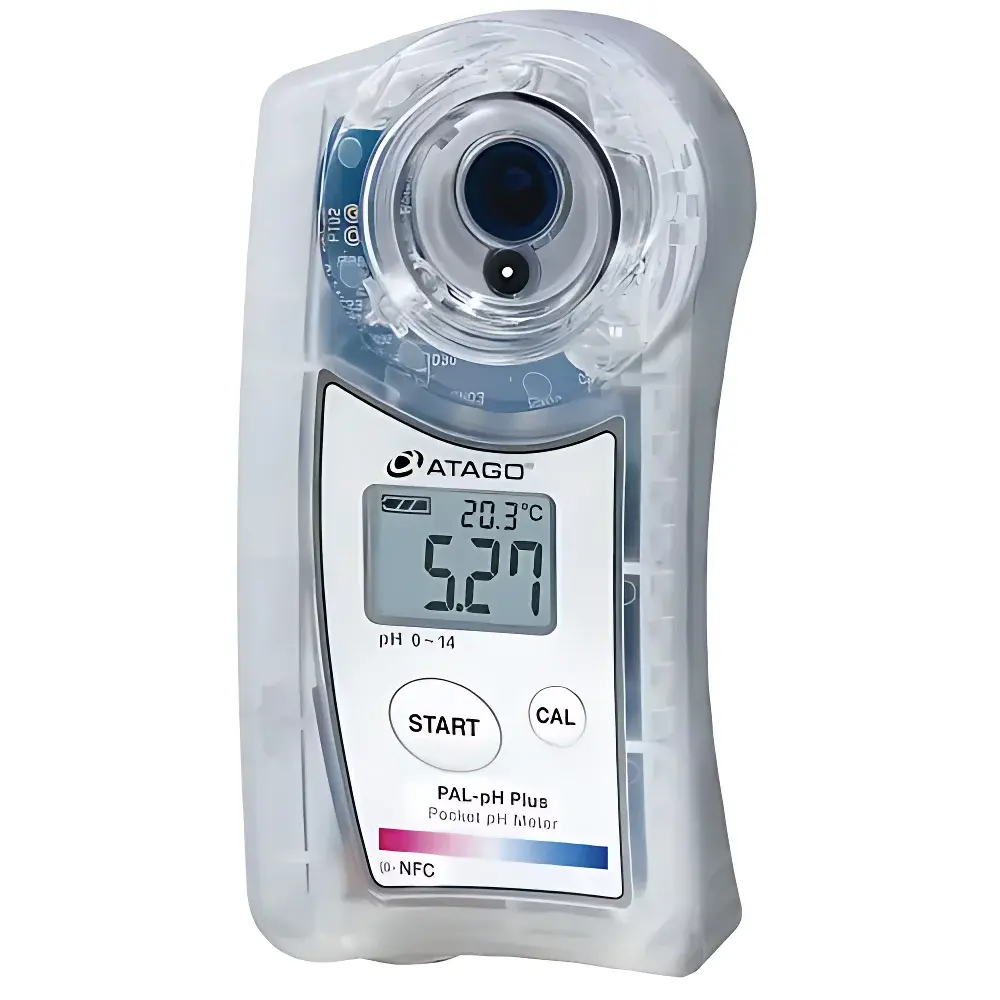
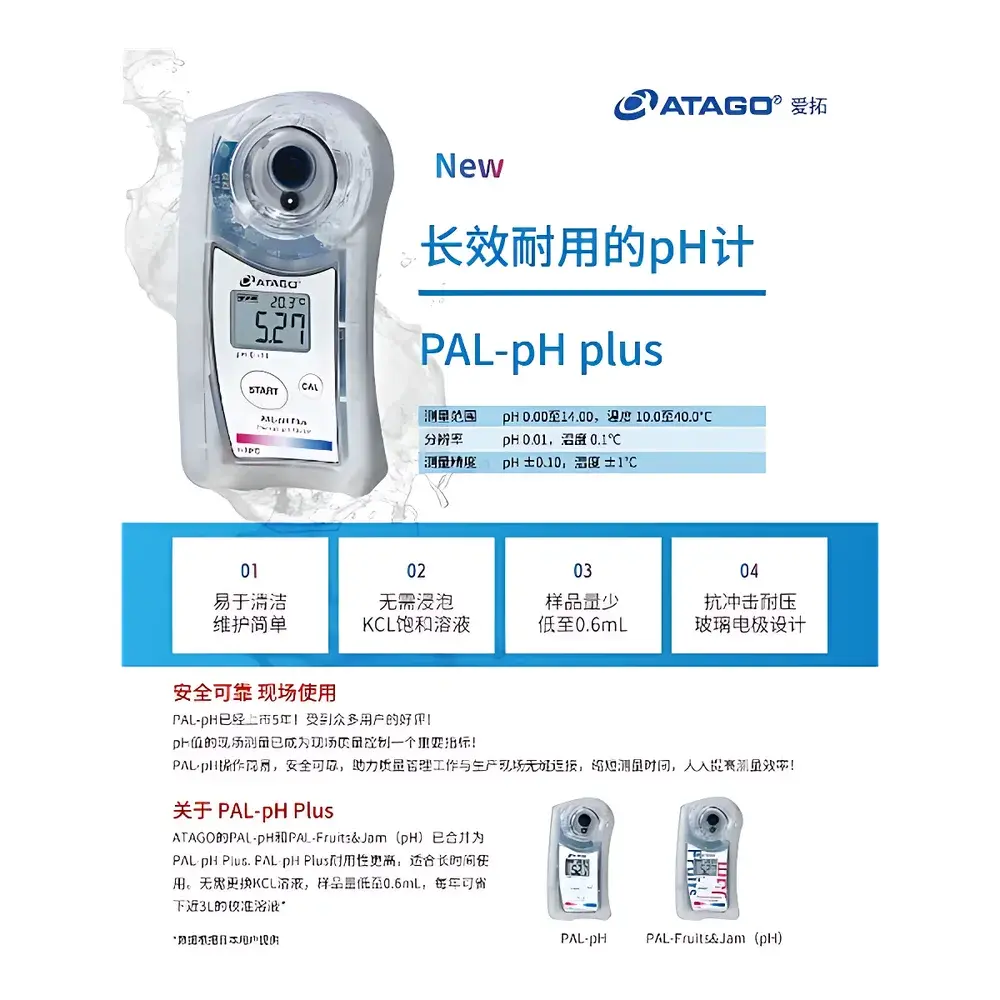
ATAGO PAL-pH Plus Portable Digital pH Meter
| Brand | ATAGO |
|---|---|
| Origin | Japan |
| Model | PAL-pH Plus |
| Instrument Type | Portable pH Meter |
| Parameter Type | Single-parameter (pH) |
| Measurement Range | pH 0.00–14.00 |
| Resolution | 0.01 pH |
| Accuracy | ±0.10 pH |
| Temperature Range | 10.0–40.0 °C |
| Temperature Accuracy | ±1.0 °C |
| Sample Volume Requirement | ≥0.6 mL |
| Electrode Type | Flat-surface glass pH electrode |
| Calibration Solutions | ATAGO-certified pH 4.01, 6.86, and 9.18 standard buffers |
| IP Rating | IP65 |
| Power Supply | Two AAA batteries |
| Dimensions | 5.5 × 3.1 × 10.9 cm |
| Weight | 100 g (instrument only) |
Overview
The ATAGO PAL-pH Plus is a compact, handheld digital pH meter engineered for rapid, reliable, and field-deployable pH measurement in low-volume liquid and semi-solid samples. Unlike conventional spherical-glass-electrode meters, the PAL-pH Plus integrates a flat-surface glass pH sensor—optimized for durability, ease of cleaning, and consistent contact with viscous or surface-limited specimens such as cosmetic formulations, topical pharmaceuticals, skincare emulsions, and biological exudates. Its operating principle follows standardized potentiometric measurement: the potential difference between the pH-sensitive glass membrane and a built-in reference electrode is converted into a digital pH reading via high-impedance analog-to-digital circuitry compliant with IUPAC-recommended pH scale conventions. Designed for routine quality control and R&D applications where portability, speed, and repeatability are critical, the instrument delivers traceable measurements across the full aqueous pH range (0.00–14.00) under ambient laboratory or production-floor conditions.
Key Features
- Flat-surface glass pH electrode: Enhances mechanical robustness and minimizes breakage risk during frequent handling; enables stable readings on non-homogeneous or low-volume samples without immersion depth dependency.
- IP65-rated enclosure: Dust-tight and protected against water jets—suitable for use in humid environments, cleanrooms (ISO Class 8), and manufacturing lines with incidental splashes.
- Minimal sample requirement: Accurate measurement from just 0.6 mL of sample—ideal for precious or limited-quantity formulations including serums, toners, and active ingredient dispersions.
- Integrated temperature compensation: Automatic temperature sensing (10.0–40.0 °C) with ±1.0 °C accuracy ensures NIST-traceable pH values corrected per DIN 19267 and ISO 3696 standards.
- Three-point calibration support: Pre-configured compatibility with ATAGO-certified pH 4.01, 6.86, and 9.18 buffer solutions—aligned with ASTM E70 and USP calibration protocols.
- Battery-operated design: Powered by two standard AAA cells (typical life >1,000 measurements), enabling uninterrupted operation during audits, supplier inspections, or multi-site QC checks.
Sample Compatibility & Compliance
The PAL-pH Plus is validated for direct-contact measurement of aqueous-based personal care products (e.g., cleansers, moisturizers, shampoos), topical dermatological preparations, hydroalcoholic solutions, and buffered biological extracts. It is not intended for highly viscous pastes, organic solvents, or strongly oxidizing media without prior dilution or matrix-matched validation. The device complies with electromagnetic compatibility (EMC) requirements per IEC 61326-1:2020 and meets essential safety criteria outlined in IEC 61010-1:2010 for electrical equipment used in laboratory environments. While not FDA 21 CFR Part 11–enabled out-of-the-box, its calibration logs, measurement timestamps, and operator ID fields (via optional PC software export) support GLP/GMP-aligned documentation when integrated into validated SOPs.
Software & Data Management
The PAL-pH Plus operates as a standalone instrument with no onboard memory or Bluetooth/Wi-Fi connectivity. All measurements are displayed in real time on a high-contrast LCD screen and may be manually recorded. For traceable data capture, users may interface the device with ATAGO’s optional PAL-Link software (Windows-compatible) via USB adapter to export CSV-formatted datasets—including date/time stamp, measured pH, temperature, and calibration status—for inclusion in electronic lab notebooks (ELN) or LIMS systems. Exported files retain metadata sufficient for audit readiness under ISO/IEC 17025:2017 clause 7.7 (result reporting) and support trend analysis across batch releases.
Applications
- Skincare formulation development: Monitoring pH drift during stability testing (e.g., accelerated aging at 40 °C/75% RH per ICH Q1A).
- In-process QC of cosmeceuticals: Verifying final product pH compliance with ISO 16128–2 guidelines for natural origin index calculations.
- Dermatological product release testing: Confirming pH alignment with physiological skin barrier norms (target range pH 5.1–5.6) per EFfCI Cosmetic Product Safety Assessment guidance.
- Academic research on acid mantle integrity: Quantifying surface pH changes pre/post-application of surfactants or preservatives in ex vivo skin models.
- Contract manufacturing oversight: Rapid verification of incoming raw material pH specifications (e.g., hyaluronic acid solutions, niacinamide suspensions).
FAQ
What is the recommended electrode activation procedure before first use?
Immerse the flat-surface electrode tip in deionized water for 20 minutes prior to initial calibration to fully hydrate the glass membrane.
Can the PAL-pH Plus measure pH in non-aqueous or high-alcohol-content solutions?
No—it is calibrated and validated exclusively for aqueous and aqueous-organic mixtures with ≤30% v/v ethanol; alternative electrodes and matrix-specific calibration are required for anhydrous systems.
How often should calibration be performed?
Perform three-point calibration at the start of each shift or before each new batch test series; verify with a single-point check (pH 6.86) between measurements if ambient temperature fluctuates >2 °C.
Is the instrument suitable for ISO/IEC 17025-accredited laboratories?
Yes—when operated within defined uncertainty budgets, supported by documented calibration certificates for ATAGO buffers, and incorporated into a validated measurement procedure per ISO/IEC 17025 clause 7.6.
Does the PAL-pH Plus meet requirements for GMP-regulated cosmetic manufacturing?
It fulfills equipment qualification prerequisites (IQ/OQ) for pH monitoring; however, formal PQ must be established per site-specific risk assessment and documented in the master validation plan.





