
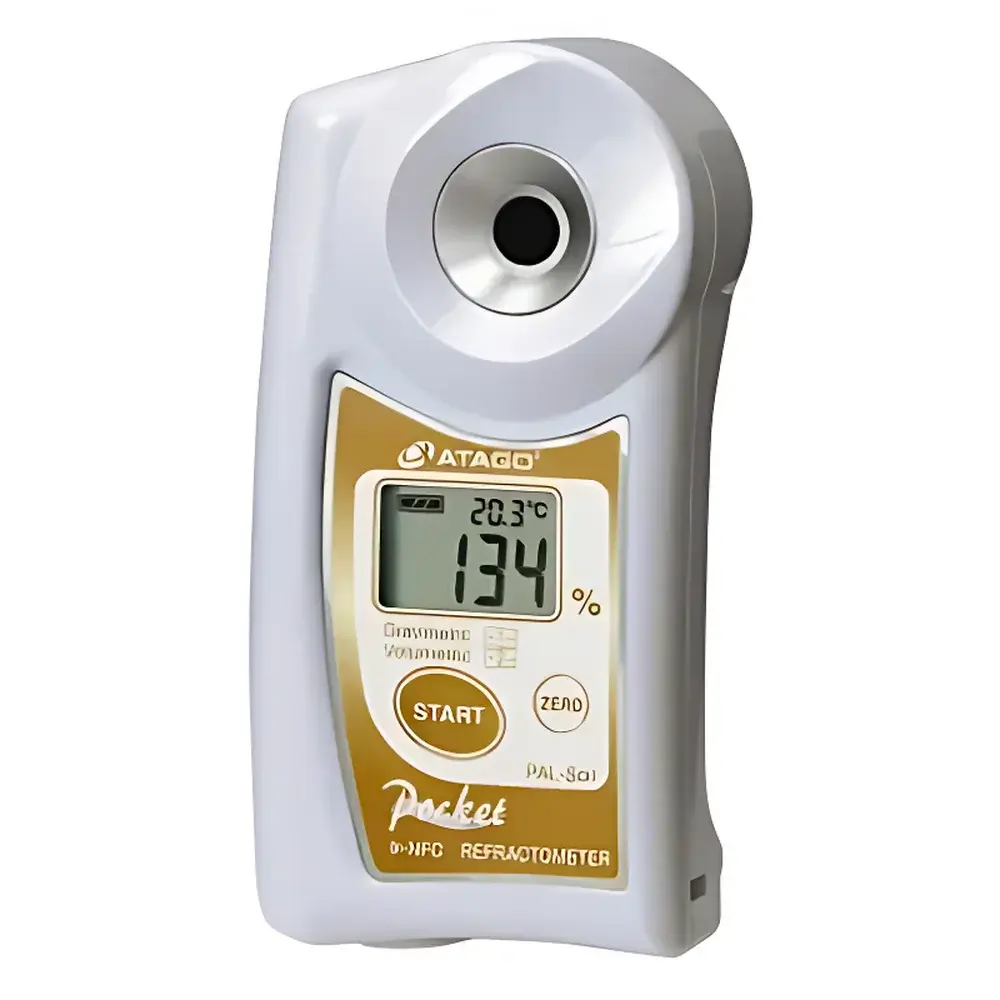
ATAGO PAL-Soil Soil Moisture Analyzer
| Brand | ATAGO |
|---|---|
| Origin | Japan |
| Model | PAL-Soil |
| Measurement Principle | Refractometric determination via glycerol–water equilibrium solution (5:3 v/v) per ISO 16586:2003 |
| Measurement Parameters | Gravimetric Water Content (0–200%, ±2% @ 0–40%, ±5% @ 41–100%), Volumetric Water Content (0–100%, ±1% @ 0–60%, ±2% @ 61–100%), Temperature (10.0–40.0 °C, ±1.0 °C, 0.1 °C resolution) |
| Auto-Temperature Compensation | 10–40 °C |
| Sample Volume | 0.3 mL |
| Measurement Time | ~3 s |
| Power | 2 × AAA batteries |
| IP Rating | IP65 |
| Dimensions & Weight | 55(W) × 31(D) × 109(H) mm, 100 g (host only) |
Overview
The ATAGO PAL-Soil Soil Moisture Analyzer is a handheld, refractometer-based instrument engineered for rapid, field-deployable quantification of soil water content in accordance with ISO 16586:2003 — “Soil quality — Determination of gravimetric water content.” Unlike gravimetric oven-drying or time-domain reflectometry (TDR) methods, the PAL-Soil employs an equilibrium-based optical principle: a precisely formulated glycerol–water extraction solution (5:3 v/v) is mixed with a representative soil sample; as water migrates into the glycerol phase, the resulting refractive index shift is measured by a high-stability prism-based optical system. This refractive index change correlates directly to water concentration and is converted in real time to both gravimetric water content (% w/w) and volumetric water content (% v/v), enabling consistent interpretation across diverse soil textures without calibration against bulk density.
Key Features
- Simultaneous dual-scale readout: Gravimetric water content (0–200%) and volumetric water content (0–100%) displayed concurrently on a high-contrast LCD screen.
- ISO 16586:2003–compliant methodology validated for regulatory and research-grade reporting in environmental monitoring, agronomy, and soil physics laboratories.
- Ultra-rapid measurement cycle: Full analysis completed in approximately 3 seconds after sample–extractant equilibration (total process time ≤10 minutes including preparation).
- Integrated automatic temperature compensation (10–40 °C), eliminating manual correction and ensuring metrological traceability across ambient field conditions.
- Rugged, portable design with IP65 ingress protection—dust-tight and resistant to low-pressure water jets—suitable for repeated use in humid, dusty, or rain-exposed environments.
- Low-power operation using two standard AAA batteries, supporting >5,000 measurements per set under typical usage conditions.
Sample Compatibility & Compliance
The PAL-Soil is optimized for mineral soils, loams, clays, and sandy substrates within the 10–40 °C operational range. It is not intended for highly organic soils (>30% OM), saline-alkali soils with EC >4 dS/m, or frozen/thawing matrices, as these may interfere with glycerol–water partitioning kinetics or refractive baseline stability. All measurement protocols align with ISO 16586:2003 requirements for homogenization, extractant volume ratio, and equilibration time. The device supports GLP-aligned documentation when paired with external lab notebooks or LIMS-integrated workflows; while it does not embed FDA 21 CFR Part 11–compliant audit trails internally, its deterministic optical measurement principle ensures full repeatability and operator-independent output.
Software & Data Management
The PAL-Soil operates as a standalone, firmware-controlled instrument with no onboard data logging or Bluetooth/Wi-Fi connectivity. Measurement results are displayed in real time and must be manually recorded or transcribed into external databases (e.g., Excel, LabArchives, or custom GIS-linked platforms). For high-throughput field campaigns, users commonly integrate the PAL-Soil into structured sampling protocols that include standardized metadata capture (location, depth, texture class, time stamp) alongside each reading. Its fixed optical architecture and absence of software-upgradable firmware ensure long-term measurement consistency—critical for longitudinal studies spanning multiple growing seasons or climate monitoring programs.
Applications
- Agricultural irrigation scheduling: Quantify plant-available water at critical growth stages to optimize water use efficiency and reduce leaching losses.
- Environmental site assessment: Monitor moisture dynamics during remediation projects, landfill cover performance verification, or wetland hydrology characterization.
- Soil physics research: Support validation of pedotransfer functions, hydraulic conductivity modeling, and evapotranspiration parameterization in mesocosm and field trials.
- Educational field labs: Provide undergraduate and graduate students with hands-on experience in standardized soil moisture methodology, refractometry fundamentals, and ISO-compliant reporting practices.
- Regulatory compliance sampling: Fulfill statutory reporting requirements for soil moisture thresholds in construction dewatering permits, erosion control plans, and brownfield redevelopment monitoring.
FAQ
Does the PAL-Soil require daily calibration?
No. The instrument uses a factory-calibrated optical path and stable glycerol reference solution; routine verification with distilled water (refractive index = 1.3330 @ 20 °C) is recommended before each field day.
Can it measure frozen or water-saturated soils?
No. The method requires liquid-phase water diffusion into glycerol; frozen, anaerobic, or perched-water table samples yield non-equilibrium readings and are outside the validated scope.
Is the glycerol–water solution supplied with the unit?
Yes. Each PAL-Soil shipment includes one 10-mL vial of pre-mixed, certified 5:3 (v/v) glycerol–water extractant (ATAGO Part No. 4570-EX). Additional vials are available as consumables.
How does temperature affect accuracy?
The built-in thermistor enables automatic compensation between 10–40 °C. Outside this range, measurement error increases nonlinearly; users should precondition samples to ambient lab/field temperature prior to analysis.
What maintenance is required?
Wipe the prism surface with lens tissue and isopropyl alcohol after each use; inspect for scratches or residue monthly. Avoid immersion, ultrasonic cleaning, or abrasive solvents.
Related Products







