
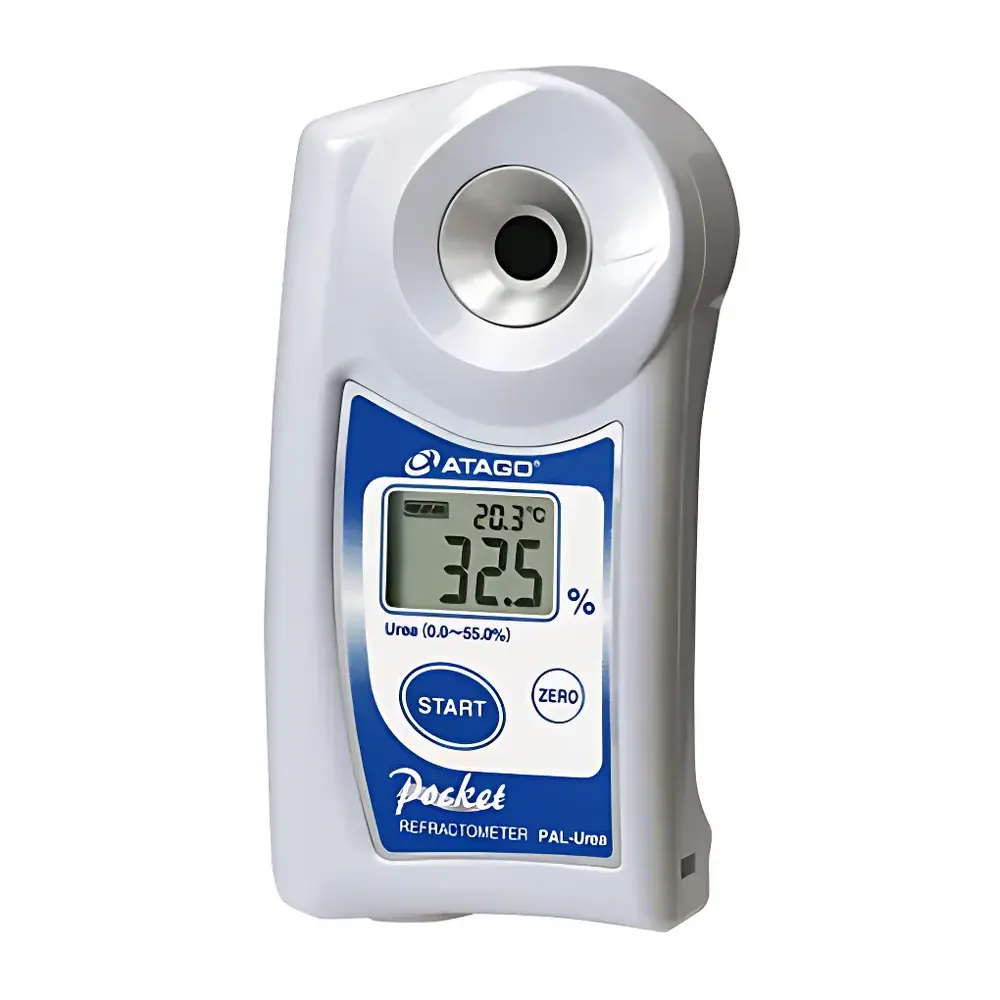
ATAGO PAL-Urea Portable Refractometer for Diesel Exhaust Fluid (DEF) Concentration Measurement
| Brand | ATAGO |
|---|---|
| Origin | Japan |
| Model | PAL-Urea |
| Measurement Range | 0.0–55.0% w/w urea |
| Accuracy | ±0.2% w/w |
| Resolution | 0.1% w/w |
| Temperature Range (with ATC) | 10–40°C |
| Automatic Temperature Compensation (ATC) | Yes, 10–75°C prism temperature range |
| IP Rating | IP65 |
| Power | 2 × AAA batteries (~11,000 measurements per set) |
| Dimensions | 5.5 × 3.1 × 10.9 cm |
| Weight | 100 g (main unit only) |
| Compliance | Designed for ISO 22241-1 / ISO 22241-2 / DIN 70070 / ASTM D7592 / US EPA 40 CFR Part 1065 |
Overview
The ATAGO PAL-Urea is a handheld, optical refractometer engineered specifically for the rapid, field-deployable quantification of aqueous urea concentration in Diesel Exhaust Fluid (DEF), also known as AdBlue® in Europe. It operates on the principle of critical-angle refractometry: incident light passes through a sapphire prism in contact with the sample, and the resulting refraction angle—directly correlated to the solution’s refractive index—is converted into a mass percentage (w/w %) of urea using a pre-calibrated polynomial algorithm traceable to ISO 22241-1 reference standards. Unlike generic Brix refractometers, the PAL-Urea applies a proprietary urea-specific calibration curve that accounts for non-linear optical response across the 0.0–55.0% range, eliminating errors associated with sucrose-based Brix-to-urea conversion. Its design supports real-time verification of DEF compliance at fueling stations, fleet maintenance bays, mobile monitoring vehicles, and roadside inspection checkpoints—ensuring SCR catalyst efficiency and regulatory adherence under EPA 40 CFR Part 1065 and EU Regulation (EC) No 715/2007.
Key Features
- Urea-specific optical calibration validated against ISO 22241-1 certified reference materials, not generic Brix interpolation
- Integrated Automatic Temperature Compensation (ATC) with high-precision thermistor embedded in the sapphire prism, compensating across 10–75°C prism temperature range
- IP65-rated enclosure for dust-tight and low-pressure water jet resistance—suitable for outdoor, vehicle-mounted, or industrial environments
- Three-second measurement cycle: single-button operation with immediate display of urea concentration (%) and sample temperature (°C)
- Low-power architecture enabling ~11,000 measurements on two standard AAA alkaline batteries
- Compact ergonomic form factor (100 g, 5.5 × 3.1 × 10.9 cm) optimized for glove-compatible use in mobile monitoring vehicles and field service kits
- ELI (Error Light Indicator) system alerts users to ambient light interference (e.g., direct sunlight), prompting corrective shading before measurement
Sample Compatibility & Compliance
The PAL-Urea is validated exclusively for aqueous urea solutions meeting ISO 22241-1 specifications—i.e., ≥99.7% pure urea, ≤0.5 ppm total aldehydes, ≤0.5 ppm biuret, and conductivity <50 µS/cm. It does not support viscous, turbid, or particulate-laden fluids (e.g., contaminated DEF, undiluted urea melts, or glycol-containing antifreeze mixtures). The instrument complies with metrological requirements outlined in ISO/IEC 17025 for field-use refractometers and supports GLP/GMP data integrity when paired with ATAGO’s optional RS-232 output and PC logging software. Its measurement uncertainty budget has been verified per ISO/IEC Guide 98-3 (GUM) and aligns with the ±0.2% w/w tolerance specified in ISO 22241-2 Annex C for on-site DEF verification.
Software & Data Management
While the PAL-Urea operates as a standalone instrument, it features an RS-232 serial interface (via optional adapter cable) for direct connection to Windows-based PCs. ATAGO’s free PAL Manager software enables time-stamped batch export of measurement records—including concentration value, temperature reading, date/time stamp, and instrument ID—to CSV or Excel formats. All exported data include audit-trail metadata compliant with FDA 21 CFR Part 11 requirements when used in regulated environments. No internal memory or cloud upload is implemented; data persistence relies entirely on external host systems—a design choice prioritizing data sovereignty and cybersecurity in fleet management and environmental enforcement applications.
Applications
- On-the-spot verification of DEF concentration during fuel delivery at truck stops and depots
- Pre-departure quality checks on heavy-duty vehicles equipped with SCR aftertreatment systems
- Mobile emissions testing units conducting roadside NOx compliance audits per EU Directive 2010/75/EU
- Field technicians validating DEF tank fill integrity following refilling or transfer operations
- Manufacturing QA/QC of bulk DEF production batches prior to packaging and distribution
- Regulatory inspections by environmental agencies verifying adherence to EPA Tier 4 Final and Euro VI emission standards
FAQ
Why can’t I use a standard Brix refractometer for DEF measurement?
Brix scales assume sucrose-based solutes and yield inaccurate results for urea due to differences in molecular polarizability and refractive index response. PAL-Urea uses a urea-specific calibration curve traceable to ISO 22241-1 reference standards.
What should I do if the ELI function displays “nnn”?
This indicates ambient light interference. Shield the sample well with your hand, press ZERO or START again, and ensure the prism surface is clean and dry before re-measurement.
How often must I recalibrate or zero the instrument?
Zeroing with temperature-equilibrated distilled water is required before each measurement session—and immediately after exposure to large ambient temperature shifts (>5°C). Daily zeroing is recommended for routine field use.
Can PAL-Urea measure DEF at extreme temperatures?
The ATC system functions only when the prism temperature remains between 10–75°C. For samples outside 10–40°C ambient range, allow thermal equilibration on the prism and repeat measurement until values stabilize.
Is cleaning the prism mandatory between measurements?
Yes. Residual urea crystallization degrades optical accuracy. Clean with lint-free tissue, then rinse with deionized water; use ethanol-dampened cotton swab only for stubborn residues—never abrasive cloths or solvents other than ethanol or isopropanol.







