
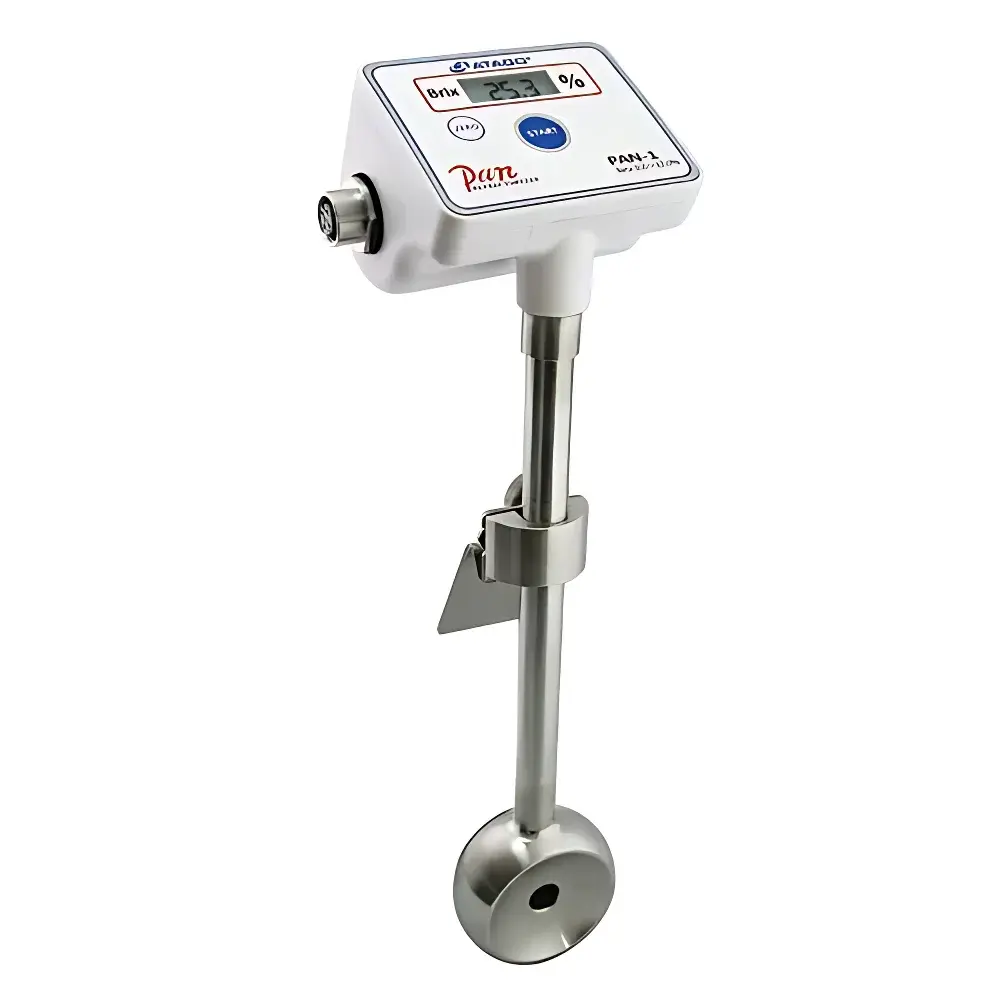
ATAGO PAN-1 DC Inline Refractometer
| Brand | ATAGO |
|---|---|
| Origin | Japan |
| Model | PAN-1 DC |
| Product Type | Inline Refractometer |
| Temperature Control | Yes |
| Digital Display | Yes |
| Measurement Range | Brix 0.0–42.0% |
| Measurement Accuracy | ±0.2% Brix, ±0.5°C Temperature |
| Resolution | 0.1% Brix, 0.1°C |
| Temperature Compensation Range | 10–95°C |
| Output Interface | RS-232C |
| Power Supply | DC 24 V |
| IP Rating | IP67 (sensor head), IP65 (display unit) |
| Dimensions (PAN-1 DC) | 8 × 30 × 7.2 cm |
| Weight (PAN-1 DC) | 680 g |
| Environmental Operating Temperature | 10–45°C |
| Power Consumption | 0.6 VA |
Overview
The ATAGO PAN-1 DC Inline Refractometer is an industrial-grade, immersion-type process refractometer engineered for continuous, real-time concentration monitoring of aqueous solutions in dynamic production environments. Based on the fundamental optical principle of critical angle refraction, the instrument measures the refractive index of a liquid sample and converts it into Brix concentration (%) with automatic temperature compensation (ATC) across 10–95°C. Designed specifically for integration into circulating coolant systems, metalworking fluid tanks, cleaning solution lines, and food & beverage processing streams, the PAN-1 DC delivers stable, high-reproducibility measurements without requiring sample extraction or manual intervention. Its compact, submersible sensor head—rated IP67 for dust-tight and water-immersion protection—mounts directly to tank rims or pipe flanges via a simple overhang configuration, enabling rapid deployment in space-constrained facilities.
Key Features
- True inline measurement architecture: No flow cells, bypass loops, or pressure-rated housings required—sensor operates in direct contact with process fluid.
- Automatic temperature compensation (ATC) using integrated Pt1000 thermistor ensures Brix accuracy remains within ±0.2% across the full operational temperature range (10–95°C).
- Fixed-interval sampling at 30-second intervals provides consistent temporal resolution for trend analysis and control loop feedback.
- Three interchangeable probe lengths (200 mm, 300 mm, 500 mm) accommodate varying tank depths and immersion requirements without recalibration.
- Low-power DC24V operation (0.6 VA) supports integration into existing plant power distribution systems with minimal electrical load impact.
- RS-232C serial output enables direct connection to PLCs, SCADA systems, or local data loggers for time-stamped Brix and temperature records.
- Dual digital display (Brix % and °C) with local readout eliminates dependency on external HMI interfaces during commissioning or maintenance.
Sample Compatibility & Compliance
The PAN-1 DC is validated for use with transparent to mildly turbid aqueous-based fluids including water-soluble cutting oils, alkaline cleaning agents, passivation baths, sugar syrups, fruit juice concentrates, and dairy process streams. It is not suitable for highly viscous, opaque, or solvent-based hydrocarbon fluids (e.g., straight mineral oils, kerosene). The device complies with IEC 60529 for ingress protection (IP67 sensor, IP65 display) and meets electromagnetic compatibility requirements per EN 61326-1 for industrial environments. While not certified to FDA 21 CFR Part 11 or GMP Annex 11 out-of-the-box, its deterministic measurement cycle, non-volatile internal logging (optional firmware upgrade), and RS-232C audit trail support validation protocols under ISO/IEC 17025 and ASTM D1218 (Standard Test Method for Refractive Index of Petroleum Products).
Software & Data Management
Data acquisition relies on standard ASCII protocol over RS-232C, transmitting timestamped Brix (%) and temperature (°C) values in fixed-field format. No proprietary software is required; raw output integrates natively with Modbus RTU gateways (via RS-232-to-Modbus converters), Siemens S7 PLCs, Rockwell Automation Logix platforms, or open-source tools such as Node-RED or Python-based data ingestion pipelines. Optional firmware upgrades enable configurable sampling intervals (10–120 s), min/max hold functions, and alarm thresholds with relay-triggered outputs (requires external relay module). All configuration parameters—including Brix calibration offset, ATC reference point, and display brightness—are retained through power cycles via EEPROM storage.
Applications
- Real-time control of coolant concentration in CNC machining centers to maintain optimal lubricity and corrosion inhibition.
- Automated dosing feedback for alkaline parts washers in automotive and aerospace manufacturing.
- In-line quality verification of syrup blending consistency prior to thermal processing in beverage plants.
- Monitoring of brine concentration in vegetable pickling and meat curing operations to ensure microbial safety compliance.
- Validation of detergent concentration in CIP (Clean-in-Place) return loops to confirm cleaning efficacy per ISO 15877.
- Process stability assessment during fermentation or enzymatic hydrolysis where soluble solids correlate with reaction progress.
FAQ
Does the PAN-1 DC require periodic recalibration?
Yes—ATAGO recommends annual calibration verification using NIST-traceable sucrose standards at two points within the 0–42% Brix range (e.g., 10% and 30%). Field recalibration is performed via the front-panel menu using the supplied calibration solution kit.
Can the sensor be installed in pressurized piping?
No—the PAN-1 DC is designed for open-tank or gravity-fed free-surface applications only. It is not rated for line pressure and must not be inserted into sealed, pressurized loops without mechanical isolation.
Is temperature measurement traceable to national standards?
The integrated Pt1000 sensor conforms to IEC 60751 Class B tolerance (±0.3°C at 0°C, ±0.8°C at 100°C); full metrological traceability requires third-party calibration against a certified dry-block calibrator.
What maintenance is required for long-term reliability?
Monthly visual inspection of the prism surface for deposits; cleaning with deionized water and lint-free cloth. In hard-water or high-mineral environments, weekly inspection is advised. Prism coating degradation is indicated by drift >±0.3% Brix between calibrations.
Can multiple PAN-1 DC units share one RS-232 port?
No—each unit requires a dedicated serial port or a multiplexer supporting addressable polling (e.g., ATAGO’s optional PAN-MUX controller). Daisy-chaining is not supported due to RS-232 point-to-point topology constraints.





