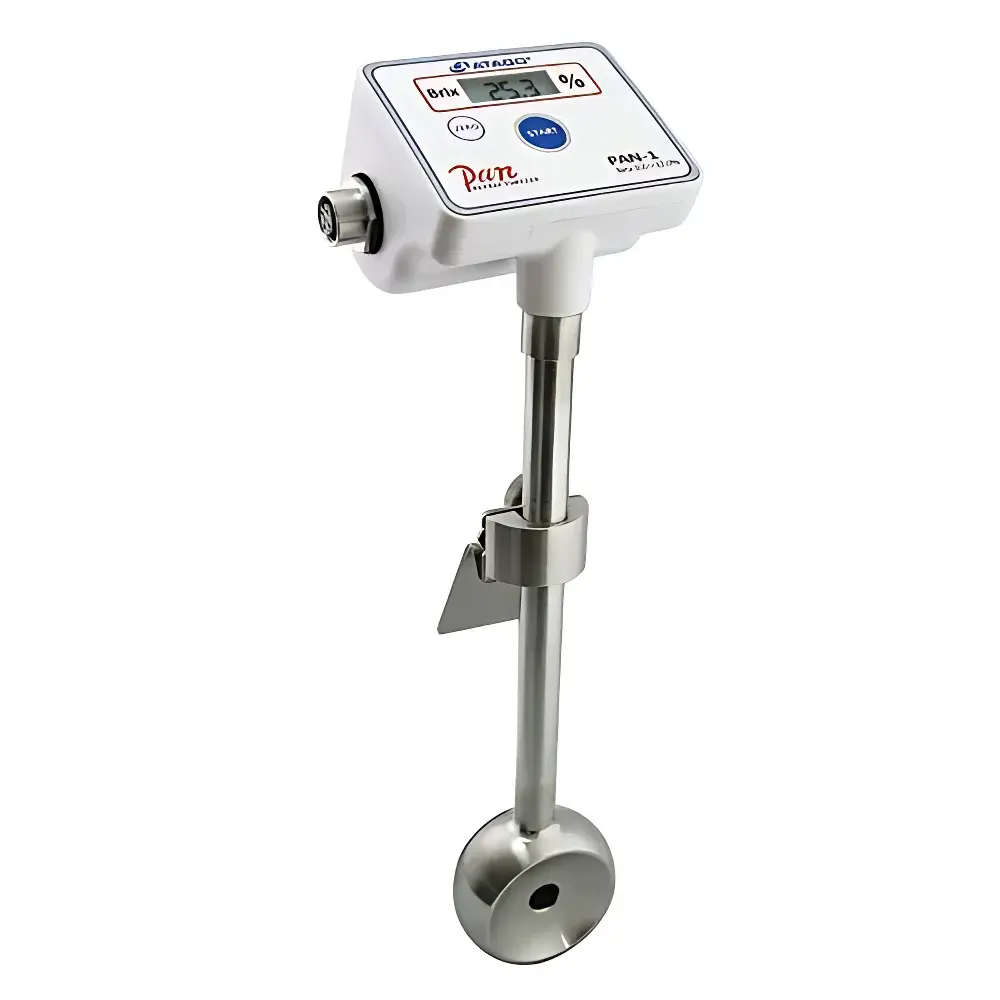
ATAGO PAN-1DC Immersion Digital Refractometer
| Brand | ATAGO |
|---|---|
| Origin | Japan |
| Model | PAN-1DC |
| Product Type | Immersion Refractometer |
| Display | Digital |
| Temperature Control | None |
| Brix Range | 0.0–42.0% |
| Temperature Range | 10.0–99.9°C |
| Brix Accuracy | ±0.2% |
| Temperature Accuracy | ±0.5°C |
| Brix Resolution | 0.1% |
| Temperature Resolution | 0.1°C |
| Temperature Compensation Range | 10.0–95.0°C |
| Output Interface | RS-232C (2400 bps, 8N1) |
| Power Supply | DC 24 V (±10%) |
| Power Consumption | 0.6 VA |
| IP Rating (Immersion Part) | IP67 |
| Housing Material (Wetted Parts) | SUS316L Stainless Steel |
| Dimensions (H×W×D) | 80×72×300 mm |
| Weight | 680 g (main unit only) |
| Cable Included | DC24V input + RS-232C output, standard length 2 m |
Overview
The ATAGO PAN-1DC Immersion Digital Refractometer is a fixed-mount, in-line process refractometer engineered for continuous, real-time monitoring of aqueous solution concentration—primarily expressed as Brix (% w/w sucrose equivalent)—in industrial tanks, mixing vessels, and piping systems. Based on the principle of critical-angle refractometry, the instrument measures the refractive index of the liquid in direct contact with its sapphire prism sensor, converting it to Brix values via built-in temperature-compensated calibration algorithms. Unlike handheld or benchtop refractometers, the PAN-1DC is designed for permanent installation: its immersion probe is sealed into the vessel wall or mounted directly onto the side of a tank, enabling unattended operation without sample extraction or operator intervention. The device operates within a wide process temperature range (10.0–99.9°C), with automatic temperature compensation applied across 10.0–95.0°C to ensure measurement stability under dynamic thermal conditions typical of food processing, beverage production, pharmaceutical manufacturing, and chemical synthesis.
Key Features
- Continuous, non-invasive concentration monitoring at 30-second measurement intervals—no manual sampling or recalibration required.
- IP67-rated immersion section constructed entirely from electropolished SUS316L stainless steel, ensuring corrosion resistance in aggressive media including acidic, alkaline, and high-sugar solutions.
- Digital display integrated into the main unit housing, showing real-time Brix and temperature readings with 0.1% and 0.1°C resolution respectively.
- DC 24 V power supply (±10% tolerance) eliminates battery dependency; suitable for integration into plant-wide DC control infrastructure.
- RS-232C serial interface compliant with industry-standard communication protocols (2400 bps, 8 data bits, no parity, 1 stop bit) for seamless connection to PLCs, SCADA systems, or data loggers.
- Customizable immersion rod length (10–120 cm) to accommodate varying tank depths and mounting configurations—engineered for mechanical stability and optical alignment integrity.
- Robust mechanical design optimized for vibration resistance and long-term reliability in continuous 24/7 operation environments.
Sample Compatibility & Compliance
The PAN-1DC is validated for use with homogeneous, optically clear to mildly turbid aqueous solutions where suspended solids do not obstruct the light path to the sapphire prism. It is widely deployed in applications involving sugar syrups, fruit juices, dairy concentrates, fermentation broths, cleaning-in-place (CIP) rinse water, and industrial electrolytes. While not certified to ISO/IEC 17025 for metrological traceability, the instrument conforms to general industrial instrumentation requirements under IEC 61000-6-2 (EMC immunity) and IEC 61000-6-4 (EMC emissions). Its materials of construction comply with FDA 21 CFR §177.2400 for repeated-use food-contact surfaces. For regulated environments, the RS-232C output supports audit-ready data capture when interfaced with validated data acquisition software meeting 21 CFR Part 11 requirements (e.g., electronic signatures, audit trails, and data integrity controls).
Software & Data Management
The PAN-1DC transmits ASCII-formatted data strings (e.g., “20.3,19.5”) representing temperature (°C) and Brix (%) values, separated by a comma. This simple, deterministic protocol ensures compatibility with legacy and modern industrial control systems without proprietary drivers. When connected to a host PC or edge controller, raw measurements can be logged at user-defined intervals, plotted in time-series format, and exported to CSV for statistical process control (SPC) analysis. Integration with MES or LIMS platforms is achievable through OPC UA or Modbus RTU gateways using RS-232-to-serial converters. No embedded firmware updates or cloud connectivity are supported—consistent with GMP-aligned instrumentation principles emphasizing validation stability and change control.
Applications
- Real-time Brix control during evaporation, blending, and dilution stages in juice concentrate and syrup manufacturing.
- Concentration trending in bioreactor feed streams and harvest buffers to maintain optimal nutrient or substrate levels.
- Monitoring CIP solution strength to verify detergent concentration and rinse efficacy prior to product contact.
- In-line verification of glycol-based coolant concentration in HVAC and process cooling loops.
- Batch consistency validation in confectionery and jam production lines where sugar content directly affects texture and shelf life.
- Process deviation detection in wastewater treatment influent streams containing dissolved organics.
FAQ
Is the PAN-1DC suitable for measuring highly viscous or particulate-laden solutions?
No. The instrument requires optical clarity at the prism-liquid interface; suspended solids, air bubbles, or heavy viscosity that impedes stable contact will compromise accuracy and repeatability.
Can the device be calibrated in situ without removal from the tank?
Yes—using standard sucrose reference solutions (e.g., 10.00%, 20.00%, and 30.00% Brix) introduced temporarily into the vessel, followed by two-point calibration via front-panel menu navigation.
What is the maximum allowable pressure on the immersion probe?
The PAN-1DC is rated for static hydrostatic pressure only; it is not designed for pressurized pipeline service. Maximum recommended depth is 2 meters of water column (≈0.02 MPa) unless custom pressure-rated housings are specified.
Does the unit support automatic temperature compensation for non-sucrose solutions?
No—the built-in compensation algorithm is optimized for sucrose-water systems. For other solutes (e.g., NaCl, ethanol), users must apply empirical correction factors or perform solution-specific calibration.
Is the RS-232C output compatible with USB-to-serial adapters?
Yes—standard FTDI- or CH340-based adapters work reliably, provided driver installation and COM port configuration align with the specified 2400 bps / 8N1 settings.