
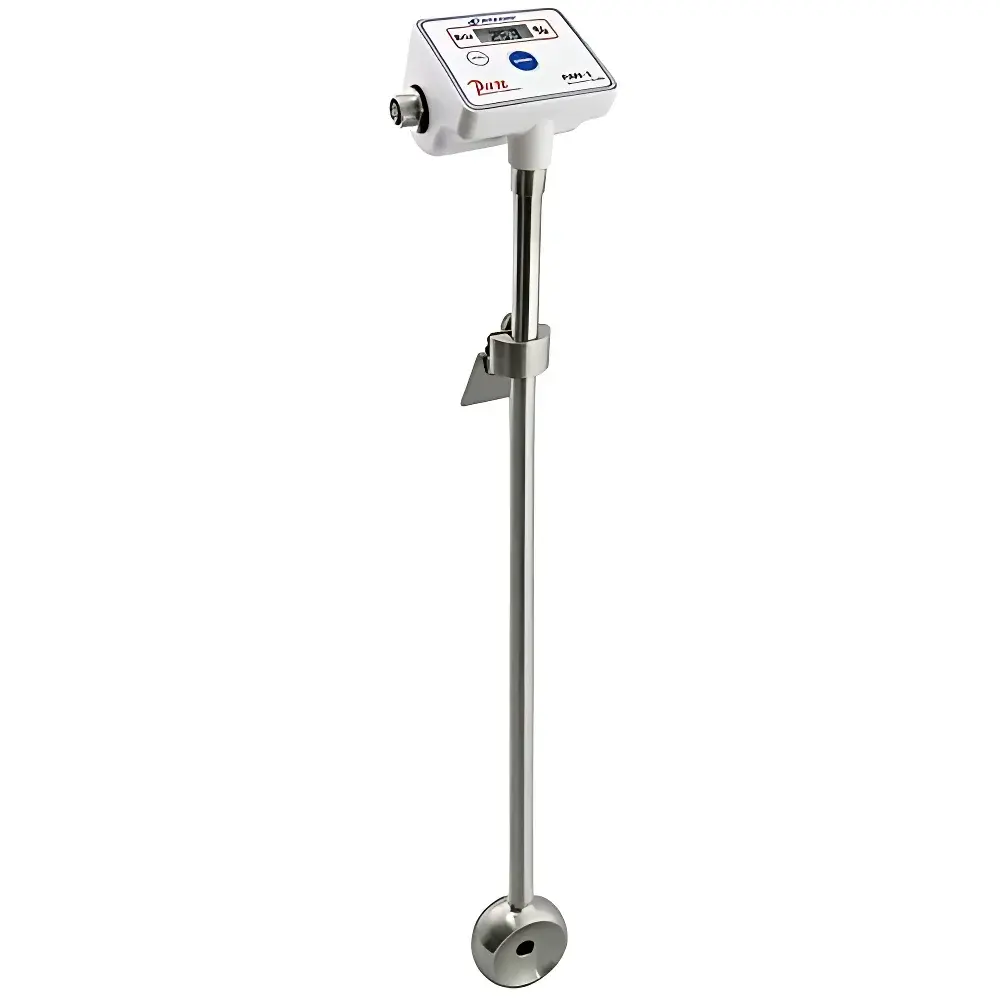
ATAGO PAN-1DC(L) Immersion Digital Refractometer
| Brand | ATAGO |
|---|---|
| Origin | Japan |
| Model | PAN-1DC(L) |
| Product Type | Handheld Immersion Refractometer |
| Temperature Control | None |
| Digital Display | Yes |
| Measurement Range | Brix: 0.0–42.0% |
| Temperature | 10.0–99.9°C |
| Accuracy | Brix: ±0.2% |
| Temperature | ±0.5°C |
| Resolution | Brix: 0.1% |
| Temperature | 0.1°C |
| Temperature Compensation Range | 10.0–95.0°C |
| Environmental Operating Temperature | 10–45°C |
| Output Interface | RS-232C (2400 bps, 8N1, no parity) |
| Power Supply | DC 24 V (±10%) |
| Power Consumption | 0.6 VA |
| IP Rating (immersed portion) | IP67 |
| Probe Length | 500 mm (customizable from 100 mm to 1200 mm) |
| Dimensions (H×W×D) | 80 × 72 × 600 mm |
| Weight | 780 g (main unit only) |
| Sample Cell Material | SUS316L stainless steel |
Overview
The ATAGO PAN-1DC(L) Immersion Digital Refractometer is a precision-engineered inline process monitoring instrument designed for continuous, real-time measurement of refractive index–derived Brix concentration in liquid solutions across industrial food, beverage, chemical, and pharmaceutical production environments. Operating on the principle of critical-angle refractometry, the device measures the angle at which light transitions between the sample medium and an internal sapphire prism, converting the resulting refractive index into a calibrated Brix value (% w/w sucrose equivalent) with temperature-compensated accuracy. Its extended 500 mm immersion probe—constructed entirely from corrosion-resistant SUS316L stainless steel—enables reliable deployment in deep tanks, reactors, and open-channel flow systems where conventional handheld or benchtop refractometers cannot reach. Unlike optical sensors requiring frequent recalibration or optical windows prone to fouling, the PAN-1DC(L) features a robust, maintenance-minimized architecture with an IP67-rated submerged section, ensuring long-term stability under continuous wet operation.
Key Features
- Fixed 500 mm immersion probe length—customizable from 100 mm to 1200 mm to match vessel geometry and installation requirements
- Real-time digital readout updated every 35 seconds, enabling dynamic tracking of concentration drift during batch processing or continuous flow
- Integrated dual-sensor measurement: simultaneous Brix (0.0–42.0%) and temperature (10.0–99.9°C) acquisition with automatic temperature compensation (10.0–95.0°C range)
- SUS316L stainless steel sample contact surface—resistant to acidic, alkaline, and high-sugar media; compliant with FDA-recommended materials for food-contact applications
- RS-232C serial interface supporting standardized ASCII data output (e.g., “20.3,19.5” for temperature,Brix), compatible with SCADA, DCS, and LIMS platforms
- Low-power DC 24 V operation (±10% tolerance) with 0.6 VA consumption—suitable for integration into existing plant power distribution systems
- No moving parts or consumables; no optical alignment required; minimal routine verification needed per ISO 21527-1 and ASTM D1218 guidelines
Sample Compatibility & Compliance
The PAN-1DC(L) is validated for use with aqueous sugar solutions (e.g., sucrose, glucose, fructose syrups), fruit juice concentrates, dairy whey streams, caustic cleaning solutions (CIP), and mild organic solvent mixtures within its specified Brix and temperature operating envelope. It is not intended for highly viscous, particulate-laden, or strongly UV-absorbing media without prior validation. The instrument meets IEC 60529 for IP67 ingress protection on the immersed probe section and conforms to electromagnetic compatibility requirements per EN 61326-1 for industrial environments. While not intrinsically safe, it may be installed in non-hazardous zones (Zone 2 / Class I, Division 2) when powered via appropriately isolated DC supplies. Documentation supports traceable calibration against NIST-traceable sucrose standards and satisfies foundational data integrity expectations aligned with ALCOA+ principles for GMP-relevant process analytical technology (PAT) applications.
Software & Data Management
Data output follows a fixed ASCII protocol over RS-232C: two comma-separated numeric values representing temperature (°C) and Brix (%), transmitted at 2400 bps (8N1, no parity). No proprietary software is required; raw output integrates natively with LabVIEW, MATLAB, Ignition SCADA, or custom Python-based logging systems using standard serial libraries. For regulated environments, users may implement audit-trail-capable middleware to record timestamps, operator IDs, and configuration changes—supporting compliance with FDA 21 CFR Part 11 where electronic records are subject to review. ATAGO provides factory calibration certificates with uncertainty budgets (k=2) and recommends annual verification against certified reference materials per ISO/IEC 17025-accredited laboratories.
Applications
- Continuous Brix monitoring in evaporator feed/effluent lines for juice concentration control
- In-process verification of syrup blending consistency in confectionery and soft drink manufacturing
- Real-time tracking of sugar recovery efficiency in beet and cane sugar refineries
- Concentration profiling during CIP cycle validation (e.g., NaOH or HNO₃ titration endpoints)
- Stability assessment of fermentation broths in bioethanol or amino acid production
- Quality gate checks for incoming raw material lots (e.g., corn syrup, invert sugar) prior to formulation
FAQ
Can the PAN-1DC(L) be used in pressurized pipelines?
No—it is rated for open-tank or atmospheric-pressure immersion only. Pressure-rated variants require mechanical redesign and are not covered under this model designation.
Is automatic temperature compensation (ATC) adjustable by the user?
ATC is factory-configured to the standard sucrose/water calibration curve per ISO 21527-2; no user adjustment is provided. Custom curves require firmware modification by ATAGO service centers.
What is the minimum sample flow velocity required for stable readings?
The sensor does not require flow; static immersion yields stable results. However, laminar flow >0.1 m/s helps prevent localized boundary-layer stratification in low-conductivity media.
Does the unit support Modbus RTU or analog 4–20 mA output?
No—only RS-232C digital output is available. Protocol conversion to Modbus or analog signals requires external gateway hardware.
How often should calibration verification be performed?
Daily verification with a certified 10.00% and 30.00% Brix standard is recommended for critical processes; weekly verification suffices for general monitoring per ISO 5725-2 repeatability guidance.



