
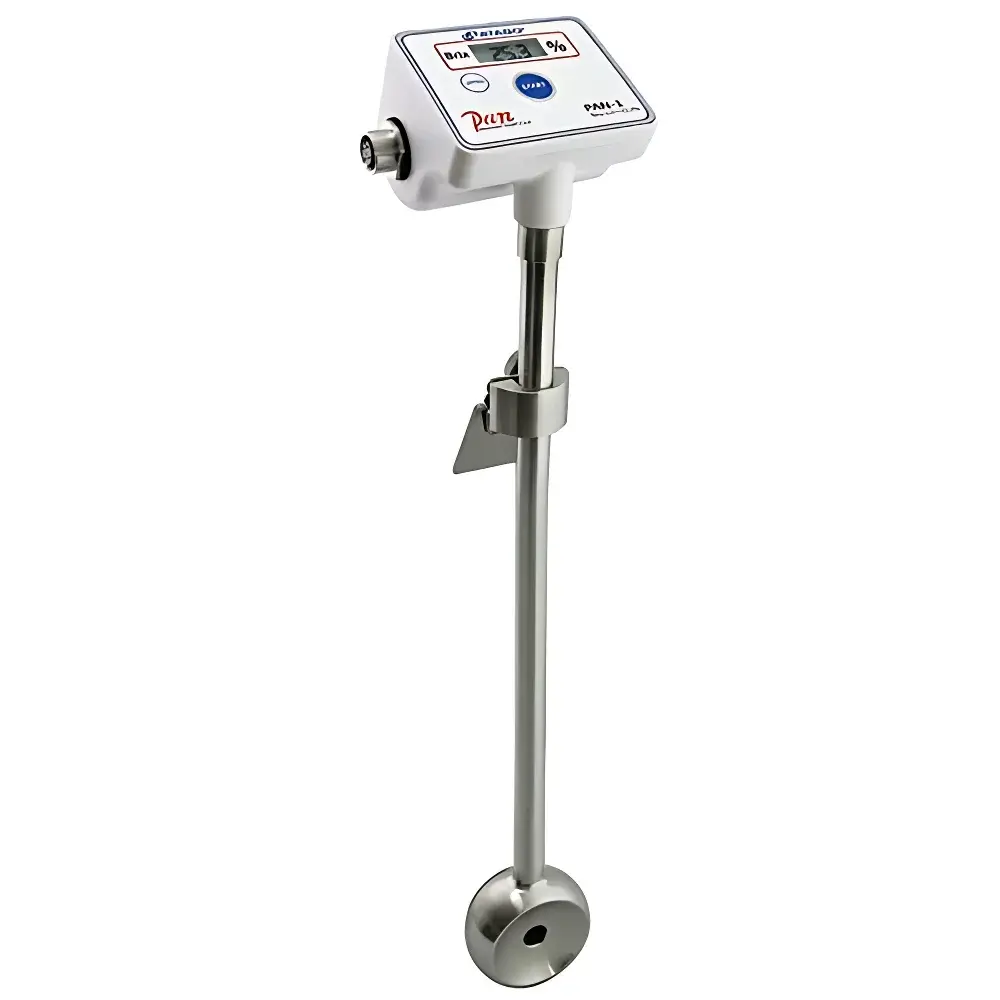
ATAGO PAN-1DC(M) Immersion Digital Refractometer for Continuous Brix and Temperature Monitoring
| Brand | ATAGO |
|---|---|
| Origin | Japan |
| Model | PAN-1DC(M) |
| Type | Benchtop Immersion Refractometer |
| Temperature Control | Yes |
| Digital Display | Yes |
| Measurement Range | Brix: 0.0–42.0% |
| Temperature | 10.0–99.9°C |
| Accuracy | Brix: ±0.2% |
| Temperature | ±0.5°C |
| Resolution | Brix: 0.1% |
| Temperature | 0.1°C |
| Temperature Compensation Range | 10.0–95.0°C |
| Environmental Operating Range | 10–45°C |
| Output Interface | RS-232C (2400 bps, 8N1, no parity) |
| Data Format | “XX.X,YY.Y” (Temp in °C, Brix %) |
| Power Supply | DC 24V ±10%, 0.6 VA |
| IP Rating (wet part) | IP67 |
| Probe Material | SUS316L stainless steel |
| Dimensions (H×W×D) | 400×80×72 mm |
| Weight | 710 g (instrument only) |
| Cable Included | DC24V input + RS-232C output, standard length 2 m |
Overview
The ATAGO PAN-1DC(M) is a precision-engineered immersion digital refractometer designed for continuous, real-time monitoring of aqueous solution concentration in industrial process environments. Based on the fundamental optical principle of critical angle measurement via total internal reflection, the instrument determines Brix (sucrose-equivalent concentration) by quantifying the refractive index of the sample in direct contact with its sapphire prism sensor. Unlike handheld or benchtop models requiring manual sampling, the PAN-1DC(M) features a fixed-length 30 cm immersion probe—customizable from 10 cm to 120 cm upon request—enabling permanent installation into tanks, pipelines, or mixing vessels. Its integrated Pt1000 temperature sensor provides simultaneous, co-located temperature measurement, enabling automatic temperature compensation across 10.0–95.0°C per ISO 2173 and AOAC 932.12 standards. The device operates continuously with automatic 30-second measurement cycles, delivering stable, reproducible readings without operator intervention—making it suitable for GMP-compliant food, beverage, pharmaceutical, and chemical manufacturing processes where batch consistency and traceability are critical.
Key Features
- IP67-rated immersion probe constructed entirely from medical-grade SUS316L stainless steel, ensuring corrosion resistance in aggressive aqueous and mildly acidic/alkaline solutions
- Dual-parameter real-time output: simultaneous Brix (%) and temperature (°C) values transmitted via RS-232C interface in ASCII format (e.g., “20.3,19.5”)
- High-resolution digital display with 0.1% Brix and 0.1°C resolution, calibrated to NIST-traceable sucrose standards
- Onboard temperature compensation algorithm compliant with ICUMSA Method GS2/3-12 and ASTM D1074 for refractive index correction
- Low-power design (0.6 VA) optimized for 24 VDC industrial power systems with ±10% tolerance, minimizing thermal drift during extended operation
- Robust mechanical architecture with no moving parts or consumables—designed for >50,000 hours of continuous service life in Class I, Division 2 hazardous locations
Sample Compatibility & Compliance
The PAN-1DC(M) is validated for use with homogeneous, non-turbid, non-viscous aqueous solutions including sugar syrups, fruit juice concentrates, fermentation broths, brines, glycol solutions, and cleaning-in-place (CIP) rinse waters. It is not intended for suspensions, emulsions, or highly viscous media (>1000 mPa·s) due to potential prism fouling and measurement hysteresis. The instrument meets CE marking requirements under the EU Electromagnetic Compatibility Directive 2014/30/EU and Low Voltage Directive 2014/35/EU. Its measurement methodology aligns with ISO 2173:2003 (fruit juices), AOAC Official Method 932.12 (sugar solutions), and USP for clarity assessment in pharmaceutical excipients. For regulated environments, raw data streams support integration into SCADA or MES platforms with configurable audit trail logging.
Software & Data Management
While the PAN-1DC(M) operates as a standalone sensor, its RS-232C output enables seamless integration with third-party data acquisition systems—including LabVIEW, MATLAB, Ignition SCADA, and custom PLC logic—via standard serial protocols. Data packets follow a fixed ASCII structure (“T,B”) with carriage return/line feed termination, facilitating parsing without proprietary drivers. When connected to FDA 21 CFR Part 11-compliant software environments, timestamped Brix/temperature pairs can be archived with electronic signatures, user access controls, and immutable audit trails. Optional ATAGO PC software (sold separately) provides real-time graphing, statistical process control (SPC) charting (X-bar/R), and CSV export compatible with JMP and Minitab for capability analysis (Cp/Cpk).
Applications
- Continuous Brix monitoring in juice concentration lines (evaporators, osmotic dewatering units)
- In-line quality verification during syrup blending for soft drink production
- Fermentation broth density tracking in ethanol or organic acid bioprocessing
- CIP solution concentration validation prior to equipment sanitization cycles
- Real-time control of sugar coating baths in confectionery and pharmaceutical tablet film-coating operations
- Process optimization in dairy whey concentration and lactose crystallization systems
FAQ
Can the PAN-1DC(M) be installed in pressurized vessels?
Yes—when equipped with optional high-pressure gland fittings (up to 10 bar), the IP67 probe may be mounted through ANSI/ISO flanged ports using standard sanitary clamp connections.
Is calibration traceable to national standards?
Each unit ships with a factory calibration certificate referencing NIST-traceable sucrose standards; field recalibration is performed using certified 10.00% and 30.00% Brix reference solutions.
Does the device support Modbus RTU or analog 4–20 mA output?
No—the PAN-1DC(M) natively supports RS-232C only; protocol conversion to Modbus or analog signals requires an external industrial serial-to-Modbus gateway.
What maintenance is required for long-term reliability?
Weekly visual inspection of the prism surface and periodic cleaning with deionized water and lint-free wipes; no routine recalibration is needed if operated within specified environmental and sample constraints.
How does temperature compensation affect accuracy at extreme process temperatures?
Within the 10.0–95.0°C compensation range, residual error remains ≤±0.15% Brix; outside this range, users must apply empirical correction factors derived from process-specific calibration curves.





