
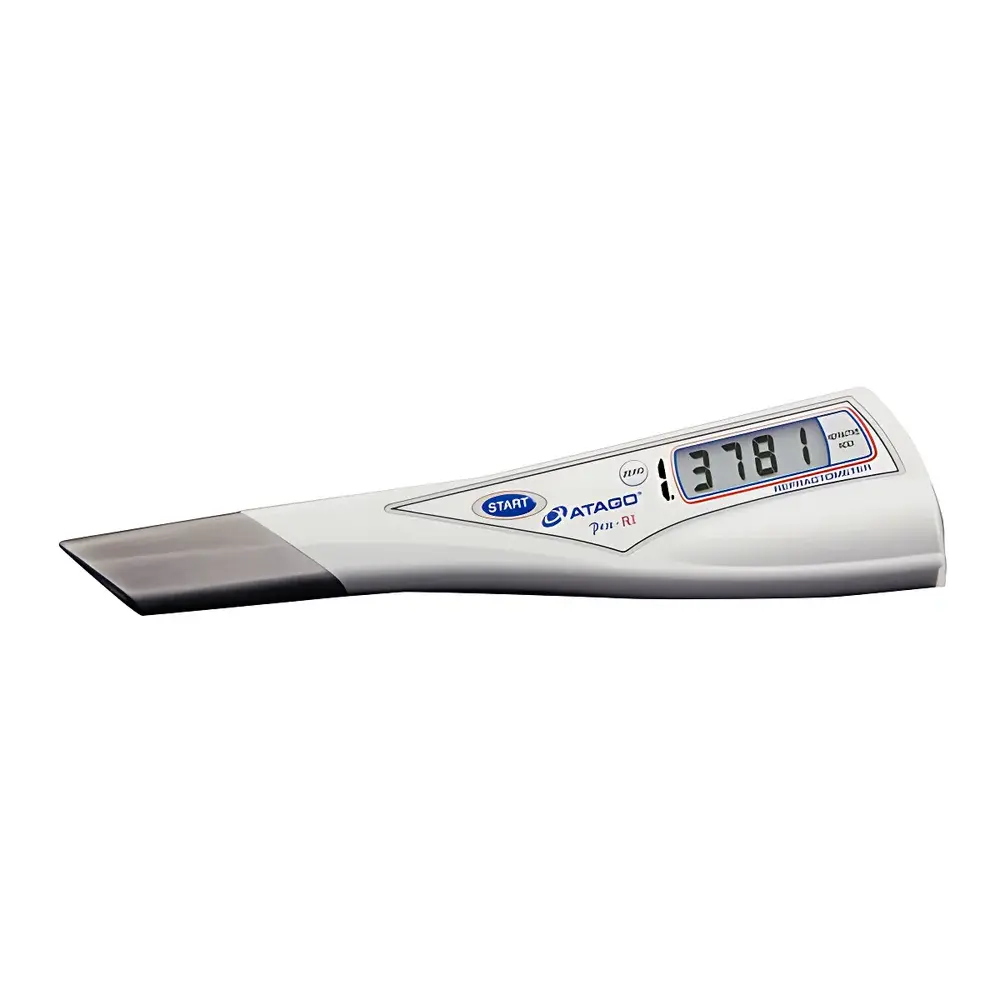
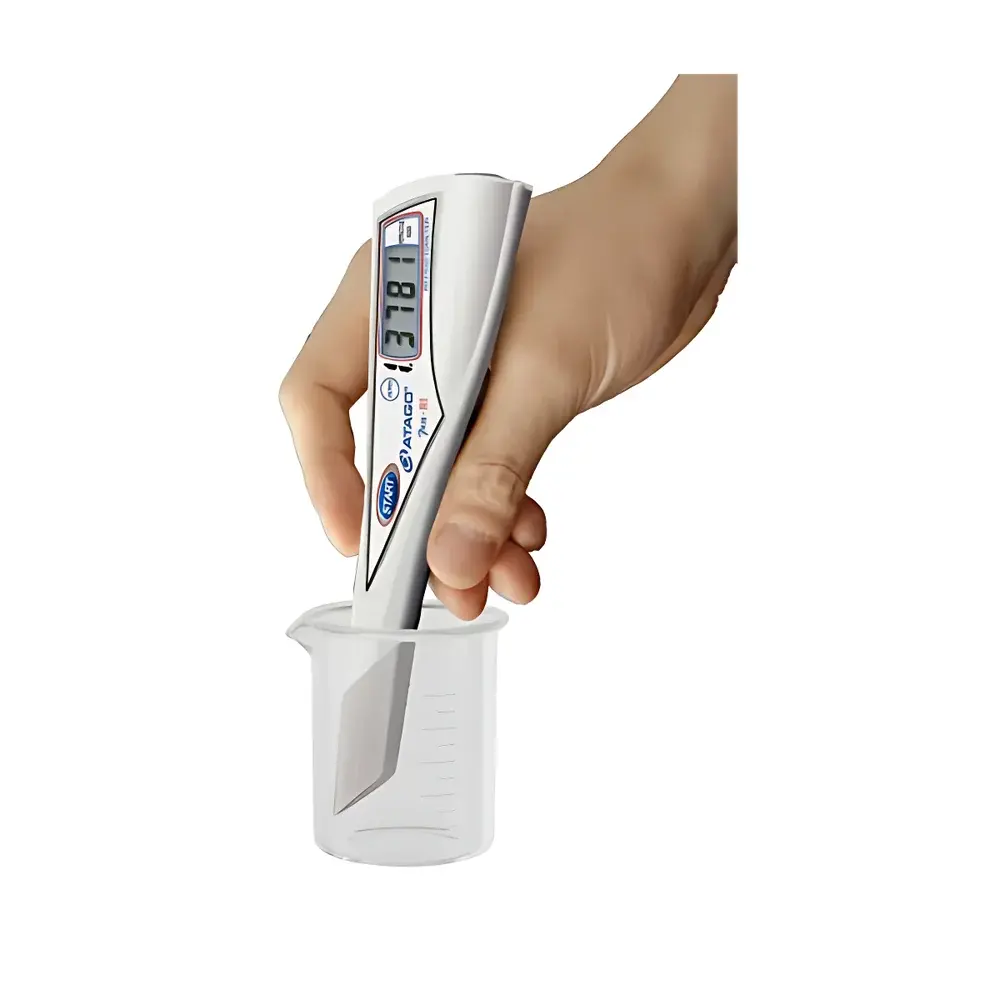
ATAGO PEN-RI Digital Pocket Refractometer
| Brand | ATAGO |
|---|---|
| Origin | Japan |
| Model | PEN-RI |
| Product Type | Handheld Refractometer |
| Temperature Control | Yes |
| Digital Display | Yes |
| Refractive Index Range | 1.3200 to 1.5100 |
| Resolution | 0.0001 RI / 1 °C |
| Accuracy | ±0.0003 RI (water at 20 °C) |
| Temperature Accuracy | ±1 °C |
| Measurement Temp Range | 10 to 100 °C |
| Ambient Temp Range | 10 to 40 °C |
| IP Rating | IP65 (prism: IP67) |
| Measurement Time | 2 seconds |
| Dimensions | 16(W) × 3.8(D) × 1.8(H) cm |
| Weight | 70 g (without battery) |
| Power | 1 × AAA alkaline battery |
Overview
The ATAGO PEN-RI Digital Pocket Refractometer is a compact, precision-engineered optical instrument designed for rapid, field-deployable refractive index measurements across laboratory, industrial, and quality control environments. Based on the fundamental principle of total internal reflection at the prism-sample interface, the PEN-RI determines refractive index (nD) by analyzing the critical angle shift induced by sample contact with a high-stability sapphire-coated glass prism. Its solid-state optical path eliminates moving parts, ensuring long-term calibration stability and resistance to mechanical shock. Unlike traditional Abbe refractometers, the PEN-RI integrates real-time temperature compensation via an embedded platinum resistance thermometer (PT1000), enabling accurate nD readings across a wide operational temperature range (10–100 °C). This makes it particularly suitable for applications requiring in-process verification—such as monitoring concentration gradients in hot syrup lines, verifying coolant formulations during machining, or assessing solvent purity in pharmaceutical cleanrooms—without necessitating sample cooling or ambient equilibration.
Key Features
- High-resolution digital display with 0.0001 refractive index resolution and 1 °C temperature resolution
- Integrated temperature sensor with automatic compensation (ATC) compliant with ISO 21748 and ASTM D1218 standards
- Rugged, ergonomic pen-style housing rated IP65 (IP67 for prism assembly), certified for dust-tight operation and resistance to low-pressure water jets
- Two-second measurement cycle with auto-hold function, minimizing operator variability and throughput bottlenecks
- Calibration traceable to NIST-traceable reference fluids; factory-calibrated using distilled water at 20 °C (nD = 1.3330)
- Battery-powered operation (1 × AAA alkaline) supporting >5,000 measurements per set, with low-battery indicator and auto-power-off after 3 minutes of inactivity
Sample Compatibility & Compliance
The PEN-RI accepts liquid, semi-liquid, and homogeneous viscous samples—including aqueous solutions, oils, glycols, organic solvents, and polymer melts—with minimal volume requirement (0.3 mL). Its sapphire-coated prism resists chemical corrosion from acids (pH ≥ 2), alkalis (pH ≤ 12), and common organic solvents, extending service life in aggressive industrial settings. The device complies with IEC 61000-4 electromagnetic compatibility standards and meets RoHS Directive 2011/65/EU requirements. While not intrinsically safe for Zone 0/1 hazardous areas, its low-power design and sealed construction support use in classified environments under appropriate risk assessment (e.g., ATEX Category 3G). Data integrity aligns with GLP/GMP documentation expectations: all measurements include timestamped temperature and RI values, supporting audit-ready recordkeeping when paired with external logging software.
Software & Data Management
The PEN-RI operates as a standalone instrument without proprietary software dependency. However, its RS-232 serial output (via optional adapter cable) enables direct integration with LIMS, SCADA, or Excel-based QA databases. When connected, it transmits ASCII-formatted data packets containing RI value, temperature reading, measurement timestamp, and instrument ID—structured to comply with ASTM E2500-19 Annex A3 for instrument data export. No firmware updates are required during normal operation; calibration constants are stored in non-volatile memory with write-protection to prevent accidental modification. For regulated environments, the device supports 21 CFR Part 11-compliant workflows when used with validated third-party data acquisition systems that enforce electronic signatures, audit trails, and user access controls.
Applications
- Food & Beverage: Brix estimation in fruit juices, honey, and syrups; ethanol content screening in fermented beverages
- Chemical Manufacturing: Glycol concentration verification in heat transfer fluids; acid/base titration endpoint confirmation
- Pharmaceuticals: Excipient concentration checks in liquid dosage forms; solvent recovery validation in API synthesis
- Automotive: Coolant freeze-point determination; brake fluid moisture content estimation (via RI correlation)
- Academic Research: Rapid screening of colloidal dispersion stability; refractive index matching in microscopy sample preparation
FAQ
What is the calibration procedure for the PEN-RI?
Calibration is performed using distilled water at 20 °C (nD = 1.3330) or certified reference standards traceable to NIST SRM 1484. The two-point calibration option (available via service mode) accommodates extended-range verification.
Can the PEN-RI measure opaque or turbid samples?
No. It requires optically clear or translucent samples; suspended particles or air bubbles will scatter light and invalidate the critical angle detection.
Is temperature compensation linear across the full 10–100 °C range?
Yes. Compensation uses a fifth-order polynomial algorithm derived from ATAGO’s proprietary refractive index–temperature database for >200 common liquids, ensuring <±0.0002 RI deviation from reference values.
How often should recalibration be performed?
Daily verification with water is recommended for QC-critical applications; full recalibration every 3 months or after exposure to thermal shock or mechanical impact.
Does the IP67 rating apply to submersion in cleaning agents?
The prism assembly is rated IP67 for freshwater immersion up to 1 m for 30 minutes; prolonged exposure to chlorinated or caustic cleaning solutions may degrade the O-ring seal and is not covered under warranty.






