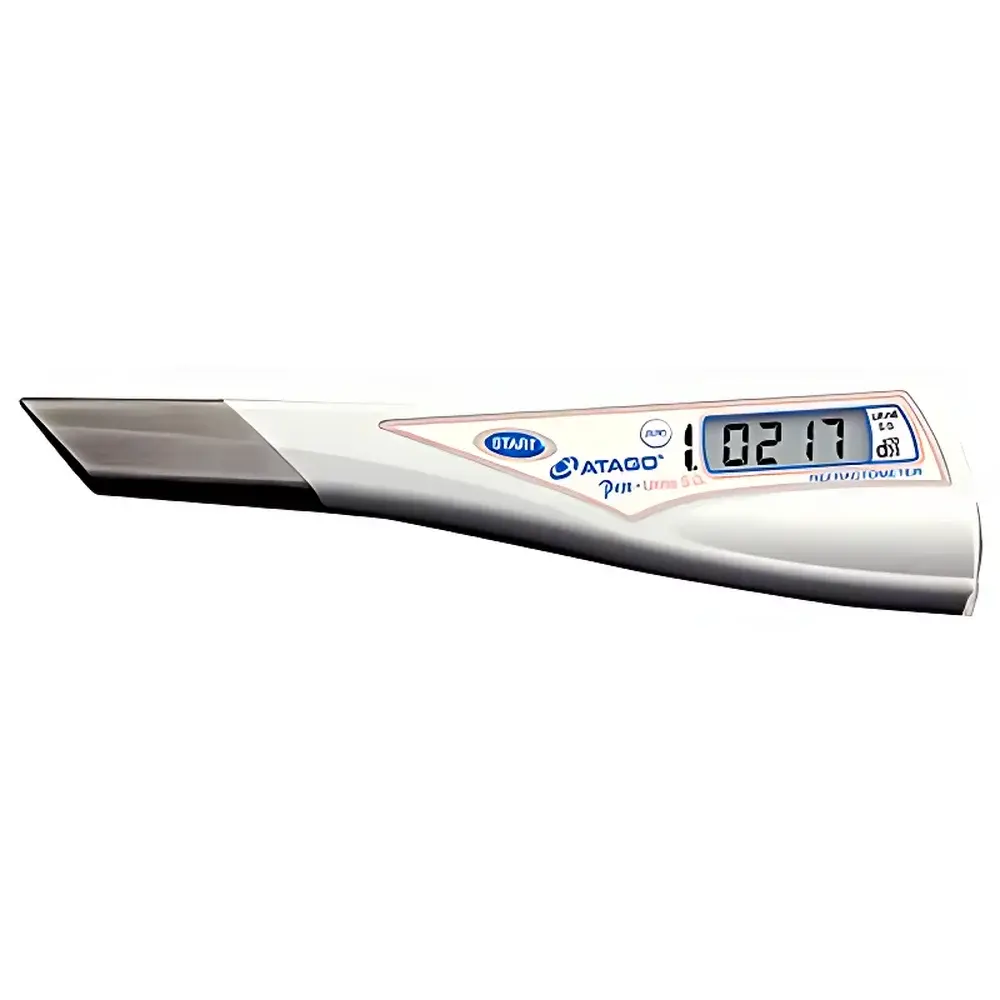
ATAGO PEN-URINE S.G. Digital Pocket Refractometer for Urine Specific Gravity
| Origin | Japan |
|---|---|
| Manufacturer Type | Authorized Distributor |
| Origin Category | Imported |
| Model | PEN-URINE S.G. |
| Price | Upon Request |
| Measurement Range | 1.0000–1.0600 (Urine Specific Gravity) |
| Resolution | 0.0001 |
| Accuracy | ±0.0010 |
| Ambient Operating Temperature | 10–40°C |
| Sample Volume | 0.3 mL |
| Power Supply | 1 × AAA Alkaline Battery |
| Measurement Time | 2 seconds |
| IP Rating | IP65 (Instrument Body), IP67 (Prism Housing) |
| Dimensions | 16(W) × 38(D) × 18(H) mm |
| Weight | 70 g (without accessories) |
Overview
The ATAGO PEN-URINE S.G. is a compact, handheld digital refractometer engineered specifically for rapid, on-site measurement of urine specific gravity (USG) in clinical, point-of-care, and veterinary settings. It operates on the principle of critical-angle refractometry: light passing through a urine sample undergoes refraction at the prism-sample interface, and the instrument calculates specific gravity by detecting the resulting shadow line position on an internal photodiode array. The device features built-in automatic temperature compensation (ATC) across the full operational range (10–40°C), eliminating manual correction and ensuring consistent readings regardless of ambient or sample temperature fluctuations. Designed for high reproducibility and minimal operator dependency, the PEN-URINE S.G. delivers quantitative USG data in under two seconds with a resolution of 0.0001 and accuracy of ±0.0010 — meeting performance expectations aligned with CLIA-waived testing requirements and supporting routine renal function assessment, hydration status evaluation, and urinalysis workflow integration.
Key Features
- Dual-mode operation: Initiate measurement either before or after sample contact — optimized for both sterile technique compliance and workflow efficiency.
- IP65-rated housing with IP67-protected optical prism ensures resistance to dust ingress and brief water immersion, suitable for use in busy clinical labs, emergency departments, and field-based veterinary clinics.
- Ultra-low sample volume requirement (0.3 mL) minimizes waste and enables analysis from micro-samples, including pediatric or catheterized specimens.
- Real-time digital display with backlight enhances readability under variable lighting conditions, including low-light triage environments.
- Compact form factor (16 × 38 × 18 mm) and lightweight construction (70 g) support single-handed operation and portability across multiple patient care locations.
- Energy-efficient design powered by a single AAA alkaline battery, providing >5,000 measurements per charge under typical usage conditions.
Sample Compatibility & Compliance
The PEN-URINE S.G. is calibrated and validated exclusively for human and animal urine matrices. It is not intended for use with viscous, turbid, or highly pigmented samples without prior centrifugation or filtration. The instrument complies with ISO 15197:2013 for in vitro diagnostic medical devices regarding measurement reliability and user safety. Its design supports adherence to Good Laboratory Practice (GLP) documentation standards when integrated into laboratory quality management systems. While classified as a CLIA-waived device in the U.S., users must verify local regulatory classification (e.g., CE-IVDR Class A, MDR Annex XVI) and maintain calibration verification logs per institutional QA protocols. No reagents, consumables, or software updates are required for basic operation — reducing long-term cost of ownership and maintenance complexity.
Software & Data Management
The PEN-URINE S.G. operates as a standalone, firmware-embedded instrument with no onboard data storage or wireless connectivity. All measurements are displayed in real time and must be manually recorded or transcribed into electronic health records (EHR), laboratory information systems (LIS), or paper-based logbooks. For institutions requiring audit trails, the device supports external documentation workflows compliant with FDA 21 CFR Part 11 when paired with validated data capture platforms (e.g., barcode-linked mobile apps or dedicated LIS interfaces). Calibration verification can be performed using certified reference solutions traceable to NIST SRM 1821 (urine simulant), and results may be archived as part of internal QC documentation per CAP or COLA accreditation requirements.
Applications
- Routine assessment of renal concentrating ability in outpatient and inpatient settings.
- Hydration status monitoring in sports medicine, geriatric care, and preoperative evaluation.
- Supporting differential diagnosis in cases of polyuria, oliguria, or suspected diabetes insipidus.
- Veterinary diagnostics for small-animal practitioners evaluating kidney disease or endocrine disorders.
- Quality control checks during urine dipstick interpretation to resolve ambiguous SG readings.
- Field deployment in mobile health units, disaster response teams, and resource-limited environments where benchtop analyzers are impractical.
FAQ
What is the calibration procedure for the PEN-URINE S.G.?
Calibration is performed using distilled water (target value: 1.0000) or a certified urine-specific gravity standard solution. Press and hold the CAL button for 3 seconds until “CAL” appears; apply the standard to the prism, close the cover, and confirm when the display stabilizes.
Can this instrument measure other parameters such as pH or protein concentration?
No — the PEN-URINE S.G. is dedicated solely to specific gravity measurement via refractometry. It does not incorporate electrochemical, enzymatic, or optical absorption sensing for additional analytes.
Is temperature compensation truly automatic and fully compensated across the entire range?
Yes — an integrated thermistor continuously monitors sample temperature at the prism surface and applies real-time correction using ATAGO’s proprietary algorithm, validated between 10°C and 40°C.
How often should the prism be cleaned, and what cleaning agents are recommended?
Clean the prism immediately after each use with lens tissue and distilled water or 70% isopropyl alcohol. Avoid abrasive materials or acetone, which may damage the anti-reflective coating.
Does the device require periodic factory recalibration?
While not mandatory, ATAGO recommends annual verification against traceable standards in accordance with ISO/IEC 17025-accredited laboratories, especially in regulated clinical environments subject to CAP or JCI audits.