
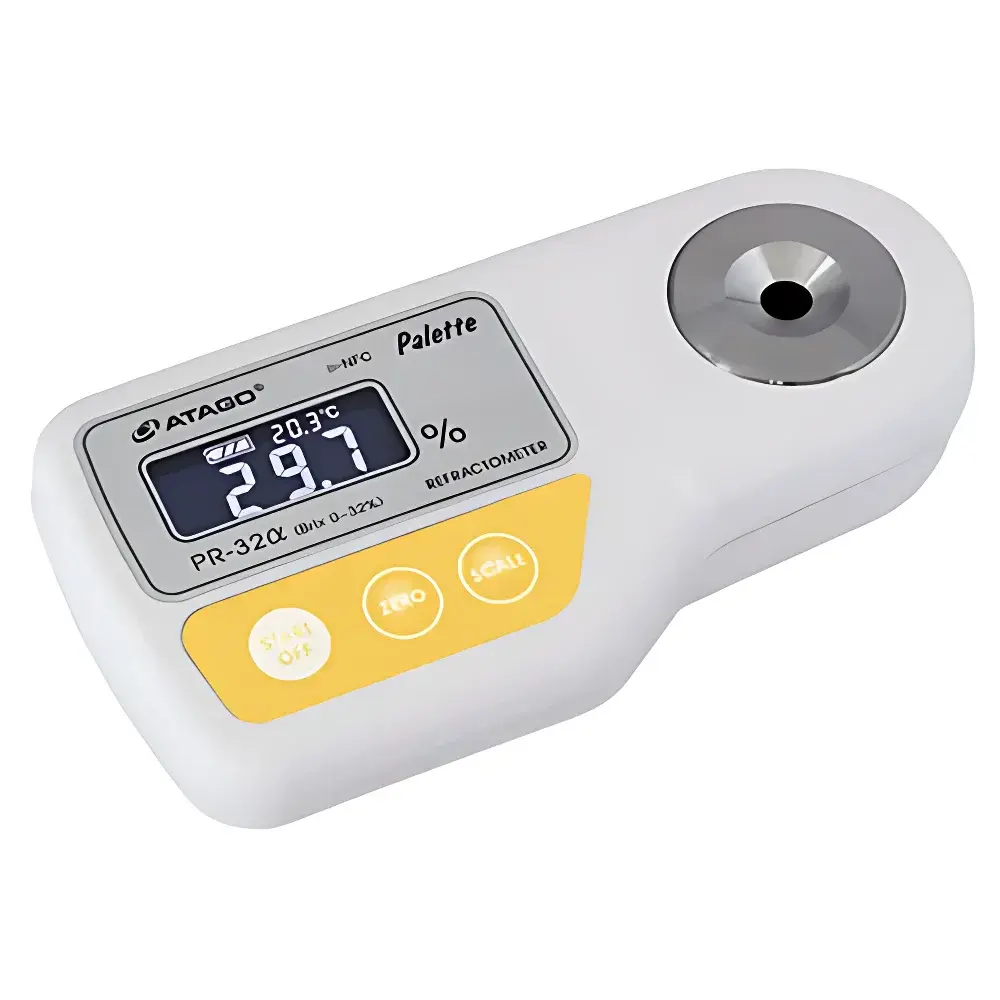
ATAGO PR-32α Digital Handheld Refractometer
| Brand | ATAGO |
|---|---|
| Origin | Japan |
| Model | PR-32α (Low-Concentration) |
| Product Type | Handheld Refractometer |
| Temperature Compensation | Automatic (ATC, 5–40°C) |
| Display | Digital LCD |
| Measurement Range | 0.0–32.0% Brix |
| Accuracy | ±0.1% Brix |
| Resolution | 0.1% Brix |
| Operating Temperature | 5–40°C |
| Power Supply | 9V Alkaline Battery (006P) |
| IP Rating | IP64 |
| Dimensions & Weight | 17 × 9 × 4 cm, 300 g (main unit only) |
Overview
The ATAGO PR-32α Digital Handheld Refractometer is an optical precision instrument engineered for rapid, field-deployable measurement of aqueous solution concentration based on the principle of total internal reflection. It determines refractive index and converts it to % Brix (sucrose-equivalent concentration) using built-in calibration curves traceable to NIST-standard sucrose solutions. Designed specifically for low-concentration applications—such as fruit juices, soft drinks, coolant fluids, cutting oils, cleaning agents, and antifreeze solutions—the PR-32α operates within a linear range of 0.0–32.0% Brix with ±0.1% Brix accuracy and 0.1% resolution. Its automatic temperature compensation (ATC) system employs a thermistor embedded in the prism block to correct readings across 5–40°C ambient conditions, ensuring metrological consistency without external thermostating. The device complies with fundamental optical metrology practices defined in ISO 21348 and JIS Z 8014 for refractometric instrumentation.
Key Features
- Digital LCD display with high-contrast backlight for readability under variable lighting conditions
- ELI (Enhanced Light Interference) optical shielding technology to suppress measurement drift caused by ambient glare or direct sunlight exposure
- Four selectable scale modes: Standard Brix (Scale 1), plus three user-definable scales (Scales 2–4) programmable via coefficient-based linear conversion (Concentration = Brix × K)
- Scale lock/unlock function to prevent accidental mode switching during routine QC workflows
- One-touch zero calibration using distilled water; automatic stabilization detection confirms completion when “000” displays steadily
- Rugged, sealed housing rated IP64 for dust resistance and protection against water splashes—suitable for factory floor, warehouse, or outdoor use
- Low-power consumption design with auto-shutdown after 3 minutes of inactivity, extending battery life beyond 10,000 measurements per 9V cell
Sample Compatibility & Compliance
The PR-32α accepts liquid samples with low to moderate viscosity (<100 mPa·s) and minimal suspended solids. Compatible matrices include clarified fruit juices, beverage concentrates, aqueous coolants, alkaline cleaning solutions, glycol-based heat transfer fluids, and mild acidic or basic process streams. It is not intended for highly turbid, emulsified, or non-aqueous solvents (e.g., pure ethanol, mineral oil). For regulated environments, the instrument supports GLP-compliant documentation through manual log entry of calibration timestamps, operator ID, and sample identifiers. While not inherently 21 CFR Part 11 compliant (as it lacks electronic audit trails), its calibration traceability, repeatable ATC behavior, and stable optical path meet foundational requirements for ISO/IEC 17025-accredited laboratories performing routine concentration verification.
Software & Data Management
The PR-32α operates as a standalone, embedded-system instrument with no USB, Bluetooth, or PC connectivity. All configuration—including scale selection, coefficient assignment (K-values ranging from 0.01 to 9.99), and calibration history—is managed via front-panel tactile buttons (START/OFF, SCAL, ZERO). Calibration events are not stored electronically but are operationally verifiable via real-time temperature readout (accessible by simultaneous ZERO + SCAL press) and visual confirmation of stable “000” during zeroing. Users are advised to maintain paper-based calibration logs aligned with internal SOPs, referencing JIS Z 8015 guidelines for refractometer maintenance intervals and environmental validation.
Applications
- Quality control of juice blends and carbonated beverages during production line sampling
- In-process monitoring of metalworking fluid concentration in CNC machining centers
- Verification of dilution ratios for industrial cleaning agents prior to tank replenishment
- Field assessment of glycol concentration in HVAC chiller systems to prevent freezing or corrosion
- Research-grade preliminary screening of fermentation broths or plant extract dilutions
- Educational demonstrations of optical density–concentration relationships in chemistry and food science labs
FAQ
What does “ATC” mean on the PR-32α specification sheet?
ATC stands for Automatic Temperature Compensation. The device uses an integrated thermistor to adjust refractive index calculations in real time across 5–40°C ambient temperatures, eliminating the need for manual correction tables.
Can I measure non-sugar solutions like sodium chloride or ethylene glycol directly?
No. The PR-32α outputs Brix values by default. To report % w/w for other solutes, users must assign a validated linear conversion coefficient (K) via Scale 2–4 programming—based on empirical correlation studies or reference method validation (e.g., titration or densitometry).
How often should I recalibrate the instrument?
Zero calibration is required before each daily use, after significant ambient temperature shifts (>5°C), and following battery replacement. Full verification with certified sucrose standards is recommended weekly or per internal QA schedule.
Is the prism surface scratch-resistant?
The prism is made of optical-grade BK7 glass with a hard-coated surface. While resistant to minor abrasion, it must be cleaned exclusively with lens tissue, cotton swabs, and reagent-grade isopropyl alcohol—never abrasive cloths or acetone.
Does the PR-32α comply with ASTM D115 or ISO 21348?
It adheres to the optical performance criteria and test methodology outlined in ISO 21348 for handheld refractometers. ASTM D115 applies specifically to asphalt penetration testing and is not relevant to this instrument’s functional scope.






