
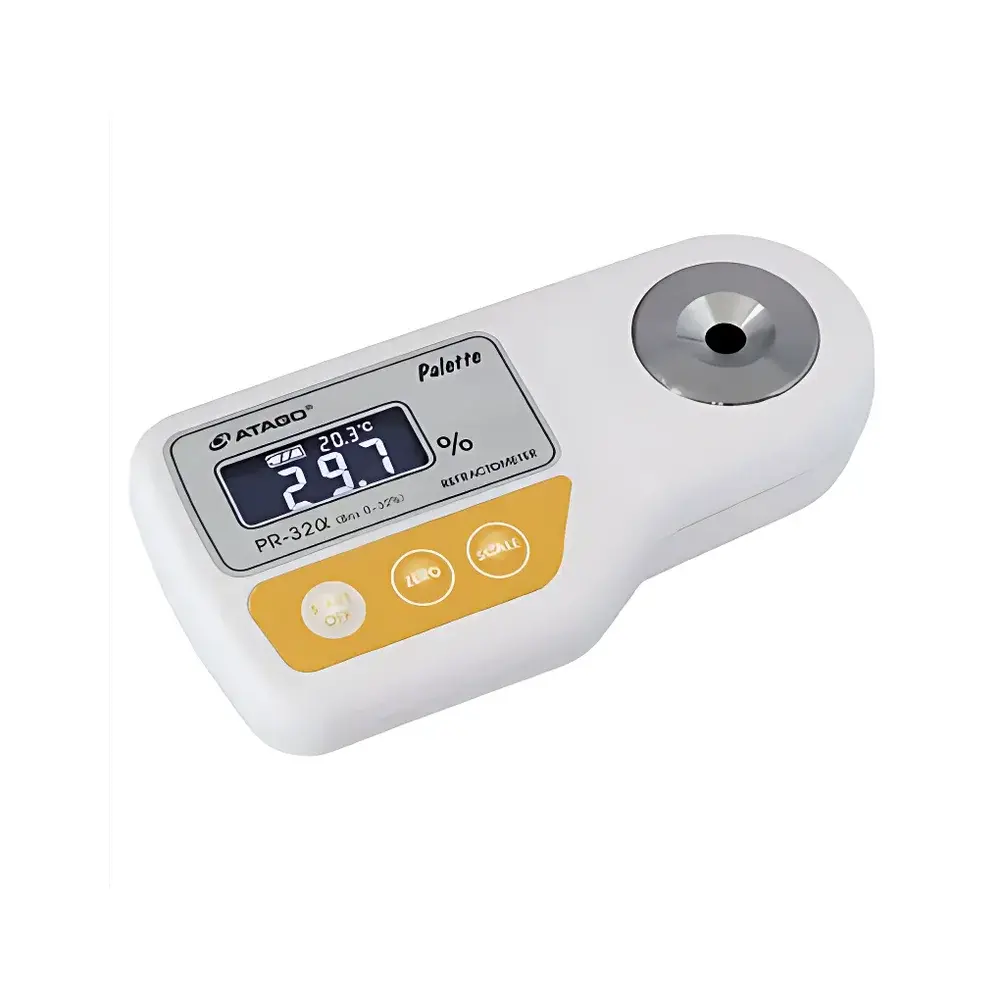
ATAGO PR-32α Portable Digital Refractometer for Hydraulic Oil and Industrial Fluid Concentration Measurement
| Brand | ATAGO |
|---|---|
| Origin | Japan |
| Model | PR-32α |
| Type | Portable Digital Refractometer |
| Measurement Range | 0.0–32.0% Brix |
| Resolution | 0.1% Brix |
| Accuracy | ±0.1% Brix |
| Temperature Compensation | 5–40°C (Automatic) |
| Power Supply | 9V battery (006P) |
| IP Rating | IP64 |
| Dimensions | 17 × 9 × 4 cm |
| Weight | 300 g (body only) |
Overview
The ATAGO PR-32α is a high-precision portable digital refractometer engineered for rapid, field-deployable concentration analysis of industrial fluids—including hydraulic oils, cutting fluids, coolant concentrates, antifreeze solutions, and cleaning agents. Based on the fundamental optical principle of critical angle refraction, the instrument measures the refractive index of transparent or translucent liquid samples and converts it—via built-in algorithms and user-configurable calibration factors—into concentration values expressed in % Brix or custom-defined units. Its core optical system employs a high-stability LED light source and precision sapphire prism, ensuring consistent measurement performance across varying ambient lighting conditions. Designed specifically for quality control technicians, maintenance engineers, and lubrication analysts working in manufacturing plants, automotive service centers, and oil distribution facilities, the PR-32α delivers laboratory-grade repeatability in a handheld format with automatic temperature compensation (ATC) across 5–40°C.
Key Features
- High-resolution digital display with 0.1% Brix resolution and ±0.1% Brix accuracy at 20°C
- Patented External-Light-Interference (ELI) optical shielding technology to maintain measurement stability under direct sunlight or strong ambient illumination
- User-definable conversion coefficient function: enables direct readout of non-Brix concentrations (e.g., % glycol, % triethanolamine, % sodium nitrite) via formula [Concentration = Brix × Custom Coefficient]
- Automatic temperature compensation (ATC) using integrated thermistor sensor; eliminates manual correction and supports reliable measurements across operational environments from 5°C to 40°C
- Dust- and splash-proof enclosure rated IP64 per IEC 60529, suitable for workshop, warehouse, and outdoor use
- Compact ergonomic design (17 × 9 × 4 cm, 300 g) with intuitive single-button operation and auto-power-off after 3 minutes of inactivity
- Sapphire prism surface for superior scratch resistance and long-term optical integrity
Sample Compatibility & Compliance
The PR-32α is validated for use with low-viscosity, optically homogeneous aqueous and semi-aqueous industrial fluids. Typical compatible samples include water-glycol hydraulic fluids, soluble oil emulsions, alkaline cleaning solutions, phosphate ester fire-resistant fluids, and ethylene/propylene glycol-based antifreezes. It is not intended for opaque suspensions, highly viscous synthetics (>100 cSt), or strongly absorbing media (e.g., dark mineral oils, used engine oils). While the device itself does not carry formal regulatory certification, its measurement methodology aligns with established refractometric principles referenced in ASTM D115, ISO 21748, and JIS K 0061. When deployed within documented SOPs—including daily verification with certified sucrose standards—the PR-32α supports GLP-compliant process monitoring and in-line QC checks in lubricant blending, coolant replenishment, and preventive maintenance workflows.
Software & Data Management
The PR-32α operates as a standalone instrument without embedded data logging or Bluetooth/Wi-Fi connectivity. However, its stable analog-to-digital conversion architecture ensures high inter-unit reproducibility, enabling traceable manual recording in paper-based or LIMS-integrated electronic logbooks. For organizations requiring audit-ready documentation, the device supports integration into controlled environments where measurement records—including date/time stamp, operator ID, sample ID, and result—are entered into validated electronic systems compliant with FDA 21 CFR Part 11 requirements. ATAGO provides optional calibration verification kits (e.g., 5.0%, 10.0%, and 20.0% Brix standard solutions traceable to NIST SRM 84d) to support routine performance qualification and annual recalibration protocols.
Applications
- Routine verification of hydraulic fluid concentrate dilution ratios prior to system top-up or commissioning
- On-site monitoring of metalworking fluid sump concentration to prevent microbial growth and maintain corrosion inhibition
- Field validation of antifreeze mixture strength in heavy-duty vehicle cooling systems
- Quality screening of incoming cleaning solution batches against supplier specifications
- Preventive maintenance checks for coolant degradation in CNC machine tools and hydraulic power units
- Educational demonstrations of refractive index–concentration relationships in mechanical engineering and tribology laboratories
FAQ
Can the PR-32α measure undiluted hydraulic oil directly?
No. The instrument requires aqueous or water-miscible base fluids. Pure mineral or synthetic hydraulic oils lack sufficient refractive index variation for accurate quantification and will yield unreliable readings.
Is temperature compensation active during cold-weather field use below 10°C?
Yes. ATC remains functional across the full 5–40°C sample temperature range. However, for optimal accuracy, allow the instrument and sample to equilibrate for ≥2 minutes before measurement when ambient temperatures are near the lower limit.
How often should the prism be cleaned and calibrated?
Clean the sapphire prism with lens tissue and distilled water after each use. Perform verification with a certified standard solution at the start of each shift or daily in high-utilization settings. Full recalibration by an ATAGO-accredited service center is recommended annually or after physical impact.
Does the PR-32α comply with ISO/IEC 17025 requirements?
The instrument itself is not accredited, but its use within a laboratory’s validated method—supported by documented uncertainty budgets, traceable standards, and personnel training records—can contribute to ISO/IEC 17025 compliance for specific concentration testing scopes.
What battery life can be expected under typical usage?
A single 9V alkaline battery (006P) supports approximately 10,000 measurements, assuming average use of 20 readings per day over six months. Low-battery indication appears 30 seconds prior to shutdown.





