
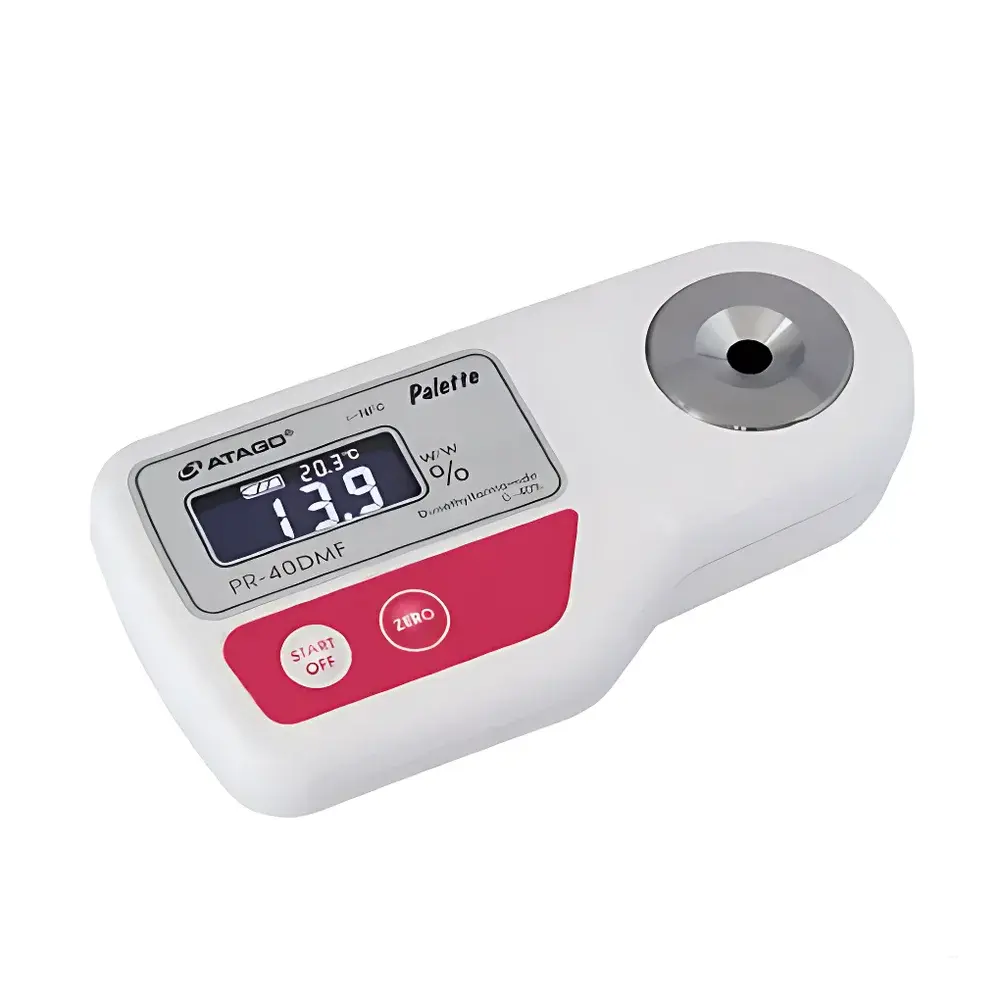
ATAGO PR-40DMF Digital Refractometer for Dimethylformamide (DMF) Concentration Measurement
| Brand | ATAGO |
|---|---|
| Origin | Japan |
| Model | PR-40DMF |
| Product Type | Handheld Refractometer |
| Temperature Compensation | Automatic (ATC, 5–40°C) |
| Display | Digital LCD |
| Measurement Range | 0.0–40.0% (w/w) DMF |
| Accuracy | ±0.3% |
| Resolution | 0.1% |
| Power Supply | 9V Alkaline Battery (006P) |
| IP Rating | IP64 |
| Dimensions | 170 × 90 × 40 mm |
| Weight | 300 g (main unit only) |
| Operating Ambient Temperature | 5–40°C |
Overview
The ATAGO PR-40DMF is a precision handheld digital refractometer engineered specifically for rapid, on-site quantification of dimethylformamide (DMF) concentration in industrial process and quality control environments. It operates on the fundamental optical principle of critical angle refractometry: incident light passing through a prism-sample interface undergoes total internal reflection at an angle inversely proportional to the sample’s refractive index. Since DMF concentration exhibits a highly linear and reproducible correlation with refractive index across the 0.0–40.0% (w/w) range, the instrument converts measured refractive index into concentration via a pre-calibrated polynomial algorithm optimized for DMF–water and DMF–organic solvent systems. Unlike generic Brix refractometers, the PR-40DMF embeds a dedicated DMF-specific calibration curve traceable to ATAGO’s certified reference standards, eliminating interpolation errors associated with indirect sugar-based scaling. Its built-in Automatic Temperature Compensation (ATC) system uses a high-stability thermistor integrated directly into the prism block, enabling real-time correction across 5–40°C without external thermostating—critical for field use where ambient fluctuations affect raw refractive index readings.
Key Features
- Dedicated DMF concentration scale (0.0–40.0% w/w) with factory-traceable calibration per ISO/IEC 17025-accredited procedures
- Automatic Temperature Compensation (ATC) with ±0.1°C resolution over 5–40°C operating range
- Digital LCD display with 0.1% resolution and automatic 3-second stabilization indicator
- Multi-scale capability: supports Brix and three user-definable scales (Scale 2, 3, 4) with programmable conversion coefficients
- IP64-rated enclosure for dust resistance and protection against water splashes during routine handling
- One-button zero calibration using distilled water; performed automatically upon power-on or manually via ZERO key
- Low-power design with 9V alkaline battery (006P), providing >5,000 measurements per set under typical usage
- Ergonomic form factor (170 × 90 × 40 mm, 300 g) optimized for single-hand operation in glove-compatible industrial settings
Sample Compatibility & Compliance
The PR-40DMF is validated for aqueous and partially miscible organic solutions containing DMF, including post-reaction mixtures from polyacrylonitrile (PAN) fiber synthesis, PU leather casting baths, and gas absorption scrubber liquors. It accommodates viscous samples up to ~200 mPa·s without clogging, provided surface debris is removed prior to measurement. Sample volume requirement is ≤0.3 mL—sufficient for dropwise application onto the sapphire-coated borosilicate glass prism. The device complies with IEC 61000-4 electromagnetic immunity standards and meets JIS Z 8807:2015 for refractometric measurement uncertainty in chemical analysis. While not FDA 21 CFR Part 11–compliant (as it lacks audit trail or electronic signature functionality), its calibration and verification protocol aligns with GLP documentation requirements when paired with laboratory logbooks and periodic verification using NIST-traceable DMF reference standards (e.g., 10.0%, 25.0%, and 35.0% w/w certified solutions).
Software & Data Management
The PR-40DMF operates as a standalone embedded system with no PC connectivity or firmware update capability. All configuration—including scale selection, coefficient adjustment, and scale lock/unlock—is executed via front-panel tactile keys (SCAL, ZERO, START/OFF). Calibration history is not stored; however, each zeroing event logs temperature data visible via diagnostic mode (activated by simultaneous ZERO + SCAL press). Users are advised to maintain external calibration records per ISO/IEC 17025 Section 7.7, documenting date, operator ID, reference standard lot number, observed deviation, and corrective action. For integration into automated QA workflows, manual transcription of displayed values into LIMS or Excel-based SPC charts is standard practice—supported by the instrument’s stable 3-second readout and minimal operator-induced variability (<0.1% RSD across five repeated measurements by trained personnel).
Applications
- Real-time monitoring of DMF recovery efficiency in solvent recycling units within synthetic fiber manufacturing
- In-process verification of DMF concentration in polyurethane coating formulations prior to casting
- Quality release testing of purchased DMF batches against supplier specifications (ASTM D1617)
- Field verification of DMF content in amine scrubbing solutions used in natural gas purification
- Teaching laboratories demonstrating colligative property–based concentration analysis principles
- Environmental labs assessing DMF residual levels in wastewater effluents following pretreatment
FAQ
Does the PR-40DMF require recalibration before each use?
Yes—zero calibration with distilled water is required before first use each day, after significant ambient temperature shifts (>5°C), and immediately following battery replacement.
Can the instrument measure DMF in non-aqueous matrices such as DMF–toluene mixtures?
It is calibrated for DMF–water systems; measurements in organic co-solvent blends may yield deviations exceeding ±0.5% unless revalidated with matrix-matched standards.
What is the service life of the prism coating?
The sapphire-enhanced glass prism resists scratching and chemical etching; with proper cleaning (alcohol-rinsed lint-free tissue only), operational lifespan exceeds 10 years under typical industrial use.
Is temperature compensation active during zero calibration?
Yes—the ATC sensor remains active during zeroing, ensuring the baseline reflects current prism temperature and eliminates thermal hysteresis effects.
How is measurement uncertainty determined for compliance reporting?
Total uncertainty combines ±0.3% instrument accuracy, ±0.1% repeatability (k=2), and ±0.2% contribution from reference standard uncertainty—yielding an expanded uncertainty of ±0.6% (k=2) for DMF concentration at 25°C.



