
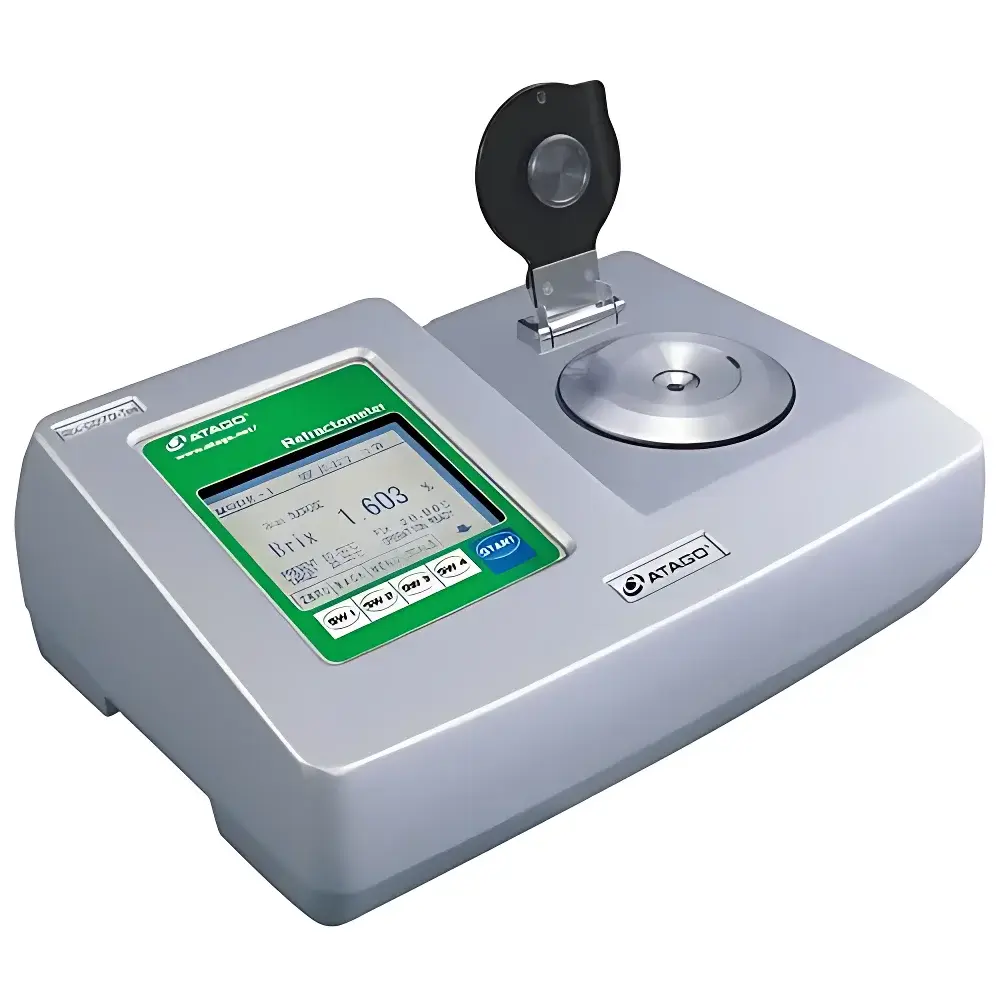
ATAGO RX-DD7α-Tea Automatic Desktop Refractometer for Low-Brix Tea Solutions
| Brand | ATAGO |
|---|---|
| Origin | Japan |
| Model | RX-DD7α-tea |
| Measurement Principle | Abbe-type Refractive Index Detection |
| Measurement Range | Brix 0.000–5.000% (ATC) |
| Accuracy | ±0.005% Brix (under temperature-stabilized conditions) |
| Temperature Accuracy | ±0.05°C |
| Brix Resolution | 0.001% |
| Temperature Resolution | 0.01°C |
| Sample Cell Material | SUS316 Stainless Steel |
| Prism Material | Optical Glass |
| Auto-Temperature Control Range | 15–25°C (dependent on ambient) |
| Power Supply | AC 100–240 V, 50–60 Hz |
| Power Consumption | 65 VA |
| Dimensions (W×D×H) | 37 × 26 × 14 cm |
| Weight | 6.7 kg (main unit only) |
| Interface | RS-232C, optional digital printer |
| Custom Scale Storage | 30 user-defined scales |
| Instrument Type | Destructive Sampling Refractometer |
Overview
The ATAGO RX-DD7α-Tea is a high-precision, fully automated desktop refractometer engineered specifically for quantitative analysis of low-concentration soluble solids in tea infusions and low-sugar beverages. Unlike conventional handheld or benchtop refractometers optimized for fruit juices or syrups (Brix >5%), the RX-DD7α-Tea employs an Abbe-type optical design with temperature-compensated refractive index detection calibrated to the Brix scale—defined as the mass percentage of sucrose in aqueous solution at 20°C. Its measurement range (0.000–5.000% Brix) aligns with the physicochemical reality of brewed tea, where total soluble solids—including polysaccharides (e.g., arabinogalactan, glucans), organic acids, catechins, caffeine, and amino acids—contribute collectively to refractive index elevation. The instrument integrates active Peltier-based temperature control to maintain prism and sample interface stability within ±0.05°C, eliminating thermal drift as a primary source of uncertainty in low-Brix quantification. This architecture ensures metrological traceability under controlled laboratory conditions compliant with ISO 5725 (accuracy, precision) and ASTM D1218 (refractometric analysis of transparent liquids).
Key Features
- Ultra-high resolution Brix measurement: 0.001% readability with certified accuracy of ±0.005% across the full 0.000–5.000% range
- Automated temperature control system with adaptive setpoint logic: maintains optimal prism-sample thermal equilibrium across ambient conditions (15–30°C), dynamically adjusting target range (e.g., 15–20°C at 15°C ambient; 20–25°C at 25°C ambient)
- Corrosion-resistant sample chamber fabricated from medical-grade SUS316 stainless steel, compatible with repeated exposure to tannin-rich, mildly acidic tea extracts (pH 4.5–6.2)
- Optical prism constructed from high-homogeneity borosilicate optical glass, minimizing chromatic aberration and ensuring long-term refractive index stability
- 30-user-definable calibration scales support method-specific conversion factors—for example, correlating Brix readings to total carbohydrate content using tea-specific empirical coefficients derived from HPLC-confirmed monosaccharide profiles (glucose, galactose, arabinose, xylose)
- RS-232C serial interface enables direct integration into LIMS environments with configurable data logging intervals and GLP-compliant audit trail generation
Sample Compatibility & Compliance
The RX-DD7α-Tea is validated for use with clarified, particle-free filtrates of green, black, oolong, and pu-erh infusions prepared according to standardized steeping protocols (e.g., ISO 3103 for tea preparation). It accommodates samples with turbidity <1 NTU and viscosity <5 mPa·s—conditions readily achieved via vacuum filtration through 0.45 µm PVDF membranes. As a destructive sampling instrument, it requires 0.3–0.5 mL per measurement, enabling replicate analysis for statistical evaluation of extraction consistency. The system complies with ISO/IEC 17025 requirements for testing laboratories when operated within documented SOPs, including daily verification with NIST-traceable sucrose standards (e.g., SRM 84d). Its temperature-controlled optics satisfy the instrumental prerequisites of USP for refractometric assays in quality control of botanical extracts.
Software & Data Management
Data output is supported via RS-232C serial protocol with ASCII-formatted real-time transmission (Brix value, temperature, timestamp, scale ID). Optional digital printer integration provides hard-copy records meeting FDA 21 CFR Part 11 requirements when paired with electronic signature-capable firmware. The embedded microcontroller stores all calibration history, user-defined scale parameters, and environmental logs (ambient temperature, internal sensor readings) with non-volatile memory retention exceeding 10 years. When connected to host software (e.g., ATAGO’s optional PC-Link application), users can generate GMP-aligned reports featuring measurement uncertainty budgets, trend charts of batch-to-batch variability, and automatic outlier detection based on Grubbs’ test (α = 0.05).
Applications
- Standardization of tea infusion strength in R&D labs developing functional beverages with controlled polysaccharide delivery
- Process validation of enzymatic hydrolysis steps in tea polysaccharide (TPS) isolation workflows, where Brix serves as a proxy for oligosaccharide release kinetics
- Quality assurance of ready-to-drink (RTD) low-sugar teas, verifying label claims for “<5g sugar per serving” against ISO 21527-1 microbiological and ISO 15512 carbohydrate specifications
- Comparative analysis of cultivar-dependent extractability—e.g., quantifying differential leaching of rhamnogalacturonan I in Assam vs. Darjeeling black teas under identical brewing parameters
- Stability studies tracking Maillard reaction progression during shelf-life testing via subtle Brix shifts correlated with 5-HMF formation (R² >0.92 in accelerated aging trials at 40°C/75% RH)
FAQ
Is the RX-DD7α-Tea suitable for measuring undiluted, unfiltered tea infusions?
No. Particulate matter and colloidal polyphenol aggregates cause light scattering that invalidates refractive index assumptions. Samples must be filtered to <0.45 µm prior to analysis.
Can this instrument differentiate between sucrose and tea-derived polysaccharides in the Brix reading?
No. Brix is a bulk refractive index metric; it reports total dissolved solids contribution without chemical specificity. Complementary techniques (e.g., HPAEC-PAD, enzymatic hydrolysis + glucose oxidase assay) are required for compositional deconvolution.
What maintenance is required to ensure long-term accuracy?
Daily prism cleaning with lens-grade tissue and anhydrous ethanol; quarterly verification with certified 1.000% and 4.000% Brix sucrose standards; annual recalibration by ATAGO-certified service centers using interferometric reference instrumentation.
Does the instrument support Good Manufacturing Practice (GMP) documentation requirements?
Yes—when used with validated PC-Link software and electronic signature modules, it supports audit trails, user access controls, and electronic record retention per Annex 11 and 21 CFR Part 11.
How does automatic temperature compensation (ATC) differ from manual temperature correction in traditional refractometers?
ATC actively regulates prism temperature to a defined setpoint, eliminating reliance on post-measurement correction algorithms. This reduces systematic error from thermal gradients across the optical path—critical below 1% Brix where ±0.1°C deviation induces >±0.02% Brix uncertainty.







