
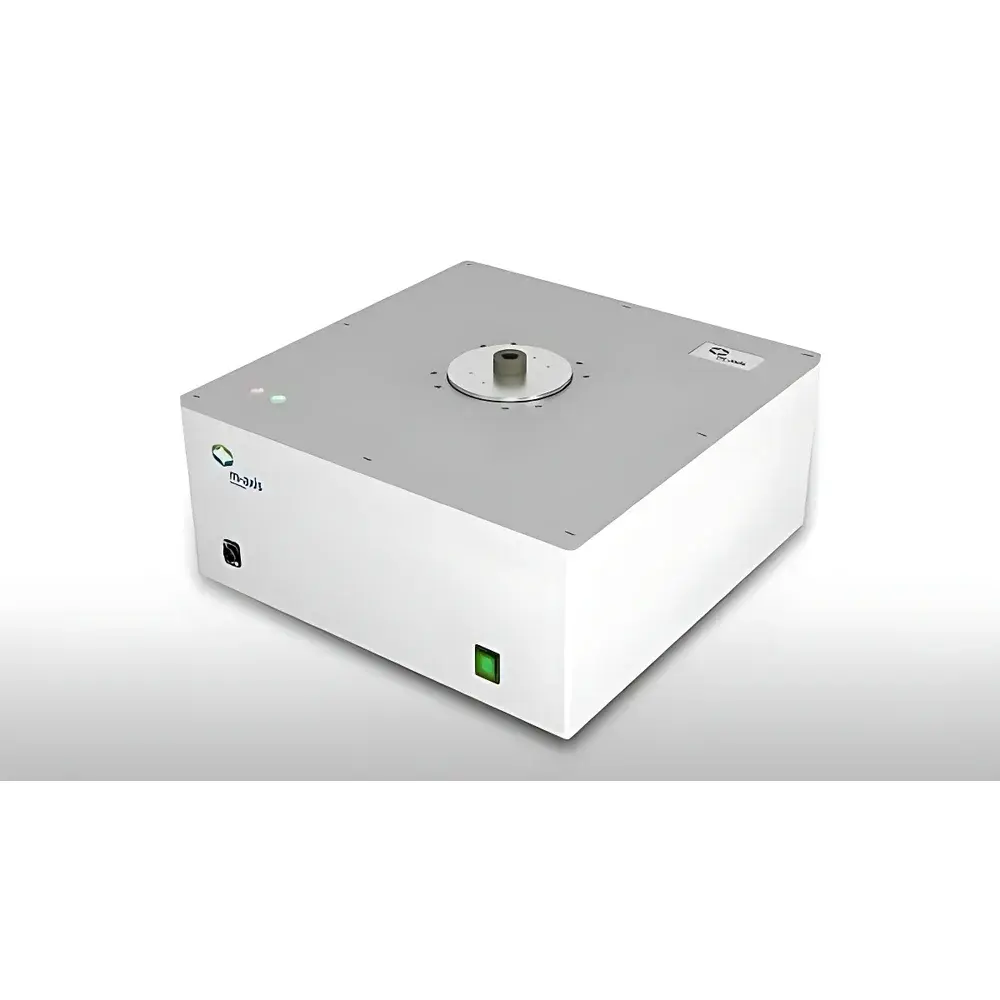
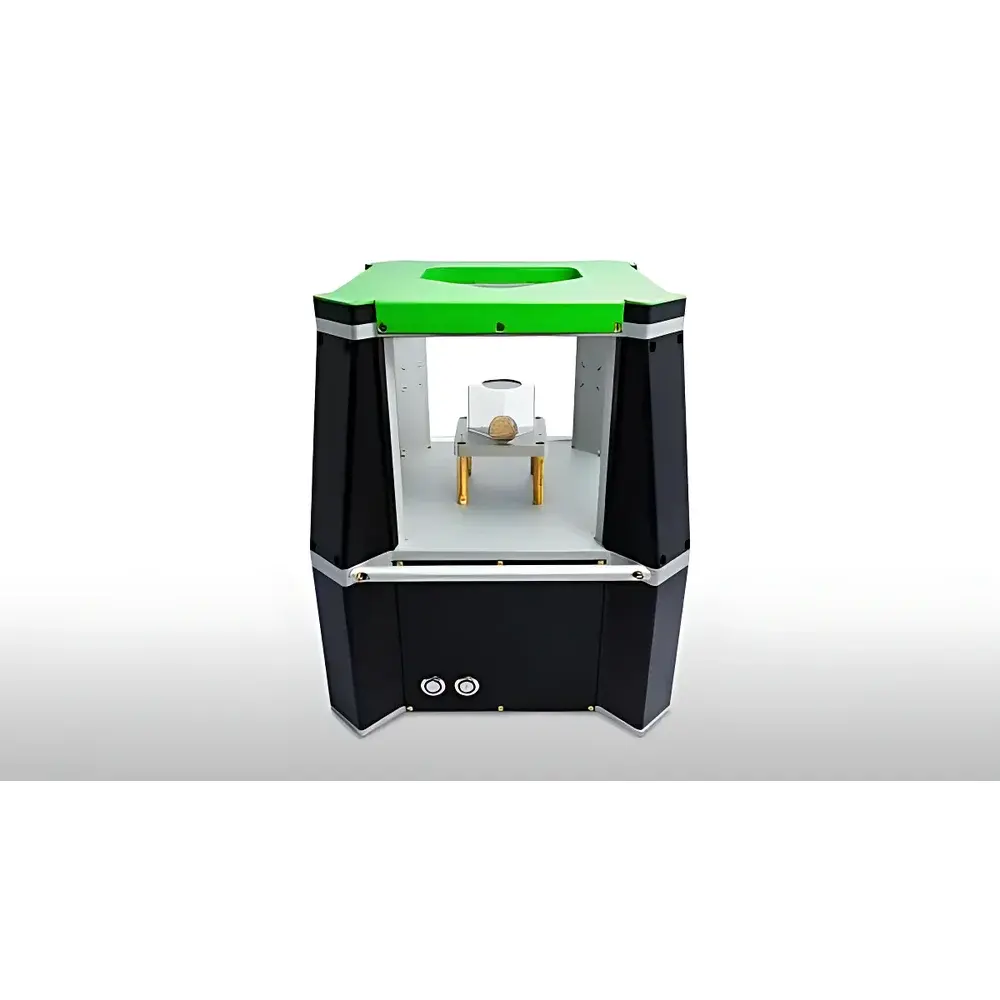
Auniontech M-axis Permanent Magnet Characterization System
| Brand | Auniontech |
|---|---|
| Model | M-axis |
| Measurement Principle | Magnetic Dipole Moment Reconstruction from Static 3D Magnetic Field Mapping |
| Sensor Type | 18× Anisotropic Magnetoresistive (AMR) Sensors |
| Measurement Frequency | 10 Hz |
| Positional Stability | Static (No Sample Rotation Required) |
| Temperature Operating Range | 15–35 °C |
| Max. System Weight | <30 kg |
| Dimensions (W×H×D) | 1.80×0.75×0.75 m |
| Power Consumption | <100 W |
| Magnetic Moment Range | 0.1–1 A·m² |
| Angular Accuracy (Magnetization Direction) | ±0.1° (for aspect ratio <1:2.5), ±0.3° (general) |
| Remanence Accuracy | ±1% |
| Data Output Format | CSV with full metadata |
| Compliance | Designed for GLP-aligned QC environments |
Overview
The Auniontech M-axis Permanent Magnet Characterization System is a high-precision, static-field-based metrology platform engineered for the non-destructive, contactless determination of intrinsic magnetic properties of sintered and bonded permanent magnets. Unlike conventional Helmholtz coil-based methods—which rely on time-integrated flux change during sample rotation—the M-axis system reconstructs the complete magnetic dipole moment vector (magnitude, orientation, and spatial offset) by directly measuring the three-dimensional static magnetic field distribution around a stationary magnet. This physics-based approach eliminates mechanical motion artifacts, enables repeatable sub-degree angular resolution, and supports geometrically invariant parameter extraction independent of magnet geometry or mounting uncertainty. The system is calibrated to ISO/IEC 17025 traceable standards and operates within a thermally stabilized ambient range (15–35 °C), making it suitable for integration into production-line quality control workflows where reproducibility, statistical process control (SPC), and metrological traceability are critical.
Key Features
- Static measurement architecture: No sample rotation or translation required—ensures mechanical stability and eliminates dynamic alignment errors.
- 18-channel anisotropic magnetoresistive (AMR) sensor array providing simultaneous Bx, By, Bz field sampling at 10 Hz across a defined 3D volume.
- Dipole model inversion algorithm delivering magnetic moment magnitude (A·m²), remanence (Br), magnetization direction (incl. polar and azimuthal angles), and positional offset relative to sensor coordinate frame.
- Angular accuracy of ±0.1° for magnets with aspect ratio <1:2.5; ±0.3° for general geometries—validated per ASTM A977/A977M Annex A2 for directional consistency testing.
- Remanence uncertainty ≤±1% (k=2), referenced to NIST-traceable calibration sources.
- Automated CSV export with timestamped metadata, including raw sensor readings, fitted parameters, confidence intervals, and residual error maps.
- Modular expansion support: I/O interface for PLC/SCADA integration, North/South polarity verification module, temperature compensation module (20 °C reference), non-magnetic workstation option, motorized rotation stage (±360°), and embedded PC variant with USB/Ethernet/RS-232 connectivity.
Sample Compatibility & Compliance
The M-axis system accommodates permanent magnets of diverse shapes—including discs, rings, blocks, arcs, and irregular sintered geometries—with dimensions up to 150 mm in any axis. It is compatible with NdFeB, SmCo, AlNiCo, and ferrite grades. All measurements comply with the physical assumptions of the magnetic dipole approximation (valid when magnet size ≪ distance to nearest sensor), and software includes geometric validity checks to flag out-of-range configurations. The system supports documentation requirements for ISO 9001, IATF 16949, and FDA 21 CFR Part 11-compliant environments through configurable audit trails, user access controls, and electronic signature readiness. Calibration certificates include uncertainty budgets aligned with GUM (JCGM 100) methodology.
Software & Data Management
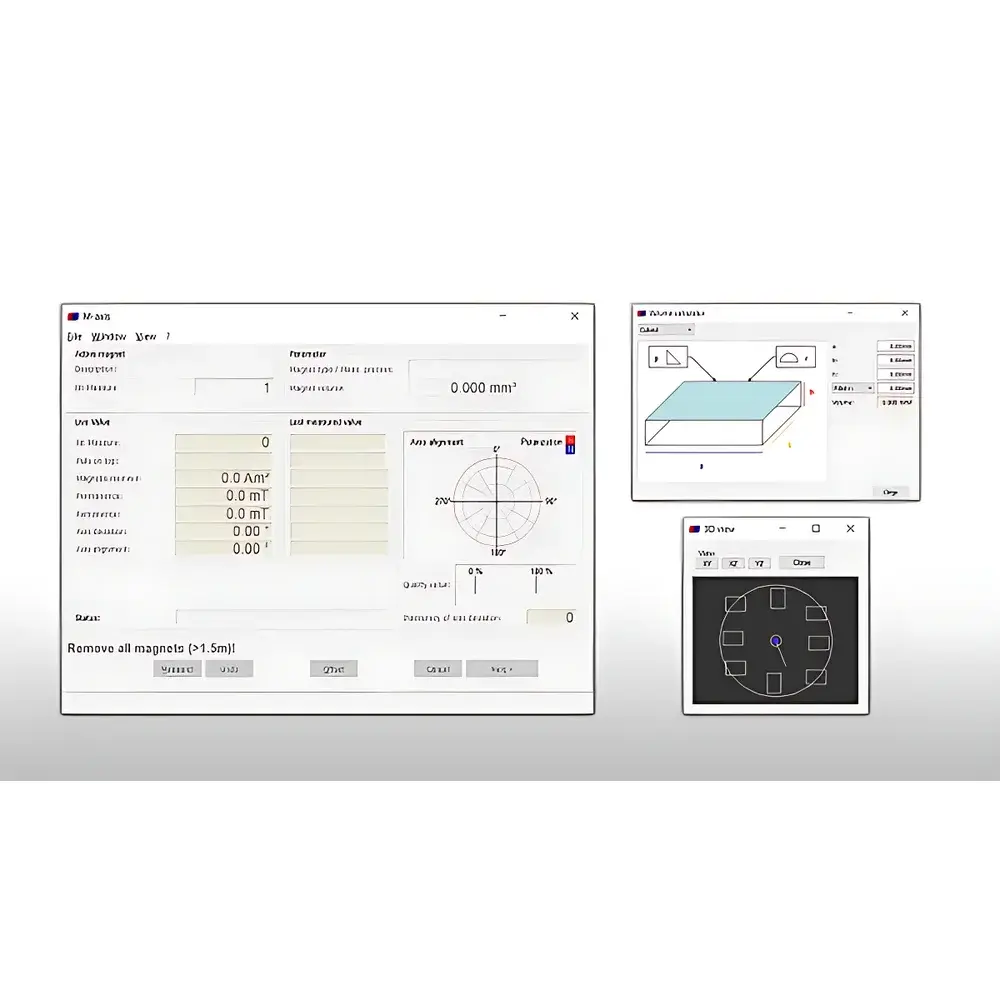
The proprietary M-axis Control Suite provides real-time field visualization, iterative dipole fitting, batch processing, and statistical analysis tools—including Cp/Cpk calculation, trend charting, histogram generation, and outlier detection via Grubbs’ test. Data files adhere to FAIR principles (Findable, Accessible, Interoperable, Reusable) and embed EXIF-like metadata (operator ID, timestamp, environmental conditions, calibration epoch). Export options include CSV (for Excel/Minitab), HDF5 (for Python/Matlab), and PDF reports with pass/fail flags against user-defined specification limits. Software validation documentation (IQ/OQ/PQ protocols) is available upon request for regulated manufacturing sites.
Applications
- End-of-line QA for automotive traction motor magnets (e.g., rotor segment polarity verification and moment uniformity screening).
- R&D characterization of new magnet compositions under thermal aging or mechanical stress protocols.
- Supplier qualification audits requiring quantitative evidence of magnetization vector consistency across production lots.
- Failure analysis of demagnetized or misoriented magnets in medical imaging systems (MRI shimming arrays) and aerospace actuators.
- Calibration traceability for secondary standards used in magnetizer setup and closed-loop feedback systems.
FAQ
Does the M-axis system require magnet rotation during measurement?
No. The system measures the static magnetic field distribution around a stationary magnet and computes its dipole parameters via inverse modeling.
Can it measure magnets with complex geometries or multi-pole magnetization patterns?
It is optimized for single-dipole dominant magnets. For multi-pole or Halbach arrays, the dipole approximation remains valid only if higher-order moments contribute <5% to total field energy—software includes a harmonic distortion index to assess suitability.
Is temperature compensation mandatory for production use?
While not mandatory, the optional Temperature Module is recommended for environments with >±1 °C drift; it applies material-specific temperature coefficients to correct moment values to a 20 °C reference per IEC 60404-5.
How is system calibration maintained over time?
Annual recalibration is advised using certified reference magnets (NIST-traceable); the software logs all calibration events and supports comparison against historical baselines.
What interfaces are supported for factory automation integration?
Standard industrial protocols include Modbus TCP, OPC UA, and digital I/O triggers via the optional I/O Module—enabling direct linkage to MES/SCADA platforms without middleware.



