
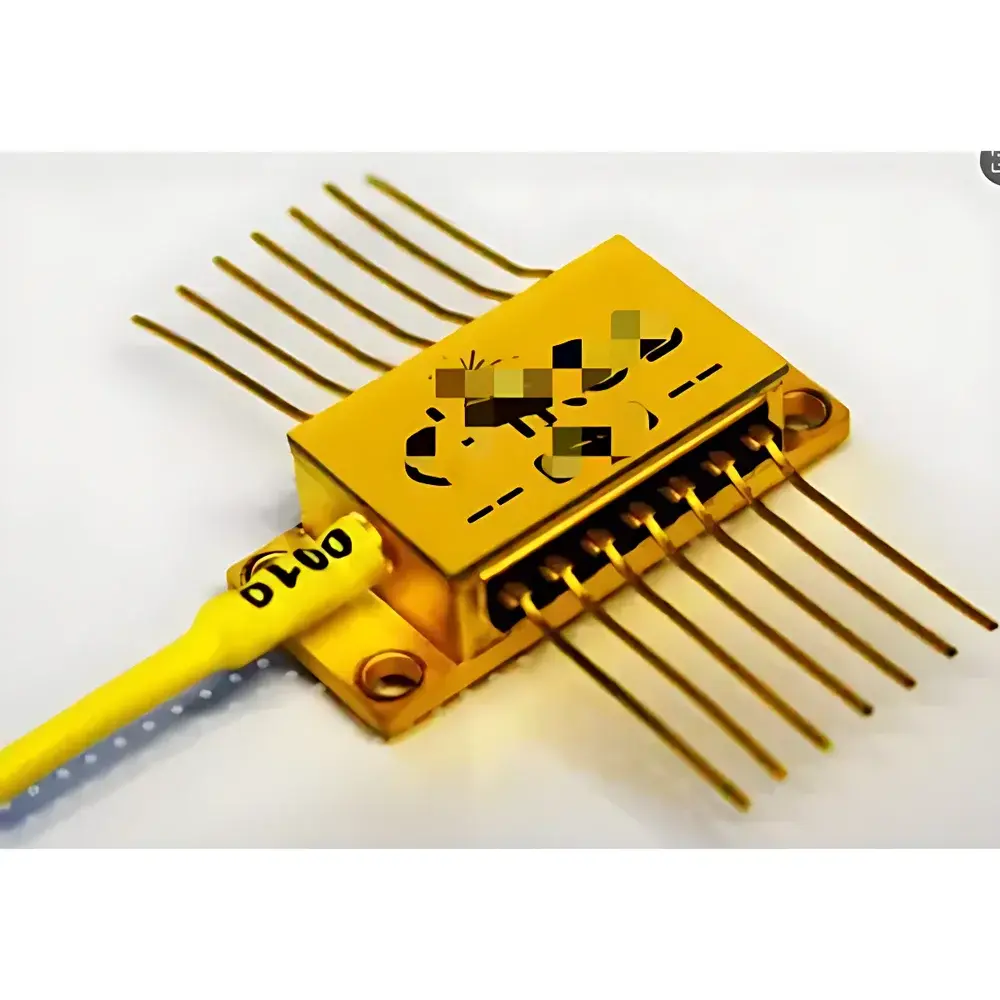
Auniontech C-Band Ultra-Narrow Linewidth Tunable Laser (100 nm Range)
| Brand | Auniontech |
|---|---|
| Origin | Shanghai, China |
| Manufacturer Type | Authorized Distributor |
| Product Category | Domestic |
| Model | Continuous-Wave Tunable Laser |
| Price | Upon Request |
| Output Power | 13 dBm (20 mW) |
| Tuning Range | 100 nm (C-Band, ~1528–1568 nm) |
| Linewidth | <10 kHz (intrinsic) |
| Side-Mode Suppression Ratio (SMSR) | >50 dB |
| Mode-Hop-Free Tuning Step | >0.25 nm |
| Cooling | Integrated Thermoelectric Cooler (TEC) |
| Fiber Pigtail | Polarization-Maintaining (PM) Single-Mode Fiber |
Overview
The Auniontech C-Band Ultra-Narrow Linewidth Tunable Laser is a photonic integrated circuit (PIC)-based continuous-wave (CW) laser engineered for high-resolution optical metrology and coherent photonic systems. It operates on the principle of hybrid-integrated external cavity feedback, combining a distributed feedback (DFB) or sampled-grating DBR (SG-DBR) gain chip with monolithic waveguide-based wavelength-selective elements and phase tuning sections. This architecture enables intrinsically narrow spectral emission (<10 kHz Lorentzian linewidth), exceptional frequency stability, and mode-hop-free tuning across the full C-band (approximately 1528–1568 nm). Designed for applications demanding precise wavelength control and low phase noise—such as coherent optical communications, heterodyne spectroscopy, and interferometric sensing—the laser delivers 20 mW (13 dBm) of output power through a polarization-maintaining (PM) single-mode fiber pigtail. Its compact footprint and integrated thermoelectric cooler (TEC) ensure stable operation under varying ambient conditions without external thermal management infrastructure.
Key Features
- Ultra-narrow intrinsic linewidth: <10 kHz (measured via delayed self-heterodyne interferometry)
- Full C-band coverage: 100 nm continuous tuning range (1528–1568 nm), supporting ITU-T DWDM channel grids
- High side-mode suppression ratio: >50 dB, ensuring spectral purity critical for coherent detection
- Mode-hop-free tuning capability with step resolution better than 0.25 nm over full range
- Integrated TEC and precision temperature monitoring for long-term wavelength stability (drift <±1 pm over 8 hours at constant setpoint)
- Polarization-maintaining (PM) fiber output with extinction ratio >20 dB, compatible with polarization-sensitive interferometers and modulators
- Compact, rack-mountable OEM module form factor (120 × 90 × 25 mm) suitable for embedded system integration
Sample Compatibility & Compliance
This tunable laser is fully compatible with standard SMF-28e+ and PM1550 fibers and interfaces seamlessly with industry-standard optical components including lithium niobate (LiNbO₃) modulators, fiber Bragg gratings (FBGs), and silicon photonics test platforms. The device complies with IEC 60825-1:2014 Class 1 laser safety requirements when operated with enclosed fiber delivery. It supports traceable calibration per ISO/IEC 17025-accredited procedures when used in metrology-grade setups. While not certified for medical or aerospace use out-of-the-box, its design adheres to key reliability benchmarks aligned with Telcordia GR-468-CORE for telecom-grade optoelectronic components, including operating temperature range (15–35 °C), storage humidity limits (≤85% RH non-condensing), and shock/vibration tolerance (IEC 60068-2-64).
Software & Data Management
The laser includes a USB 2.0–based digital interface supporting SCPI command protocol for remote control of wavelength, output power, and TEC setpoint. A Windows/Linux-compatible SDK provides APIs in C/C++, Python, and LabVIEW for integration into automated test systems. All parameter settings and real-time operational logs—including wavelength lock status, TEC current, photodiode monitor readings, and internal temperature—are timestamped and exportable in CSV format. Audit trails are maintained locally on-device memory (non-volatile EEPROM) to support GLP-compliant workflows. Optional firmware updates preserve backward compatibility and may include enhanced wavelength calibration algorithms compliant with NIST-traceable reference standards.
Applications
- Coherent Optical Communications: Local oscillator source for DP-QPSK and higher-order modulation formats in 100G/400G ZR and Open ROADM systems
- Gas Sensing & Spectroscopy: High-fidelity absorption line scanning in methane (CH₄), acetylene (C₂H₂), and carbon dioxide (CO₂) detection using tunable diode laser absorption spectroscopy (TDLAS)
- Optical Coherence Tomography (OCT): Swept-source OCT (SS-OCT) engines for ophthalmic and dermatological imaging, enabling axial resolution <10 µm in tissue
- LIDAR & Metrology: Frequency-modulated continuous-wave (FMCW) LIDAR sources for absolute distance measurement and vibration analysis
- Fiber Sensing: Interrogation source for distributed acoustic sensing (DAS) and phase-sensitive OTDR (φ-OTDR) systems
- Quantum Optics Research: Pump/probe source in cavity-enhanced spectroscopy and cold atom trapping experiments requiring sub-kHz linewidth stability
FAQ
What is the typical tuning speed across the full 100 nm range?
Tuning is accomplished via thermal and current actuation; full-range sweep takes approximately 10–15 seconds with settling time <100 ms per 0.1 nm step under closed-loop control.
Is the laser compliant with FDA 21 CFR Part 11 for regulated environments?
The base unit does not include electronic signature or audit trail features required for Part 11 compliance; however, the SDK supports integration with validated third-party data acquisition software that meets Part 11 requirements.
Can this laser be used as a seed source for fiber amplifiers?
Yes—its high SMSR (>50 dB) and narrow linewidth make it suitable as a low-noise seed for EDFA and YDFA amplification stages in testbeds and subsystems.
Does the PM fiber output maintain polarization alignment over temperature variations?
The integrated PM fiber maintains >18 dB extinction ratio across the specified operating temperature range (15–35 °C); angular alignment stability is ±0.5° over 8 hours.
Is factory recalibration available, and what is the recommended recalibration interval?
NIST-traceable wavelength calibration is offered annually; users operating in high-stability metrology applications are advised to schedule recalibration every 12 months or after 2,000 hours of cumulative operation.





