
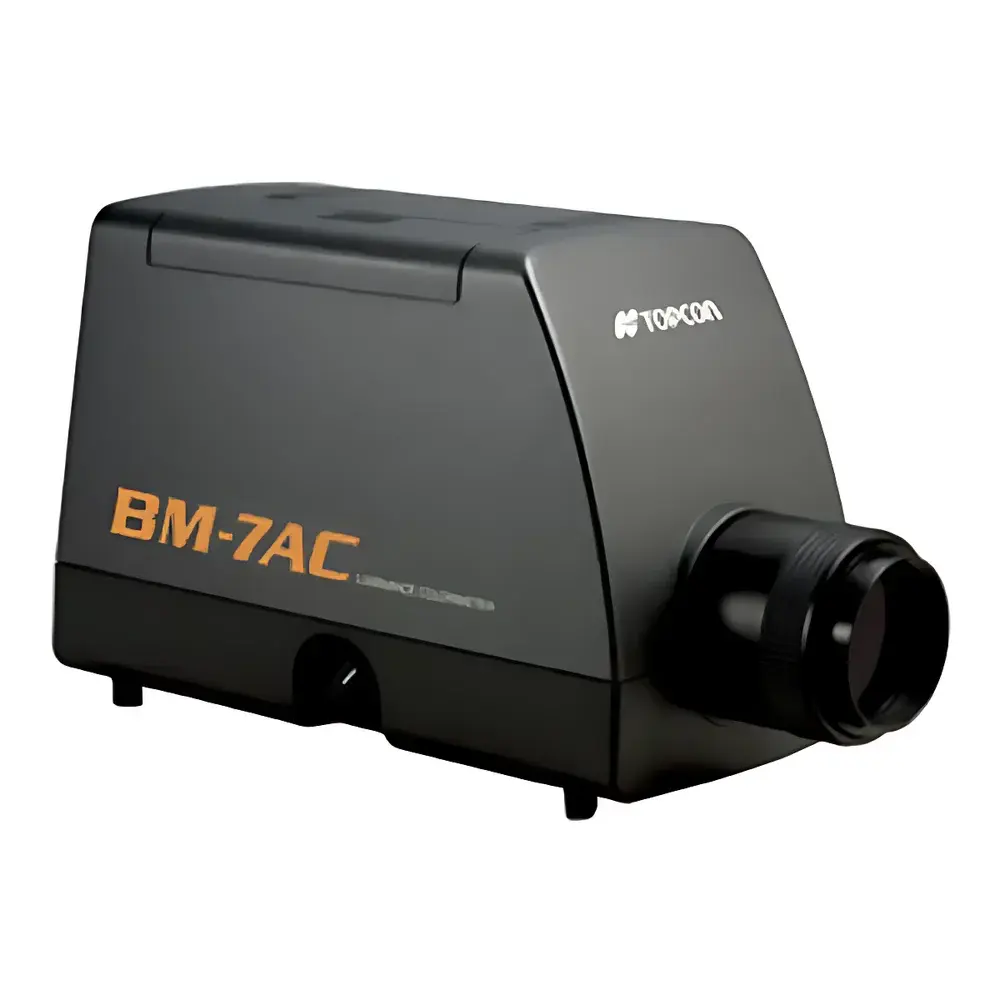
Auniontech BM-7 Chroma-Brightness Meter
| Brand | Auniontech |
|---|---|
| Origin | Shanghai, China |
| Model | BM-7 |
| Detection Principle | CIE 1931 Tristimulus Matching via Silicon Photodiode Array |
| Field of View | 2°/1°/0.2°/0.1° (switchable) |
| Luminance Range | 0.01–12,000,000 cd/m² (auto/manual 5-range) |
| Luminance Accuracy | ±2% (≥5 cd/m²), ±4% (1–5 cd/m²) |
| Chromaticity Accuracy (dx, dy) | ±0.002 (≥10 cd/m², Standard Illuminant A) |
| Repeatability (Luminance) | ≤0.5% (≥5 cd/m², 2σ, SLOW mode) |
| Repeatability (x,y) | ≤0.002 (≥5 cd/m², 2σ, SLOW mode) |
| Measurement Time | ~0.5 s |
| Spectral Response | CIE 1931 photopic luminosity function (V(λ)) and color matching functions (x̄(λ), ȳ(λ), z̄(λ)) matched via 3-segment silicon photodiodes |
| Optical System | f=80 mm, F2.5 objective |
| Working Distance | 350 mm to ∞ (from front metal flange) |
| Output Interface | RS-232C, USB |
| Analog Output (optional) | DC 0–3 V (X, Y, Z channels) |
| Power Supply | AC 100–240 V, 50/60 Hz |
| Operating Environment | 0–40 °C, ≤85% RH (non-condensing) |
| Dimensions (W×D×H) | 120 × 325 × 162 mm |
| Weight | 3.0 kg |
Overview
The Auniontech BM-7 Chroma-Brightness Meter is a precision optical measurement instrument engineered for high-fidelity photometric and colorimetric characterization of flat panel displays (FPDs), LEDs, OLEDs, LCD backlights, and general-purpose light sources. It operates on the fundamental principle of tristimulus colorimetry, employing a calibrated three-segment silicon photodiode array whose spectral responsivity is rigorously matched to the CIE 1931 standard observer functions (x̄(λ), ȳ(λ), z̄(λ)) and the photopic luminosity function V(λ). This photometric architecture enables direct calculation of CIE XYZ tristimulus values, chromaticity coordinates (x, y), luminance (L), correlated color temperature (Tc), Duv deviation, and CIE 1976 color difference metrics (ΔEab*, ΔEuv*). Designed as the latest iteration of the long-established BM-7 series, the BM-7 integrates robust mechanical construction with real-time analog output capability and multi-angle field-of-view selection—making it suitable for both laboratory-grade validation and high-throughput production line testing where traceability, repeatability, and operational efficiency are critical.
Key Features
- High-speed photometric acquisition: Single measurement completed in approximately 0.5 seconds, supporting rapid batch evaluation of display panels or LED arrays.
- Four selectable field angles (2°, 1°, 0.2°, 0.1°) with corresponding spatial resolution scaling—enabling precise targeting of sub-pixel regions or small-area emitters without physical repositioning.
- Dual calibration correction modes: Instrument-to-instrument correction against reference spectroradiometers (e.g., Konica Minolta SR-series) and internal zero/balance adjustment—ensuring long-term stability and cross-device consistency.
- Optional analog voltage output (DC 0–3 V per X, Y, Z channel) with configurable response timing (down to 0.3 ms), compatible with oscilloscopes or data acquisition systems for dynamic waveform capture of luminance transients.
- Five auto/manual luminance range settings spanning six orders of magnitude (0.01–12,000,000 cd/m²), each optimized for signal-to-noise ratio and linearity across its designated span.
- Integrated 20×4 character backlit LCD with intuitive menu navigation and real-time parameter display—including absolute and delta-mode readings for comparative analysis.
Sample Compatibility & Compliance
The BM-7 supports direct measurement of self-luminous devices including OLED microdisplays, mini-LED backlight units, automotive headlamps, and signage modules. Its optical configuration allows non-contact evaluation at working distances from 350 mm to infinity, with optional auxiliary lenses (AL-6, AL-11, AL-12) extending flexibility for near-field micro-spot applications. The instrument conforms to foundational photometric standards underpinning international metrology: spectral response alignment follows CIE Publication No. 15:2018 and ISO/CIE 11664-1:2019 for colorimetry; luminance accuracy specifications are referenced to CIE Standard Illuminant A, consistent with ASTM E308-23 and IEC 62341-6-3 for OLED testing. While not certified to GLP/GMP or FDA 21 CFR Part 11 out-of-the-box, its RS-232C and USB interfaces support integration into validated QA workflows when paired with compliant data logging software.
Software & Data Management
Data acquisition and reporting are facilitated through native serial/USB communication protocols, enabling seamless integration with third-party platforms such as LabVIEW, MATLAB, or custom Python-based test automation suites. Raw measurement outputs include ASCII-formatted strings containing timestamped x, y, L, Tc, Duv, and ΔE values—structured for direct ingestion into statistical process control (SPC) dashboards. Optional PC software (not bundled) provides graphical trend visualization, pass/fail thresholding, and CSV export with metadata tagging (operator ID, sample ID, lens configuration). Audit trails—while dependent on host system implementation—can be maintained via external logging servers adhering to ISO/IEC 17025 requirements for accredited calibration laboratories.
Applications
- Photometric qualification of emissive display technologies: pixel-level uniformity mapping, white point drift monitoring, and gamma curve verification during FPD manufacturing.
- LED binning and sorting based on chromaticity tolerance zones defined by MacAdam ellipses or ANSI C78.377 spectral bins.
- Correlated color temperature (CCT) and Duv validation for architectural lighting fixtures under varying drive currents and thermal loads.
- Dynamic luminance profiling of pulsed or PWM-driven sources using analog output synchronization with external triggers.
- Calibration transfer between primary spectroradiometers and secondary field instruments in metrology networks.
- Research-grade characterization of novel phosphor-converted LEDs, quantum dot films, and laser-excited remote phosphors.
FAQ
What is the minimum measurable spot size at 500 mm working distance with the 0.1° field angle?
At 500 mm, the 0.1° field angle corresponds to an approximate measurement diameter of 0.8 mm (φ), calculated geometrically from angular subtense.
Can the BM-7 measure pulsed light sources with duty cycles below 10%?
Yes—when equipped with the optional analog output and configured in FAST mode (Range 4 or 5), the instrument achieves effective temporal resolution of ≤0.3 ms, sufficient for capturing individual pulses in many low-duty-cycle applications.
Is NIST-traceable calibration documentation available?
Factory calibration certificates traceable to national standards (via Auniontech’s accredited partners) can be supplied upon request; full NIST-traceable recalibration services require shipment to authorized service centers.
Does the BM-7 support automated focus or motorized lens positioning?
No—the optical system is manually focused and fixed-focus by design; all focusing adjustments must be performed mechanically prior to measurement.
How is chromaticity accuracy validated across the full luminance range?
Accuracy specifications (±0.002 dx, dy) apply strictly under standardized conditions: CIE Illuminant A spectrum, ≥10 cd/m², 2° field, and SLOW measurement mode—per ISO/CIE 11664-6:2019 Annex B verification methodology.




