
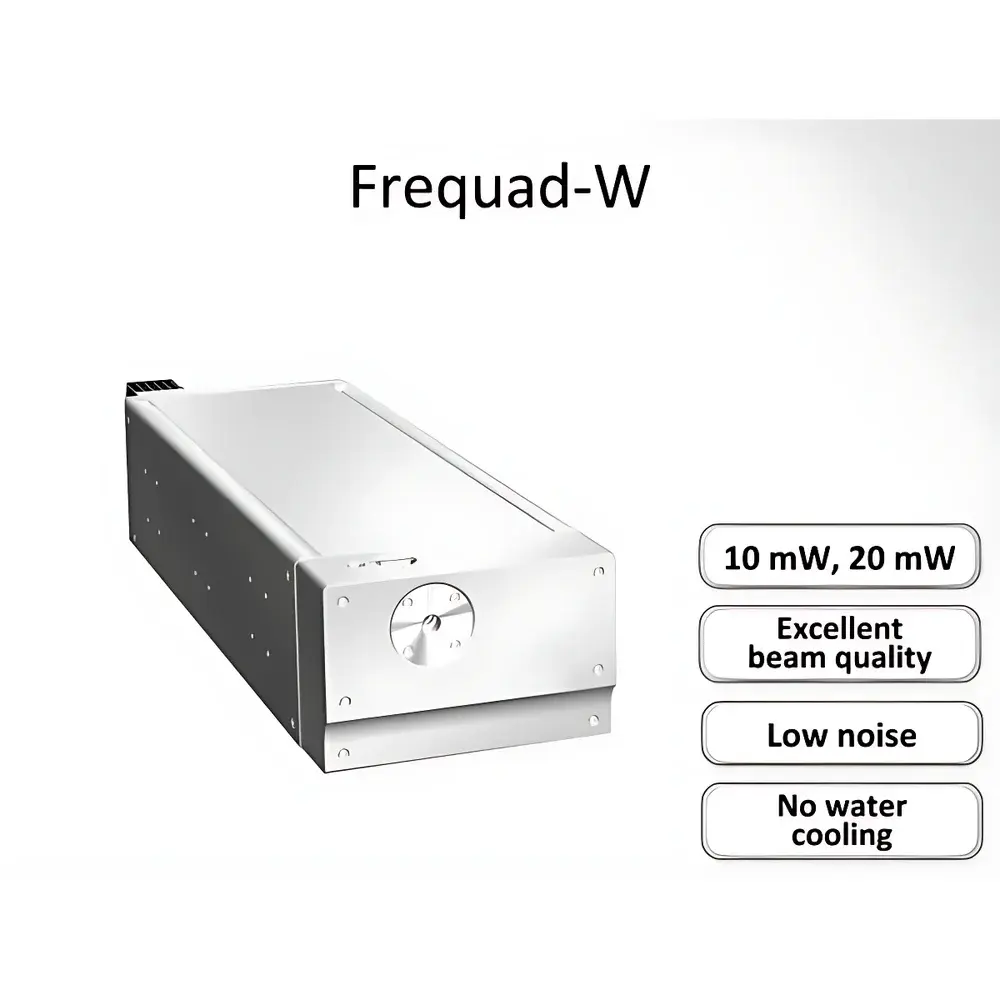
Auniontech Frequad-W 213 nm Single-Frequency Continuous-Wave Deep-Ultraviolet Laser System
| Brand | Auniontech |
|---|---|
| Wavelength | 213 nm |
| Output Power | 10–20 mW (CW) |
| Linewidth | < 0.01 pm |
| Polarization | Vertical, Linear |
| Beam Quality | TEM₀₀ |
| Extinction Ratio | > 100:1 |
| Power Supply | 100–240 V AC, 50/60 Hz |
| Power Consumption | < 300 W |
| Cooling | Air-cooled |
| Dimensions | 240 × 840 × 160 mm |
| Origin | Shanghai, China |
| Laser Type | Single Longitudinal Mode (SLM), Frequency-Doubled Quadrupled Solid-State Laser |
Overview
The Auniontech Frequad-W 213 nm Single-Frequency Continuous-Wave Deep-Ultraviolet (DUV) Laser System is a high-stability, narrow-linewidth coherent light source engineered for demanding scientific and industrial applications requiring precise deep-UV excitation. Based on OXIDE’s proven Frequad platform—refined over two decades for 266 nm CW single-frequency DUV generation—the Frequad-W extends this architecture to the 213 nm spectral region via fourth-harmonic generation (FHG) in nonlinear optical crystals. Its operation relies on intracavity frequency quadrupling of a master-oscillator fiber laser followed by active servo-locking to maintain longitudinal mode stability and spectral purity. With a typical output power of 10–20 mW, sub-0.01 pm intrinsic linewidth, and TEM₀₀ spatial profile, the system delivers exceptional coherence length (>100 m) and long-term frequency stability—critical for high-resolution photoemission spectroscopy, quantum material characterization, and metrology-grade lithography alignment.
Key Features
- Deep-ultraviolet emission at precisely 213 nm with single longitudinal mode (SLM) operation and guaranteed TEM₀₀ beam profile
- Ultra-narrow spectral linewidth < 0.01 pm (FWHM), enabling high-resolution spectroscopic interrogation and coherent interference applications
- High polarization extinction ratio > 100:1 with stable vertical linear polarization orientation
- Integrated active frequency stabilization via piezo-driven cavity locking and real-time error signal feedback
- Air-cooled thermal management architecture ensures low maintenance, compact footprint (240 × 840 × 160 mm), and operational reliability in standard laboratory environments
- Low power consumption (< 300 W) and universal AC input (100–240 V, 50/60 Hz) support flexible integration into cleanroom or benchtop setups
- Engineered for long-term operational stability using high-purity, radiation-hardened nonlinear crystals and hermetically sealed optical paths to minimize UV-induced degradation
Sample Compatibility & Compliance
The Frequad-W laser is designed for compatibility with vacuum-compatible and UHV-integrated instrumentation—including angle-resolved photoemission spectroscopy (ARPES) chambers, ultra-low-temperature cryostats (≤ 10 K), and high-NA UV microscopy platforms. Its 213 nm output meets critical requirements for bandgap-selective excitation in wide-bandgap semiconductors (e.g., AlN, Ga₂O₃, diamond), photoelectron ejection from valence bands with minimal thermal broadening, and efficient two-photon absorption in fused silica and specialized DUV-transmissive optics. The system complies with IEC 60825-1:2014 Class 3B laser safety standards and supports interlock integration per EN 61511 for industrial process control environments. While not certified to FDA 21 CFR Part 11, its deterministic frequency behavior and hardware-based stabilization architecture are compatible with GLP/GMP-aligned data acquisition workflows when paired with validated spectrometers or electron analyzers.
Software & Data Management
The laser operates via embedded microcontroller firmware with RS-232 and USB-C digital interfaces for remote monitoring and parameter adjustment. Optional OEM SDKs provide API-level access to real-time status telemetry—including diode current, crystal temperature, lock error voltage, and output power drift history—for synchronization with third-party DAQ systems (e.g., National Instruments PXI, Keysight PathWave). All operational logs—including runtime hours, thermal cycle counts, and lock acquisition events—are timestamped and stored in non-volatile memory for traceability. For research labs operating under ISO/IEC 17025 or ASTM E2912-compliant protocols, the system supports external TTL gating and analog modulation inputs (0–5 V) to enable synchronized pump-probe experiments or duty-cycle-controlled exposure in lithographic mask writing.
Applications
- Angle-resolved photoemission spectroscopy (ARPES) and laser-based ARPES (L-ARPES) for mapping electronic band structure in quantum materials, including kagome superconductors and topological insulators
- Deep-UV Raman spectroscopy for stress/strain analysis in SiC, GaN, and 2D heterostructures with enhanced signal-to-noise ratio and reduced fluorescence background
- Fiber Bragg grating (FBG) inscription in hydrogen-loaded or femtosecond-laser-sensitized photosensitive fibers requiring high spatial coherence and short interaction lengths
- UV photoluminescence imaging and lifetime mapping of wide-bandgap phosphors, perovskites, and defect-engineered diamond NV⁻ centers
- Photolithography alignment and overlay metrology in semiconductor front-end-of-line (FEOL) processes where 213 nm offers superior resolution over 248 nm KrF sources
- Time-resolved UV pump–UV probe studies of ultrafast carrier dynamics in oxide semiconductors and molecular crystals
FAQ
Is the 213 nm output power tunable across the specified range?
No—the system is factory-calibrated for fixed-output configurations (10 mW or 20 mW nominal); power adjustment is not implemented to preserve spectral purity and mode stability.
What is the expected lifetime of the nonlinear crystals under continuous 213 nm operation?
Based on accelerated aging tests and field data from the Frequad platform, the FHG crystal set maintains >95% initial conversion efficiency after ≥10,000 hours of cumulative operation when operated within specified thermal and power density limits.
Can the laser be integrated into a UHV chamber with differential pumping?
Yes—the beam delivery port is compatible with standard CF-63 or KF-40 vacuum feedthroughs; optional UV-grade CaF₂ windows and kinematic mounts are available for direct flange mounting.
Does the system include beam diagnostics such as power metering or M² measurement capability?
A calibrated photodiode monitor is integrated for real-time relative power tracking; however, absolute power calibration and M² characterization require external NIST-traceable instrumentation and are performed during installation qualification.
Are there restrictions on ambient operating conditions (temperature, humidity, vibration)?
Optimal performance requires ambient temperature stability ±1 °C/hour and relative humidity < 60% non-condensing; vibration isolation is recommended when used with interferometric or scanning electron-optical systems.





