
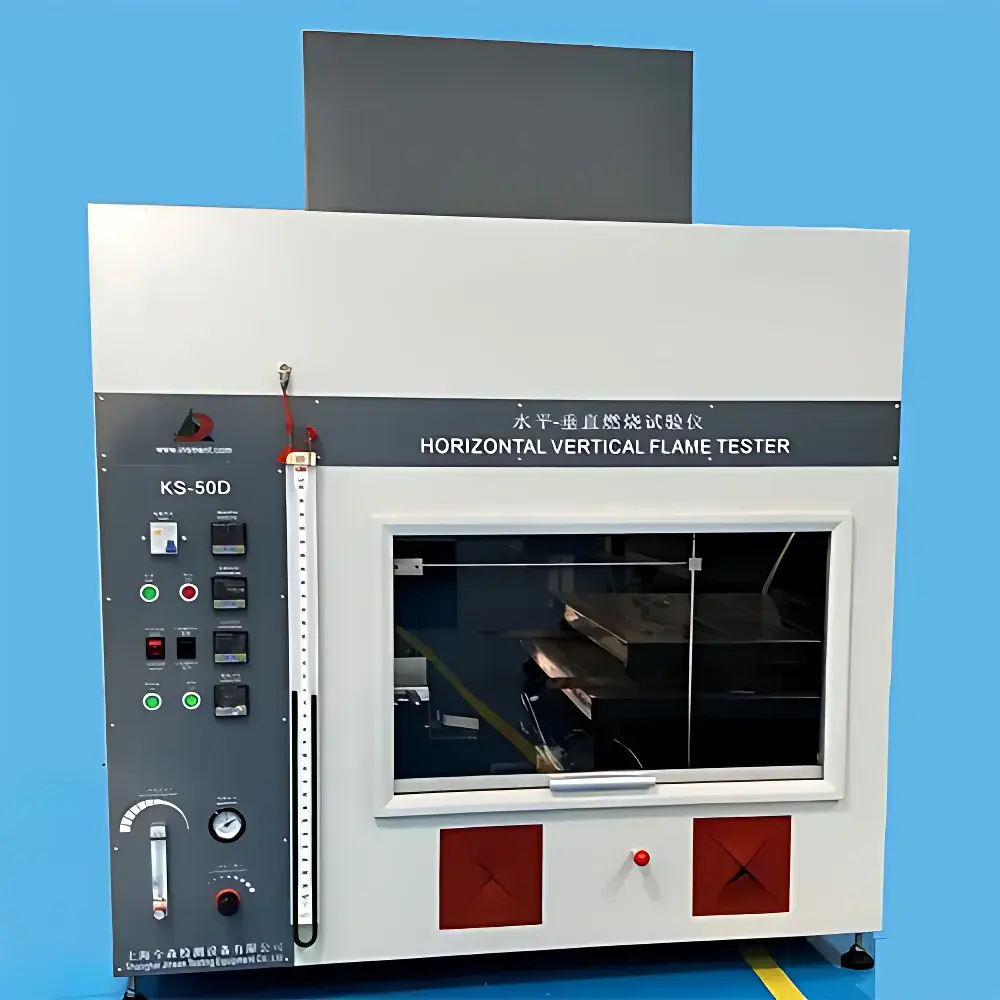
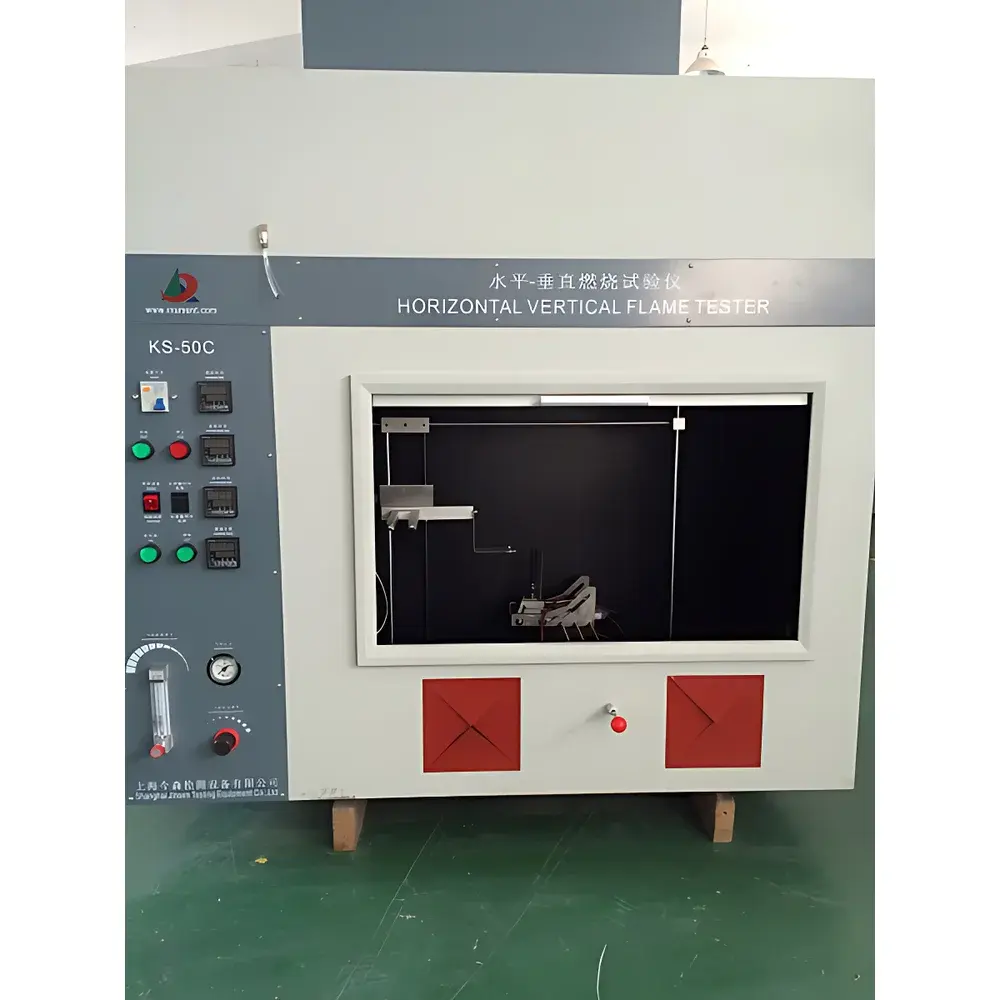
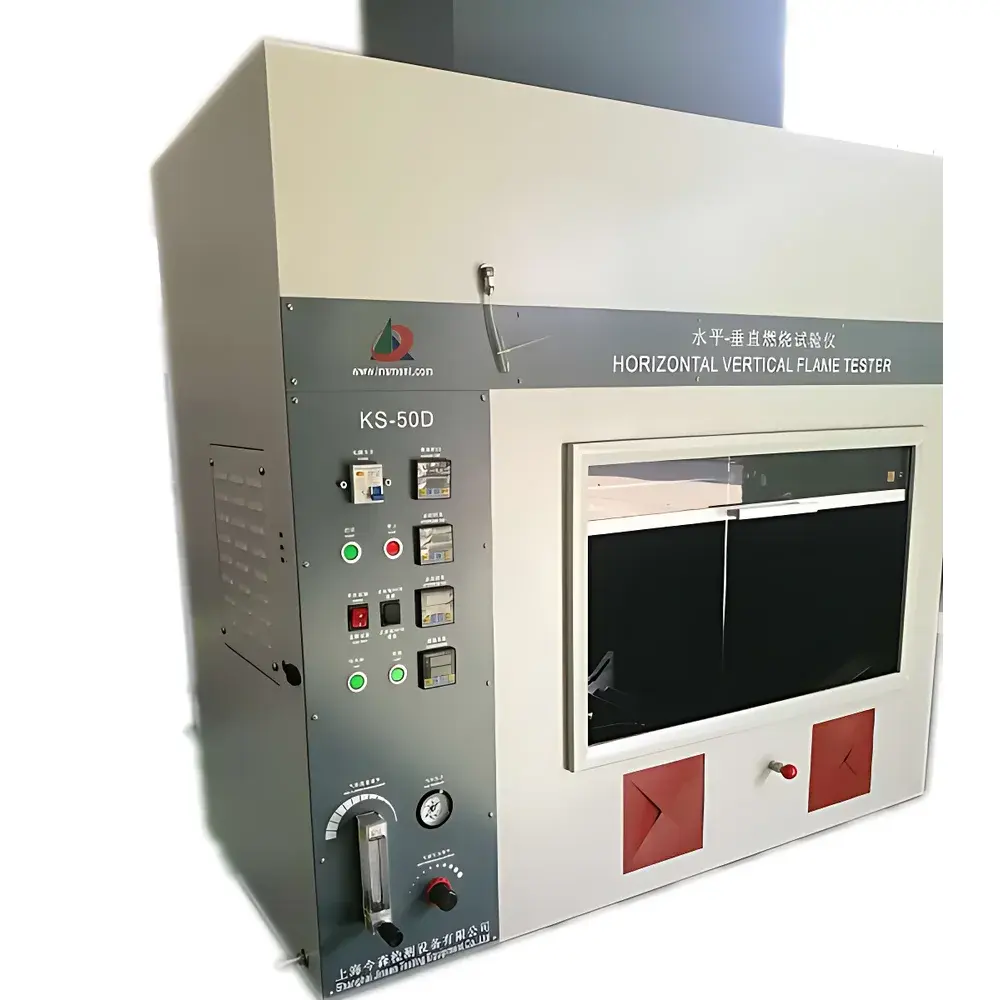
Insment KS-50D UL94 Horizontal & Vertical Combustion Test Chamber
| Brand | Insment |
|---|---|
| Model | KS-50D |
| Origin | Shanghai, China |
| Compliance | UL 94 (HB, V-0/V-1/V-2, 5VA/5VB), ASTM D5025/D5207, IEC 60695-11-3/-11-4/-11-10/-11-20, GB/T 2408-2008, GB/T 5169.16-2017, GB/T 5169.17-2017, ISO 9772:2001, ISO 9773:2018, ISO 10093:1998, GB/T 8332-2008 |
| Burner | 9.5 mm ± 0.5 mm Bunsen burner tip |
| Flame angle adjustment | 0–45° (graduated scale) |
| Flame height | 20 ± 1 mm (calibrated with 98% methane or equivalent 37 MJ/m³ natural gas/propane) |
| Flame temperature gradient | 100 °C ± 2 °C to 700 °C ± 3 °C in 54 s ± 2.0 s |
| Timing range | 1.0–999.9 s (digital presettable) |
| Ignition cycles | 1–9999 (digital presettable) |
| Ignition source | Medical-grade cotton |
| Chamber dimensions | 1220 mm (W) × 600 mm (D) × 1300 mm (H) |
| Chamber volume | 0.75 m³ |
| Construction | Stainless steel or powder-coated steel |
| Exhaust port | Ø100 mm |
| Power supply | AC 220 V, 50 Hz, 5 A |
| Optional accessories | K-type armored thermocouple (Ø0.5 mm), copper calibration probe (Ø9 mm, 10.0 ± 0.05 g), flame temperature verification system |
Overview
The Insment KS-50D UL94 Horizontal & Vertical Combustion Test Chamber is a precision-engineered apparatus designed for standardized flammability evaluation of solid polymeric materials, electrical enclosures, and component assemblies under controlled laboratory conditions. It operates on the fundamental principle of calibrated flame impingement—using a standardized Bunsen burner with precisely regulated gas flow, flame geometry, and thermal profile—to assess material response to ignition sources per internationally recognized fire safety protocols. The device supports both horizontal (HB-class) and vertical (V-0, V-1, V-2, 5VA, 5VB) test configurations as defined in UL 94, as well as specialized assessments for thin films (VTM-0/VTM-1/VTM-2), foams (HF-1/HF-2/HBF), and surface-burning behavior per ISO 9772 and GB/T 8332. Its architecture conforms to the mechanical, thermal, and operational requirements specified in ASTM D5025 (standard test method for conformance of burners used in small-flame tests), ensuring traceable repeatability across laboratories conducting regulatory compliance testing for lighting equipment, low-voltage apparatus, household appliances, motor components, and insulating materials.
Key Features
- Standard-compliant Bunsen burner with 9.5 mm ± 0.5 mm tip diameter and adjustable flame angle (0–45°) supported by a calibrated angular scale for precise orientation during vertical or inclined testing.
- Dual-mode digital timing system enabling independent presetting of application time (flame exposure duration) and afterflame/afterglow durations (1.0–999.9 s), with programmable cycle repetition (1–9999 iterations) for multi-step protocols.
- Integrated U-tube manometer mounted directly on the front panel for real-time gas pressure monitoring—eliminating external gauges and streamlining operator workflow.
- Remote-controlled footswitch interface allowing single-operator execution of ignition sequence, flame application, and timing initiation without manual proximity to the combustion zone.
- Auto-ignition module using piezoelectric spark generation, reducing operator variability and enhancing test consistency across shifts and personnel.
- Modular fixture system including horizontal, vertical, and flexible specimen holders—all equipped with three-axis (X/Y/Z) manual adjustment capability and compatible with rigid, semi-rigid, and compliant substrates per ISO 9773 and UL 94 Annex G.
- Explosion-rated internal lighting and sealed viewing window ensure optical observation while maintaining chamber integrity and operator safety during active combustion phases.
Sample Compatibility & Compliance
The KS-50D accommodates specimens up to 130 mm × 13 mm × 12.5 mm (standard UL 94 bars), thin films ≥ 0.1 mm thickness (VTM series), and foam slabs conforming to HF classification dimensions. Specimen mounting complies with dimensional tolerances and conditioning requirements outlined in IEC 60695-11-10 and GB/T 2408-2008. All test procedures adhere strictly to the pass/fail criteria defined in UL 94 Section 5 (burning rate, afterflame time, dripping behavior, and cotton ignition), ensuring results are admissible for certification submissions to Underwriters Laboratories, TÜV Rheinland, SGS, and CNAS-accredited bodies. The chamber’s construction materials, airflow management, and exhaust configuration meet ISO/IEC 17025 environmental control prerequisites for accredited testing laboratories.
Software & Data Management
While the base KS-50D model operates via electromechanical controls and digital timers, it is fully compatible with optional data acquisition modules supporting GLP-compliant audit trails. When integrated with third-party PC-based logging systems, the unit provides timestamped records of flame-on/off events, cycle counts, and operator identifiers—enabling alignment with FDA 21 CFR Part 11 requirements where electronic records are mandated. Calibration documentation—including burner temperature profile verification using NIST-traceable K-type thermocouples and copper probe validation—can be archived alongside raw test logs. All firmware and hardware configurations are documented per ISO/IEC 17025 Clause 5.5.2, facilitating internal audits and external accreditation reviews.
Applications
This test chamber serves quality assurance and R&D laboratories engaged in flame-retardant formulation development, comparative material screening, and pre-certification validation for end-use sectors including consumer electronics, automotive interior components, building insulation, textile upholstery, and medical device housings. It is routinely deployed to verify compliance with UL 94 V-0 ratings for PCB substrates, assess HB-class performance of polypropylene enclosures, validate 5VB resistance in high-temperature connectors, and evaluate HF-1 flame spread limits in mattress foams. Its adaptability to multiple international standards makes it suitable for global product development teams requiring harmonized test data across EU (EN 60695), North America (UL/ASTM), and China (GB/T 5169 series) regulatory frameworks.
FAQ
What gases are acceptable for calibration and routine testing?
Methane (≥98% purity, 37.3 MJ/m³ nominal calorific value), propane (≥98% purity, 94 ± 1 MJ/m³ at 25°C), or butane (≥99% purity, 120 ± 3 MJ/m³ at 25°C) may be used—provided the resulting flame meets the 20 ± 1 mm height and 100–700°C temperature ramp specifications verified with a calibrated thermocouple.
How often must the burner flame be recalibrated?
Flame calibration is required at least every 30 days, immediately after changing gas cylinders, and prior to each test session if non-standard gas is employed or if visual inspection indicates deviation from the established blue inner cone geometry.
Is the KS-50D suitable for testing flexible or irregularly shaped specimens?
Yes—the optional flexible specimen holder incorporates linear-motion guide rails and micrometer-adjustable clamping, enabling secure positioning of curved, layered, or low-rigidity samples while maintaining alignment with the burner axis per UL 94 Clause 7.3.
Does the chamber include provisions for exhaust gas treatment?
The unit features a dedicated Ø100 mm exhaust port compatible with standard laboratory fume hood ducting; however, an external scrubber or catalytic afterburner is recommended when testing halogenated polymers to mitigate corrosive off-gases.
Can test data be exported for LIMS integration?
When paired with the optional RS-485 or USB data interface module, timing events and cycle logs export in CSV format, supporting direct ingestion into Laboratory Information Management Systems compliant with ISO/IEC 17025 Clause 7.9.



