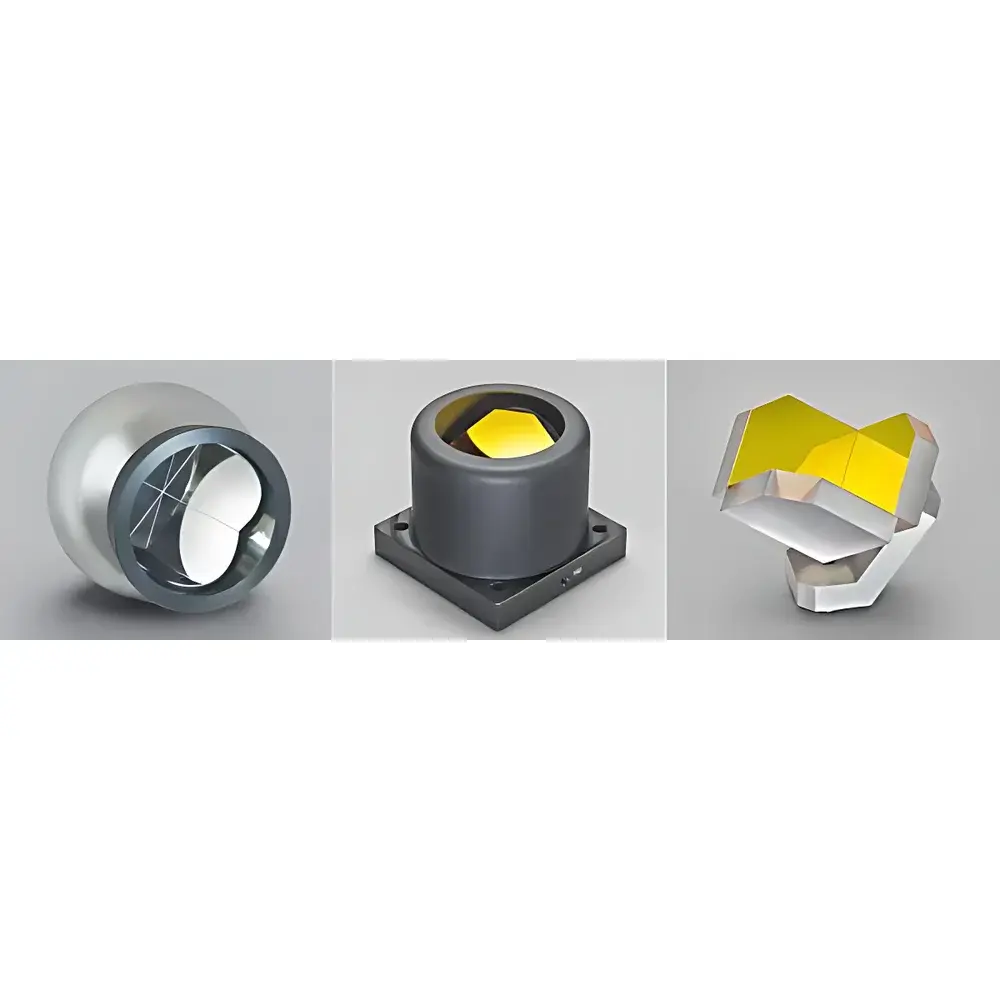
Auniontech High-Precision Hollow Retroreflector / Corner Cube Retroreflector
| Brand | Auniontech |
|---|---|
| Origin | Imported |
| Manufacturer Type | Authorized Distributor |
| Model | Hollow Retroreflector Series (USHM/LPR/OWHR/TC/AR) |
| Optical Principle | Air-core three-mirror corner cube retroreflection |
| Beam Deviation | 0.5–30 arcsec |
| Wavefront Error (p.v., 633 nm) | 0.10–18.0 λ |
| Weight Range | 21 g – 3.86 kg |
| Material | Invar (USHM), Aluminum (LPR, OWHR), Stainless Steel Housing (AR) |
| Coating | Broadband Dielectric (UV–IR Optional) |
| Compliance | ISO 10110-7, MIL-PRF-13830B, ANSI/OEOSC B11.1 |
Overview
The Auniontech High-Precision Hollow Retroreflector is an optomechanical device engineered for ultra-stable, air-path retroreflection in demanding metrological, interferometric, and alignment applications. Unlike solid-glass corner cubes, its hollow architecture eliminates material-induced wavefront distortion, chromatic dispersion, and thermal absorption—making it ideal for high-power laser systems, vacuum environments, and broadband spectral applications (e.g., FTIR, LIDAR, gravitational wave detection testbeds). The device consists of three precisely aligned, dielectric-coated mirrors mounted orthogonally on a rigid mechanical frame. Incident collimated light—regardless of input angle within the acceptance cone—is reflected back along its incident path with angular deviation as low as 0.5 arcseconds and wavefront error (p.v. at 633 nm) down to λ/10. Its insensitivity to mechanical vibration and thermal drift stems from symmetric mass distribution, low thermal expansion substrates (e.g., Invar in USHM series), and absence of bulk optical material.
Key Features
- Air-core optical path: Eliminates refractive index variation, bulk absorption, and chromatic aberration—critical for UV–IR broadband operation and high-average-power laser systems.
- Sub-arcsecond angular stability: USHM-series units achieve ≤0.5 arcsec beam deviation; OWHR-series maintains <1.0 arcsec over ±5° field of view.
- Low wavefront distortion: p.v. errors range from λ/10 (USHM-15) to λ/3.5 (USHM-10), verified via phase-shifting interferometry per ISO 10110-7.
- Vibration-insensitive design: Hollow geometry reduces mass inertia; Invar-based mounts (USHM) deliver coefficient of thermal expansion (CTE) <2 × 10⁻⁶ /°C over −20°C to +60°C.
- OEM-optimized form factors: LPR-series features low-profile packaging (<12 mm height) for integration into FTIR spectrometers and compact interferometers.
- Modular scalability: AR-series retroreflector arrays support up to 60 elements on aluminum carrier plates, enabling large-aperture self-compensating reference surfaces with field uniformity ≤20 arcsec.
Sample Compatibility & Compliance
The Auniontech Hollow Retroreflector series is compatible with collimated beams from HeNe, diode, fiber-coupled, and ultrafast lasers (CW and pulsed, up to 10 J/cm² at 1064 nm with appropriate coating). All models meet surface quality requirements per MIL-PRF-13830B (scratch-dig 10–5), and coated optics conform to ISO 9211-3 for environmental durability (humidity, abrasion, adhesion). USHM and TC series are qualified for use in Class 100 cleanrooms and vacuum chambers (10⁻⁶ Torr). Documentation includes full interferometric test reports, CTE validation data, and RoHS/REACH compliance certificates. Units intended for regulated industries (e.g., aerospace metrology, medical laser calibration) support traceable calibration to NIST standards upon request.
Software & Data Management
While inherently passive, these retroreflectors integrate seamlessly into automated alignment and metrology platforms. Auniontech provides mechanical drawings (STEP, IGES), mounting interface specifications (ISO 20/30/50 tapped holes, kinematic grooves), and alignment tolerance stacks for system-level error budgeting. For customers implementing closed-loop interferometric control (e.g., using Zygo Verifire or Keysight 5530 systems), we supply wavefront error maps and beam deviation profiles in ASCII format for direct import into error compensation algorithms. Full GLP/GMP documentation packages—including calibration history, environmental test logs, and material certifications—are available under controlled document release protocols compliant with ISO/IEC 17025 and FDA 21 CFR Part 11 audit requirements.
Applications
- Laser interferometry: Primary retroreflector in heterodyne and homodyne displacement measurement systems (e.g., HP/Keysight 5529A, Renishaw XL-80).
- FTIR spectrometer beam steering: LPR-series enables stable, low-profile retroreflection in Michelson interferometers without thermal lensing artifacts.
- Gravitational wave detector alignment: OWHR-series used in mode-cleaner cavities and auxiliary beam paths requiring wide-angle, low-distortion return.
- Aerospace ground testing: TC-series cube retroreflectors serve as orthogonal axis references during multi-laser alignment of satellite optical benches.
- Large-scale metrology: AR-series arrays function as distributed fiducial surfaces in photogrammetric and laser tracker verification workflows (e.g., ISO 10791-6).
- Quantum optics setups: Air-path design prevents decoherence pathways associated with glass media—used in cavity QED and atom interferometry experiments.
FAQ
What distinguishes a hollow retroreflector from a solid fused-silica corner cube?
Hollow retroreflectors eliminate material-dependent effects: no thermal lensing, no chromatic dispersion, no UV absorption, and no birefringence—enabling superior long-term stability and broadband performance.
Can these retroreflectors be used in vacuum environments?
Yes. All USHM, OWHR, and TC series units are vacuum-compatible (10⁻⁶ Torr) with outgassing rates certified per ASTM E595.
Do you provide custom coating options?
Yes. Broadband (400–1600 nm), high-LIDT (1064 nm, 10 ns), and polarization-preserving coatings are available upon specification.
Is wavefront error measured per element or across the full aperture?
Each unit undergoes full-aperture, phase-shifting interferometric testing at 633 nm; reported p.v. values reflect worst-case deviation across the clear aperture.
How is angular stability validated?
Beam deviation is measured using autocollimation with a 0.01 arcsec-resolution electronic autocollimator (e.g., Thorlabs ACL250), under thermal soak (±5°C/h) and mechanical perturbation per ISO 10110-7 Annex D.