
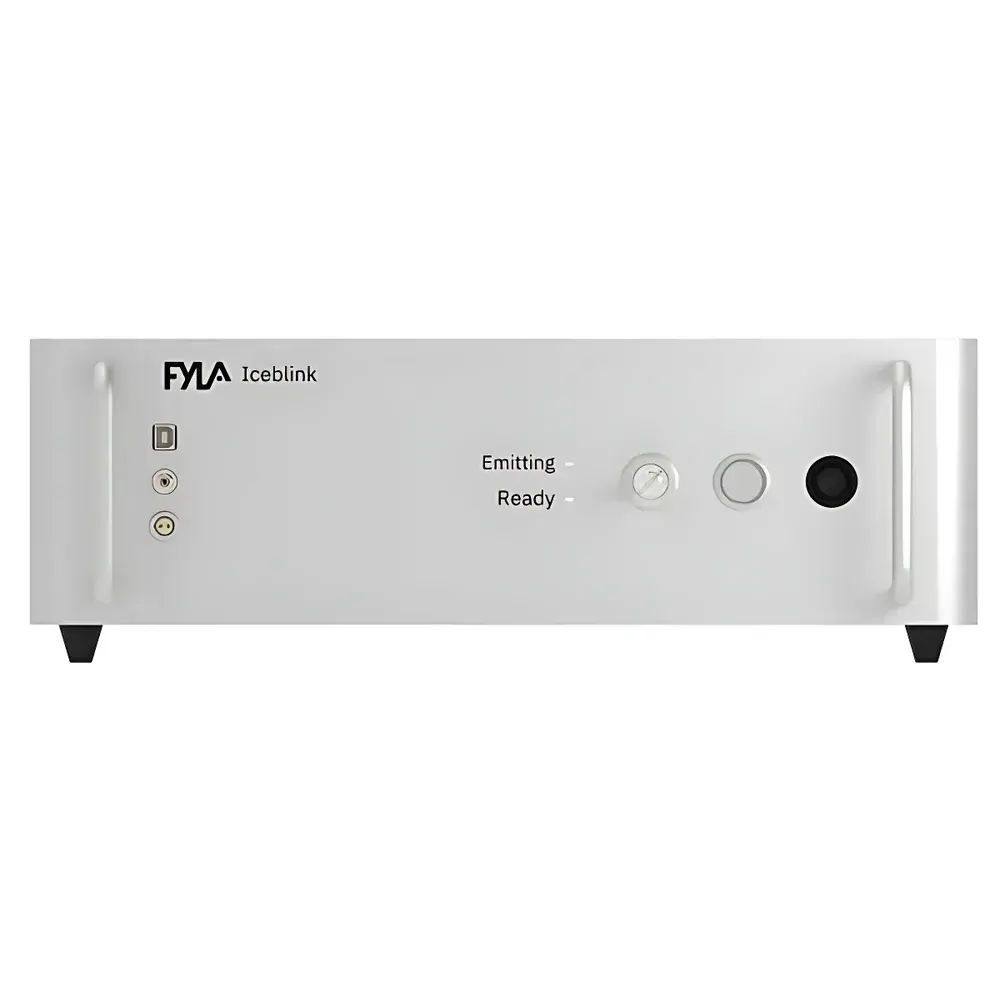
Auniontech Iceblink 400–2300 nm Picosecond Supercontinuum Laser
| Brand | Auniontech |
|---|---|
| Spectral Range | 450–2300 nm |
| Average Output Power | >1000 mW |
| Pulse Width | <10 ps |
| Repetition Rate | 40 MHz (adjustable from 2.5 to 40 MHz via optional PulsePicker) |
| Power Stability | <0.5% RMS (std. dev.) |
| Polarization | Unpolarized |
| Beam Delivery | Collimated (450–1000 nm), Single-Mode Fiber-Coupled (entire spectrum) |
| Spatial Mode | M² < 1.2 |
| Beam Diameter | <4.0 mm (1/e² @ 532 nm, 0.5 m from output) |
| Cooling | Air-cooled |
| Input Power | 110/220 V, 50/60 Hz |
| Operating Temperature | 20–30 °C |
| Storage Temperature | 0–60 °C |
| Dimensions (W×D×H) | 436 × 560 × 151 mm |
| Output Connector | FC/APC |
| Optional Accessories | Visible-band bandpass filters, PulsePicker module, BOREAL wavelength-selective tuning unit |
Overview
The Auniontech Iceblink 400–2300 nm Picosecond Supercontinuum Laser is a fiber-based, high-brightness broadband light source engineered for demanding applications in ultrafast spectroscopy, multispectral imaging, and precision optical metrology. It generates coherent supercontinuum radiation through nonlinear spectral broadening—primarily self-phase modulation and soliton fission—in highly nonlinear photonic crystal fiber pumped by a mode-locked picosecond Yb-fiber laser. With a continuous spectral coverage spanning the visible (VIS), near-infrared (NIR), and short-wave infrared (SWIR) regions—from 450 nm to 2300 nm—the Iceblink delivers >1000 mW of average power with sub-10 ps pulse duration and exceptional temporal stability (<0.5% RMS power fluctuation over 24 h). Its spatial coherence (M² < 1.2), collimated VIS/NIR output, and single-mode fiber delivery across the full bandwidth enable direct integration into confocal microscopes, OCT systems, hyperspectral cameras, and pump-probe setups without requiring complex beam conditioning.
Key Features
- Ultra-Broadband Emission: Seamless spectral output from 450 nm to 2300 nm—covering UV-Vis-NIR-SWIR—enabling simultaneous multi-region excitation or detection without source switching.
- High Average Power & Stability: >1000 mW total average power with <0.5% RMS power stability (measured over 8 hours), ensuring reproducible quantitative measurements in long-duration experiments.
- Picosecond Pulse Architecture: <10 ps pulse width at 40 MHz repetition rate; compatible with external pulse picking (2.5–40 MHz) for time-resolved studies requiring variable duty cycle or reduced average power.
- Engineered Beam Quality: Collimated free-space output (450–1000 nm) and diffraction-limited single-mode fiber coupling (entire 450–2300 nm range) support both bulk-optics alignment and fiber-integrated architectures.
- Robust Thermal Management: Fully air-cooled design with passive heat dissipation architecture—no chiller or water lines required—ensuring reliability in lab and cleanroom environments.
- Modular Expandability: Native compatibility with optional accessories including visible-band bandpass filters, the BOREAL tunable wavelength selector (enabling quasi-monochromatic output across VIS), and FC/APC-coupled synchronization ports for lock-in or time-of-flight triggering.
Sample Compatibility & Compliance
The Iceblink is designed for use with standard optical components rated for broadband operation (e.g., fused silica lenses, CaF₂ windows, InGaAs detectors) and supports non-destructive, non-contact measurement protocols compliant with ISO/IEC 17025-accredited laboratory practices. Its low timing jitter (<100 fs RMS) and stable pulse-to-pulse energy make it suitable for GLP- and GMP-aligned applications where traceable, repeatable illumination is required—such as reference-grade spectrophotometer calibration, quantum efficiency mapping of photodetectors, and absorption coefficient validation per ASTM E275 and ISO 11146. The system operates without hazardous materials or Class IV laser enclosures when used with appropriate interlocks and beam containment—fully conforming to IEC 60825-1:2014 safety standards for Class 4 laser products.
Software & Data Management
The Iceblink integrates seamlessly with third-party control ecosystems via TTL-synchronized optical trigger output and RS-232/USB interfaces. While no proprietary GUI is bundled, its hardware-level synchronization signals are fully compatible with National Instruments LabVIEW, MATLAB Instrument Control Toolbox, and Python-based automation frameworks (e.g., PyVISA, QCoDeS). All operational parameters—including pulse picker frequency, internal shutter state, and thermal sensor readouts—are accessible through ASCII command protocol, enabling full audit trail logging for FDA 21 CFR Part 11–compliant workflows. Power monitoring data can be streamed in real time for integration into centralized LIMS or ELN platforms, supporting automated QC pass/fail decisions based on predefined stability thresholds.
Applications
- Time-Resolved Spectroscopy: Pump-probe experiments leveraging dual-wavelength excitation (e.g., 500 nm pump + 1550 nm probe) with precise temporal overlap enabled by low-jitter synchronization.
- Hyperspectral Imaging: Illumination source for push-broom and snapshot SWIR imaging systems requiring uniform spectral radiance across 1000–2300 nm.
- Fluorescence Lifetime Imaging (FLIM): Excitation of multiple fluorophores (e.g., GFP, Cy5, IRDye800CW) with single-source broadband pulses, eliminating sequential filter wheel delays.
- Optical Coherence Tomography (OCT): High-resolution axial scanning in ophthalmic and dermatological OCT systems, benefiting from extended coherence length in the 1300 nm and 1550 nm windows.
- Material Characterization: Broadband reflectance/transmittance mapping of thin films, 2D materials, and photovoltaic absorbers under standardized irradiance conditions per IEC 60904-9.
- Calibration Standards: Reference source for NIST-traceable spectral radiance calibration of integrating spheres, monochromators, and array spectrometers.
FAQ
What is the typical spectral power distribution across the 450–2300 nm range?
The Iceblink delivers >30 mW in the 450–750 nm band, ~550 mW from 750–1000 nm, >400 mW from 1000–1100 nm, and >800 mW from 1100–2300 nm—optimized for balanced NIR/SWIR throughput while maintaining usable VIS intensity.
Is the output polarized?
No—the supercontinuum emission is unpolarized by design, though polarization-maintaining fiber variants or external polarization optics can be integrated upon request.
Can the Iceblink be synchronized with external femtosecond lasers?
Yes—via its optical sync output (TTL-compatible, <100 fs jitter relative to pulse train), it serves as a stable master clock reference for hybrid ultrafast systems.
Does the system require water cooling or external chillers?
No—all thermal management is achieved via convection-cooled heatsinks and intelligent fan control; ambient air exchange is sufficient for continuous operation within 20–30 °C.
What safety certifications does the Iceblink hold?
It complies with IEC 60825-1:2014 (Class 4 laser product) and carries CE marking for EMC and LVD directives; full safety documentation—including hazard analysis and interlock schematics—is provided with each unit.




