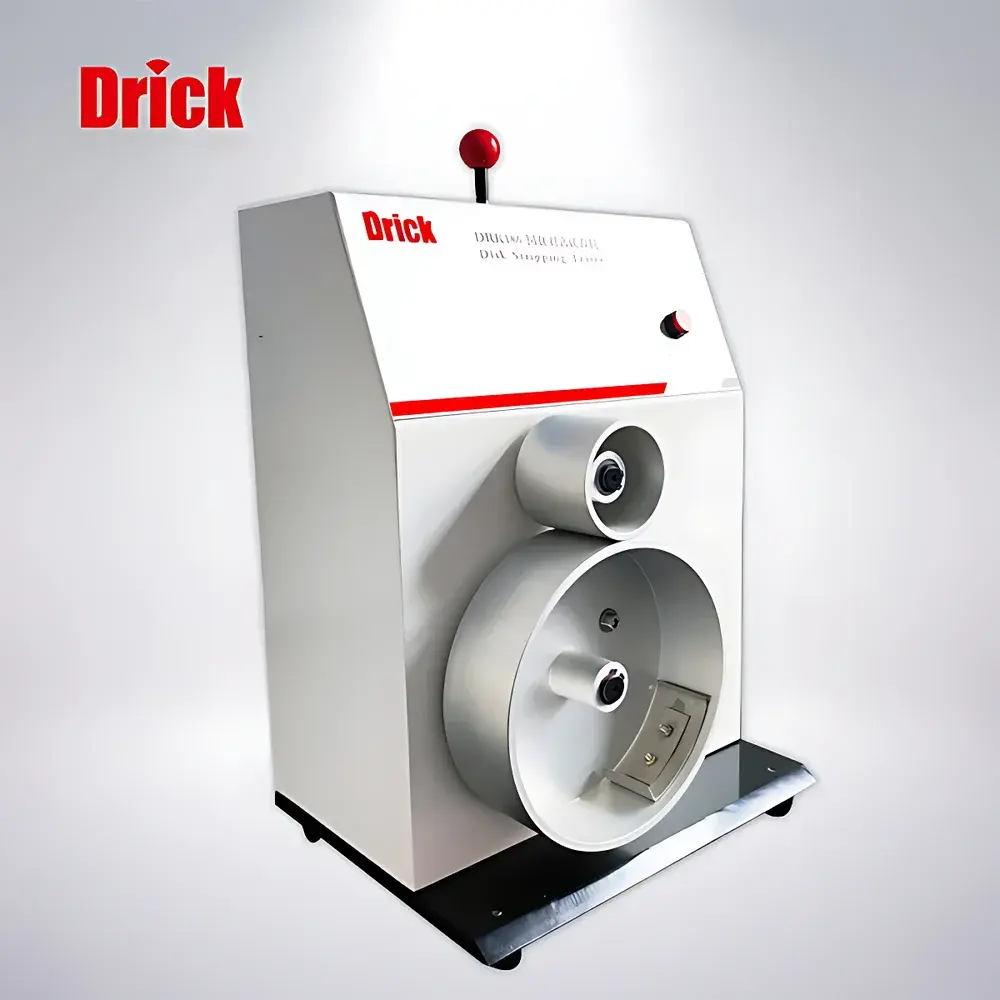
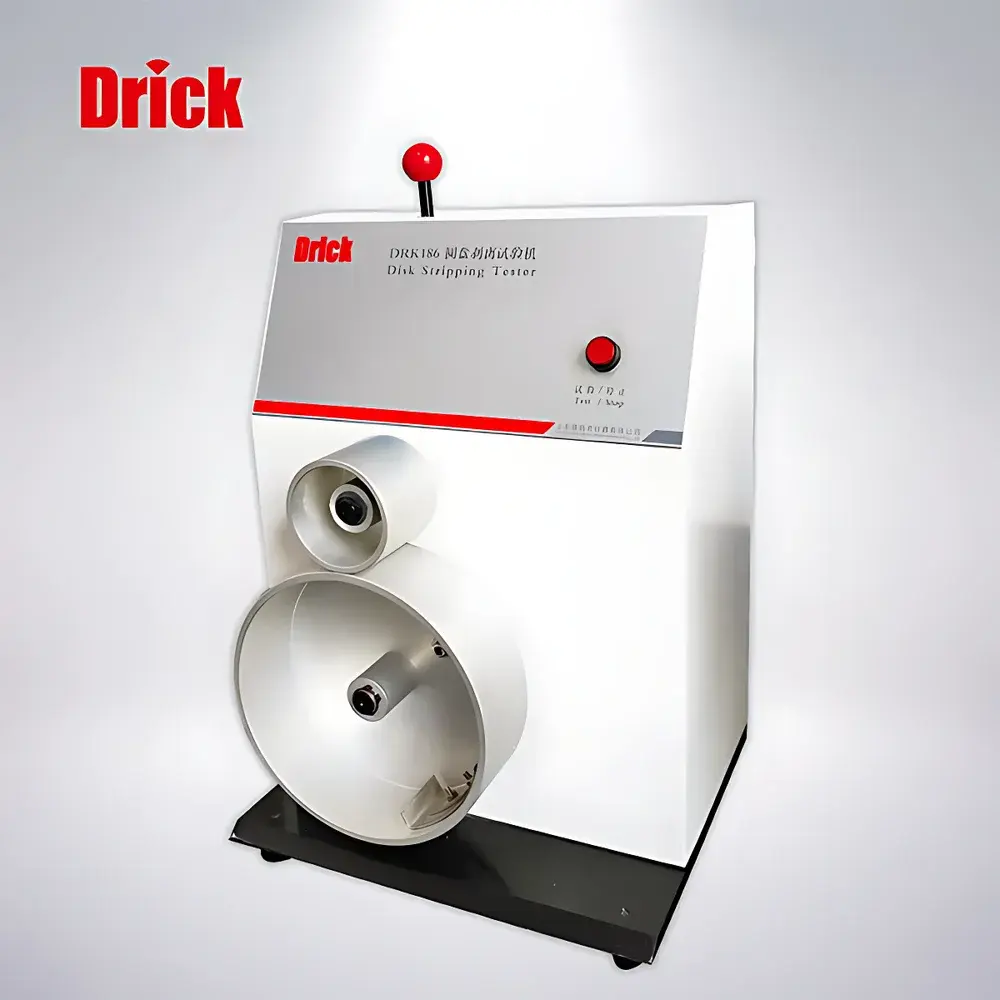
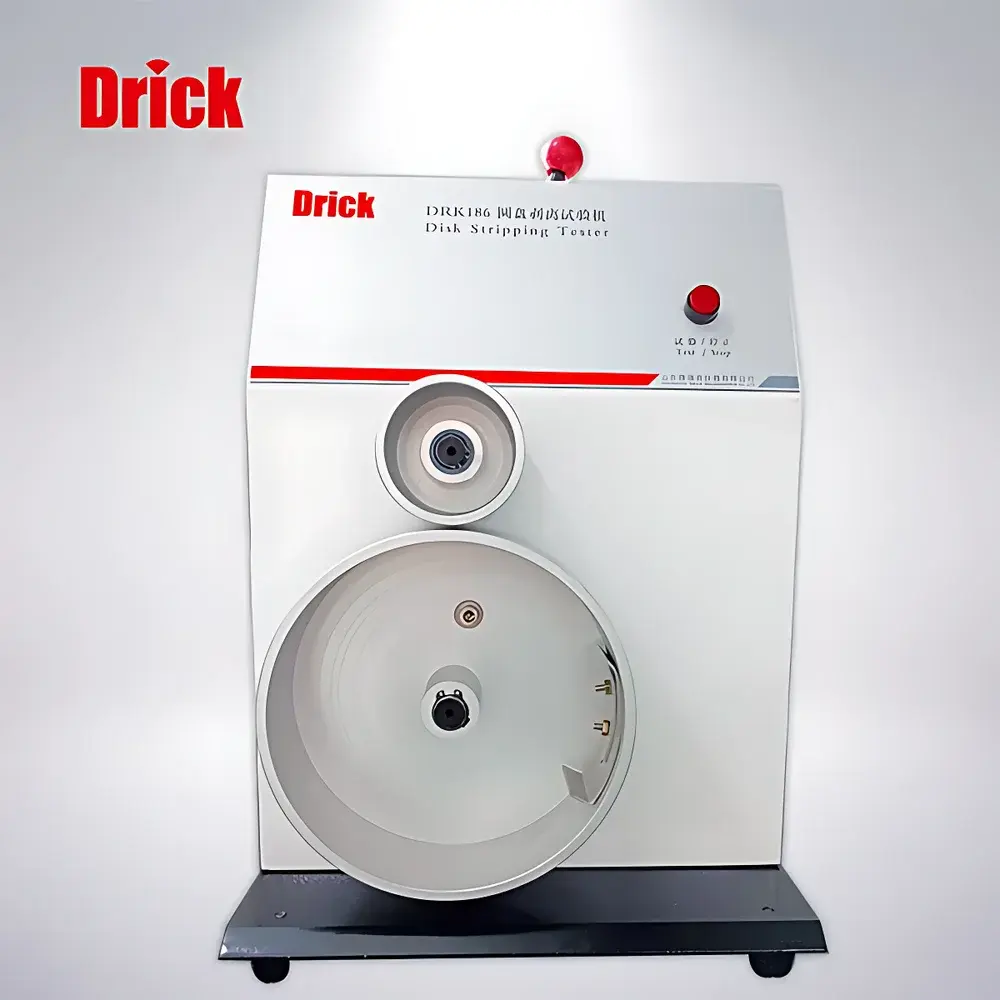
Drick DRK186 Disc Peel Tester for Ink Adhesion Strength Testing of Plastic Films and Printed Packaging
| Brand | Drick |
|---|---|
| Model | DRK186 |
| Principle | Controlled-disc peel adhesion measurement under standardized normal force and constant linear speed |
| Standard Compliance | GB/T 7707, JIS C2107, JIS Z0237 |
| Disc Pressure | 100 N |
| Peel Speed | 0.8 m/s |
| Dimensions (L×W×H) | 280 × 230 × 380 mm |
| Power Supply | AC 220 V, 50 Hz |
| Net Weight | 21 kg |
| Application Scope | Plastic films, cellophane, laminated flexible packaging, vacuum-metallized substrates, coated surfaces |
Overview
The Drick DRK186 Disc Peel Tester is an engineered laboratory instrument designed to quantitatively evaluate the interfacial adhesion strength between ink layers and flexible substrates—particularly plastic films (e.g., BOPP, PET, PE), cellophane, and metallized or coated packaging materials. It operates on the principle of controlled-disk peel testing: a rotating circular disc applies a defined normal force (100 N) while traversing the printed surface at a fixed linear velocity (0.8 m/s), mechanically inducing progressive delamination of the ink film. The resulting resistance—measured as peak or average peel force—is directly correlated with ink-substrate bond integrity. This method replicates real-world mechanical stresses encountered during high-speed packaging line operations, unwinding, or post-printing lamination, making it indispensable for quality control in gravure-printed flexible packaging production.
Key Features
- Fixed-disc geometry with precision-machined stainless-steel peeling head ensures repeatable contact area and consistent normal loading (100 N) across test cycles.
- Motor-driven constant-speed translation system maintains a stable peel velocity of 0.8 m/s—aligned with GB/T 7707 and JIS Z0237 requirements for comparative adhesion assessment.
- Compact benchtop footprint (280 × 230 × 380 mm) enables integration into QC labs with limited floor space, without compromising structural rigidity or vibration damping.
- Integrated thermal-printing module delivers immediate hard-copy output of peel force curves and numerical maxima/averages—eliminating dependency on external data loggers or PC software for routine pass/fail verification.
- Designed for operational robustness: aluminum alloy frame, corrosion-resistant hardware, and sealed motor housing support long-term reliability in industrial lab environments.
Sample Compatibility & Compliance
The DRK186 accommodates standard test specimens measuring ≥100 mm × 100 mm—including monolayer and coextruded plastic films, metallized polyester (VMPET), sputter-coated substrates, solvent- or UV-cured gravure inks, and aqueous-based flexographic overprints. Its mechanical configuration conforms to the geometric and procedural specifications outlined in GB/T 7707–2008 (Chinese national standard for gravure print adhesion), JIS C2107 (Japanese standard for printed electronics substrate adhesion), and JIS Z0237 (adhesion testing of pressure-sensitive tapes and functional coatings). While not certified to ISO/IEC 17025 calibration requirements out-of-the-box, the unit supports traceable verification using NIST-traceable force calibration standards (e.g., Class M2 load cells) and is routinely employed in GLP-compliant packaging validation workflows.
Software & Data Management
The DRK186 operates as a standalone instrument with embedded firmware; no proprietary PC software is required for basic operation. Peel force data are recorded in real time and printed directly via its built-in thermal printer—each report includes date/time stamp, sample ID field (manually entered), peak force (N), average peel force (N), and graphical trace (force vs. displacement). For laboratories requiring digital archiving, raw analog output (0–10 V) is accessible via rear-panel BNC connector, enabling connection to third-party DAQ systems compliant with FDA 21 CFR Part 11 (when paired with validated acquisition software and audit-trail-enabled hardware). All printed reports retain permanent physical records suitable for internal QA audits and customer documentation packages.
Applications
- Verification of ink adhesion performance after curing (thermal, UV, or electron beam) in gravure printing lines for food and pharmaceutical packaging.
- Comparative evaluation of primer efficacy on low-surface-energy films (e.g., PP, PE) prior to metallization or coating.
- Process validation of vacuum aluminizing parameters by assessing aluminum layer cohesion on PET or OPP substrates.
- Root-cause analysis of delamination defects observed in laminated pouches—distinguishing ink-substrate failure from interlayer adhesive failure.
- Supplier qualification testing per ASTM D3330 Annex A3 (peel adhesion of pressure-sensitive tapes) adapted for thin-film functional coatings.
FAQ
Does the DRK186 comply with ISO 8510-2 for peel testing?
No—the DRK186 implements a disc-based peel methodology specified in GB/T 7707 and JIS standards, not the 90° or 180° tensile peel configurations covered by ISO 8510-2.
Can it test samples thinner than 12 µm?
Yes—provided the substrate exhibits sufficient tensile modulus to resist buckling under 100 N disc pressure; ultra-thin films (e.g., 6 µm PET) require rigid backing support during clamping.
Is calibration certificate included with shipment?
A factory verification report is supplied; however, formal calibration against accredited standards must be performed onsite by qualified metrology personnel using traceable force references.
What maintenance intervals are recommended?
Lubrication of the disc translation rail every 6 months and periodic inspection of peeling disc edge wear (visual check every 200 tests) ensure measurement consistency.
Is the thermal printer compatible with continuous-feed label stock?
No—it accepts only standard 57 mm wide thermal paper rolls (included); custom media adaptation requires firmware modification not supported by Drick.