
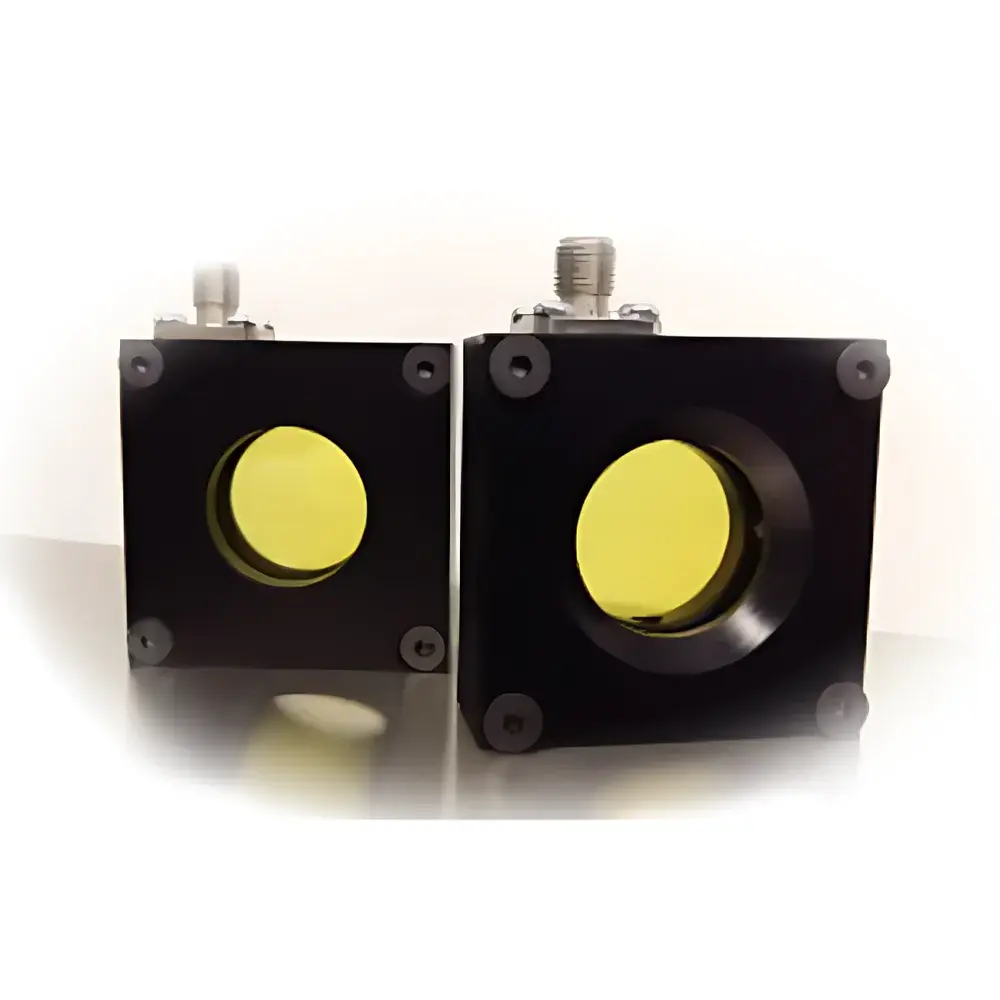
Auniontech OA-SLM Optical Addressable Liquid Crystal Spatial Light Modulator
| Brand | Auniontech |
|---|---|
| Origin | Shanghai, China |
| Model | OA-SLM |
| Wavelength Range | 400–590 nm or 780–1650 nm |
| Operating Mode | Transmissive |
| Aperture | Ø20 mm (up to 4×4 cm²) |
| Resolution | 1920×1080 pixels |
| Response Time | 15 ms |
| Transmission | >83% |
| Laser-Induced Damage Threshold (LIDT) | 2 J/cm² @ 1064 nm, 10 ns, 10 Hz |
Overview
The Auniontech OA-SLM Optical Addressable Liquid Crystal Spatial Light Modulator is a high-fidelity, transmissive photonic device engineered for dynamic, pixel-level control of optical wavefronts. Unlike conventional electrically addressed SLMs, the OA-SLM employs an optical addressing architecture: a spatially patterned “write beam” (typically in the visible range, 450–570 nm) illuminates a photoconductive layer, locally modulating its conductivity and thereby establishing a corresponding voltage distribution across the liquid crystal (LC) layer. This voltage profile induces reorientation of LC molecules—altering birefringence—and thus spatially encoding phase, amplitude, or polarization modulation onto a collimated “read beam”. The device operates on the principle of coupled optoelectronic feedback within a hybrid thin-film stack, enabling non-contact, parallel, and diffraction-limited wavefront shaping without physical electrode patterning constraints. Its design supports both static and real-time programmable light-field engineering, making it suitable for applications demanding high spatial fidelity and temporal agility in coherent optical systems.
Key Features
- Optical Addressing Architecture: Eliminates electrode-based pixel wiring; enables scalable, high-density pixel arrays with uniform drive characteristics and no electrical crosstalk.
- Multi-Parameter Modulation Capability: Supports independent or concurrent control of phase, intensity, and polarization states via precise LC orientation tuning—facilitating vectorial light-field synthesis.
- High Spatial Resolution: Native 1920×1080 pixel array with sub-20 µm pitch, optimized for diffraction-limited performance in near-UV to near-IR spectral bands (400–590 nm and 780–1650 nm).
- Fast Electro-Optic Response: <15 ms full-range LC reorientation time, compatible with kHz-rate pattern updates when synchronized with external trigger signals.
- High Optical Throughput: >83% average transmission across operational bands, minimizing thermal loading and signal loss in power-sensitive interferometric or holographic setups.
- Robust Laser Compatibility: LIDT of 2 J/cm² at 1064 nm (10 ns, 10 Hz), validated per ISO 21254-1, supporting integration into pulsed laser processing and ultrafast optical systems.
Sample Compatibility & Compliance
The OA-SLM is designed for use with standard collimated free-space optical beams and integrates seamlessly into breadboard-based or cage-system optical platforms. Its transmissive geometry and Ø20 mm clear aperture (expandable to 4×4 cm² custom variants) accommodate common Gaussian and flat-top beam profiles up to 12 mm 1/e² diameter. The device complies with IEC 61000-6-3 (EMC emission limits) and meets RoHS Directive 2011/65/EU for hazardous substance restriction. While not certified for medical or aerospace safety-critical use out-of-the-box, its optical and thermal performance data are traceable to NIST-traceable calibration protocols. For regulated environments (e.g., GLP-compliant holographic metrology or FDA-reviewed optical trapping setups), full audit trails—including firmware version logs, exposure history, and environmental sensor records—can be enabled via optional API-integrated monitoring modules.
Software & Data Management
Auniontech provides a cross-platform SDK (Windows/Linux/macOS) supporting Python, MATLAB, and C/C++ APIs for low-latency pattern generation and synchronization. The included control suite features real-time gamma correction, phase unwrapping utilities, and hardware-accelerated Fourier hologram computation. All generated patterns are stored with embedded metadata (timestamp, wavelength, polarization state, exposure duration), ensuring full reproducibility. When deployed in validated laboratory environments, the software supports 21 CFR Part 11-compliant electronic signatures and audit trail generation—including user login events, parameter change logs, and export timestamps—via optional enterprise license modules. Raw frame buffers and calibration matrices are saved in HDF5 format for interoperability with SciPy, LabVIEW, and Zemax OpticStudio workflows.
Applications
- Reconfigurable phase/amplitude/polarization masks for adaptive optics and computational imaging
- Digital holographic lithography and maskless laser direct writing
- Dynamic point-spread function engineering in super-resolution microscopy
- Quantum optics experiments requiring spatially structured pump/probe fields (e.g., orbital angular momentum sorting, entangled photon shaping)
- Real-time optical encryption and diffractive neural network inference
- Calibration source for wavefront sensors (Shack–Hartmann, curvature sensors) and interferometer reference generation
FAQ
What write beam specifications are required to drive the OA-SLM?
A collimated, spatially uniform visible-light source (450–570 nm) with adjustable intensity (0.1–10 mW/cm²) and stable pointing is recommended. LED or CW diode lasers are commonly used; pulsed sources require synchronization with LC relaxation timing.
Can the OA-SLM operate simultaneously at two wavelengths (e.g., 532 nm write + 1064 nm read)?
Yes—the photoconductive layer responds only to the write band (VIS), while the LC layer modulates the read beam across both specified ranges (400–590 nm and 780–1650 nm) independently.
Is temperature stabilization required for phase-stable operation?
For sub-wavelength phase accuracy (<λ/20 RMS), active temperature control (±0.1°C) of the SLM housing is recommended; passive thermal management suffices for amplitude-only or coarse-phase applications.
How is calibration performed for quantitative phase modulation?
Auniontech supplies factory-measured voltage–phase transfer functions (V-Φ curves) per batch, along with interferometric calibration reports traceable to NIST standards. In-house calibration can be executed using a Mach–Zehnder interferometer and phase-shifting algorithms.
Does the device support analog voltage input for hybrid addressing modes?
No—the OA-SLM is exclusively optically addressed; however, analog-to-digital pattern generators (e.g., DMD controllers or arbitrary waveform generators driving VIS LEDs) may serve as upstream signal sources.




