
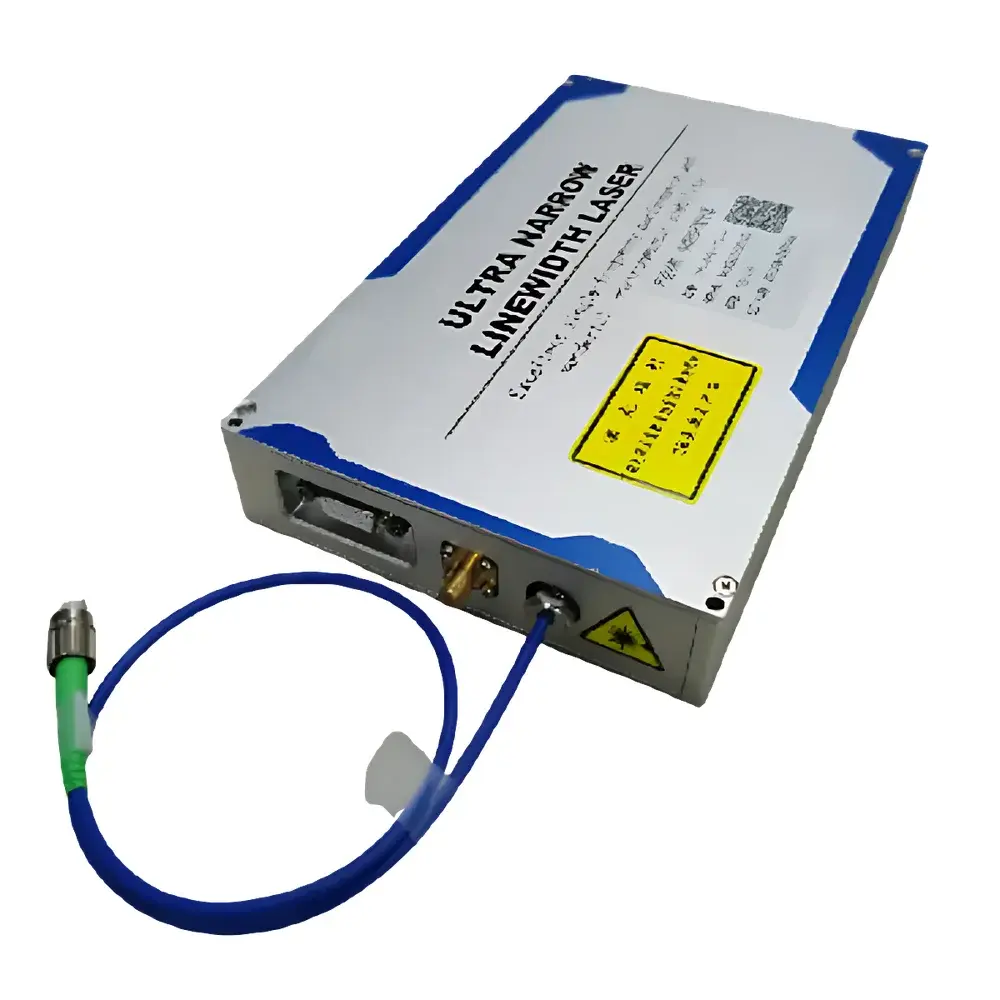
Auniontech SFFL-DFB-N15 Single-Frequency Fiber Laser
| Brand | Auniontech |
|---|---|
| Model | SFFL-DFB-N15 |
| Wavelength | 1530–1570 nm (customizable) |
| Output Power | 35–100 mW |
| Linewidth | ≤1.5 kHz (with 50 km delay line) |
| Polarization Extinction Ratio | 20–25 dB |
| Beam Quality (M²) | ≤1.1 |
| RIN @ 10 MHz | ≤−140 dBc/Hz |
| Phase Noise (1 m OPD) | 35 μrad/√Hz @ 10 Hz, 20 μrad/√Hz @ 100 Hz, 0.4 μrad/√Hz @ 20 kHz |
| Wavelength Drift (12 h) | <50 MHz |
| Power Stability (RMS, 3 hrs) | <0.5% |
| PZT Tuning Range | >4.5 GHz (fast), 0.5 nm (slow) |
| Operating Temperature | −10 to +50 °C |
| Dimensions | 200 × 120 × 35 mm |
| Weight | <1 kg |
| Output Fiber | Panda PM1550 or SMF |
| Isolation | 35–45 dB |
| Control Interface | USB Type-A |
Overview
The Auniontech SFFL-DFB-N15 is a distributed-feedback (DFB)-based single-frequency fiber laser engineered for ultra-low phase noise, sub-kilohertz linewidth, and long-term frequency stability at the telecom C-band (1530–1570 nm). It operates on a monolithic, all-polarization-maintaining (PM) resonator architecture incorporating a narrow-linewidth phase-shifted fiber Bragg grating (PS-FBG) and a short high-gain erbium-doped fiber segment. This design enforces robust single-longitudinal-mode (SLM) operation without mode hopping—critical for coherent optical systems requiring high temporal coherence and minimal phase drift. The laser delivers continuous-wave (CW) output with M² 23 dB, and RMS power instability <0.5% over 3 hours—achievable through thermal and mechanical decoupling of the cavity from ambient perturbations. Its intrinsic linewidth—measured via delayed self-heterodyne interferometry with a 50 km spool—is ≤1.5 kHz, while relative intensity noise (RIN) remains below −140 dBc/Hz at 10 MHz offset, meeting stringent requirements for quantum optics, metrology-grade interferometry, and coherent LIDAR.
Key Features
- True single-frequency, single-longitudinal-mode (SLM) emission with no mode hops under thermal or mechanical stress
- Ultra-narrow intrinsic linewidth: ≤1.5 kHz (50 km delayed self-heterodyne measurement)
- Exceptional frequency stability: center wavelength drift <50 MHz over 12 hours (DC-coupled)
- Low phase noise: 35 μrad/√Hz @ 10 Hz, 0.4 μrad/√Hz @ 20 kHz (1 m optical path difference)
- High polarization purity: >23 dB extinction ratio using all-PM fiber components (Panda PM1550)
- Dual-speed wavelength tuning: >4.5 GHz fast modulation via integrated PZT; 0.5 nm slow thermal tuning
- Industrial-grade environmental resilience: operational range −10 to +50 °C; storage range −40 to +85 °C
- Integrated optical isolation (>35 dB) and USB-based digital control interface for lab and OEM integration
Sample Compatibility & Compliance
The SFFL-DFB-N15 is compatible with standard 9/125 µm PM1550 or SMF-28 pigtails and integrates seamlessly into fiber-coupled optical benches, interferometric sensor heads, and free-space beam paths via FC/APC or FC/PC connectors. All optical components—including the PS-FBG, gain fiber, and pump combiner—are qualified per Telcordia GR-1221-CORE reliability standards. The device conforms to IEC 61340-5-1 (ESD control), IEC 60825-1:2014 (laser safety Class 3B), and RoHS Directive 2011/65/EU. While not certified for medical or aerospace use out-of-the-box, its design supports traceable calibration protocols aligned with ISO/IEC 17025 requirements when deployed in accredited metrology laboratories.
Software & Data Management
The laser is controlled via a vendor-provided USB HID-compliant firmware interface, supporting real-time monitoring of output power, temperature, and PZT drive voltage. ASCII-based command sets enable integration with LabVIEW, Python (PySerial), MATLAB, or custom C/C++ applications. Firmware logs include timestamped power and temperature telemetry with 1 Hz sampling—exportable as CSV for GLP-compliant recordkeeping. Although the device does not implement FDA 21 CFR Part 11 electronic signature functionality natively, its deterministic response and non-volatile configuration storage support audit-ready system integration when paired with validated host software and access-controlled network environments.
Applications
- Coherent optical communications (e.g., QPSK/QAM transceivers, local oscillator sources)
- Fiber-optic sensing: distributed acoustic sensing (DAS), interferometric hydrophones, strain/temperature demodulation in FBG and Φ-OTDR systems
- Coherent LIDAR and wind velocimetry: enabling sub-mm/s velocity resolution via heterodyne detection
- Cold atom physics: magneto-optical trap (MOT) cooling and repumping at 1560 nm transitions
- Optical frequency metrology: serving as a stable seed for nonlinear frequency doubling or optical parametric oscillation
- High-resolution spectroscopy: cavity ring-down (CRDS) and photoacoustic detection where narrow linewidth minimizes Doppler broadening artifacts
- Quantum optics experiments: heralded photon generation, squeezed state synthesis, and continuous-variable entanglement distribution
FAQ
What defines “single-frequency” operation in this laser?
Single-frequency refers to stable, uninterrupted lasing in a single longitudinal cavity mode—confirmed by absence of side modes >60 dB below the main peak in RF spectrum analysis and lack of mode-hopping events during 24-hour thermal cycling tests.
Is the output polarization state guaranteed linear and stable?
Yes—the entire resonator uses polarization-maintaining fiber (Panda PM1550), delivering linearly polarized output with extinction ratio ≥23 dB across the full operating temperature range.
Can the laser be used in field-deployable sensing systems?
Yes—its compact footprint (200 × 120 × 35 mm), low mass (<1 kg), wide operating temperature window (−10 to +50 °C), and vibration-insensitive cavity design make it suitable for mobile LIDAR platforms and unattended geophysical sensor nodes.
Does the laser support analog modulation of output power or frequency?
No analog modulation input is provided; however, digital PZT tuning enables fast frequency dithering up to 20 kHz, and external AOMs or EOMs can be added for amplitude or phase modulation in user-defined configurations.
What is the typical warm-up time to achieve specified stability specifications?
Full thermal equilibrium and specification compliance are achieved within 30 minutes after power-on at room temperature (23 ± 2 °C); stabilization time extends to ~45 minutes at temperature extremes (−10 °C or +50 °C).




