
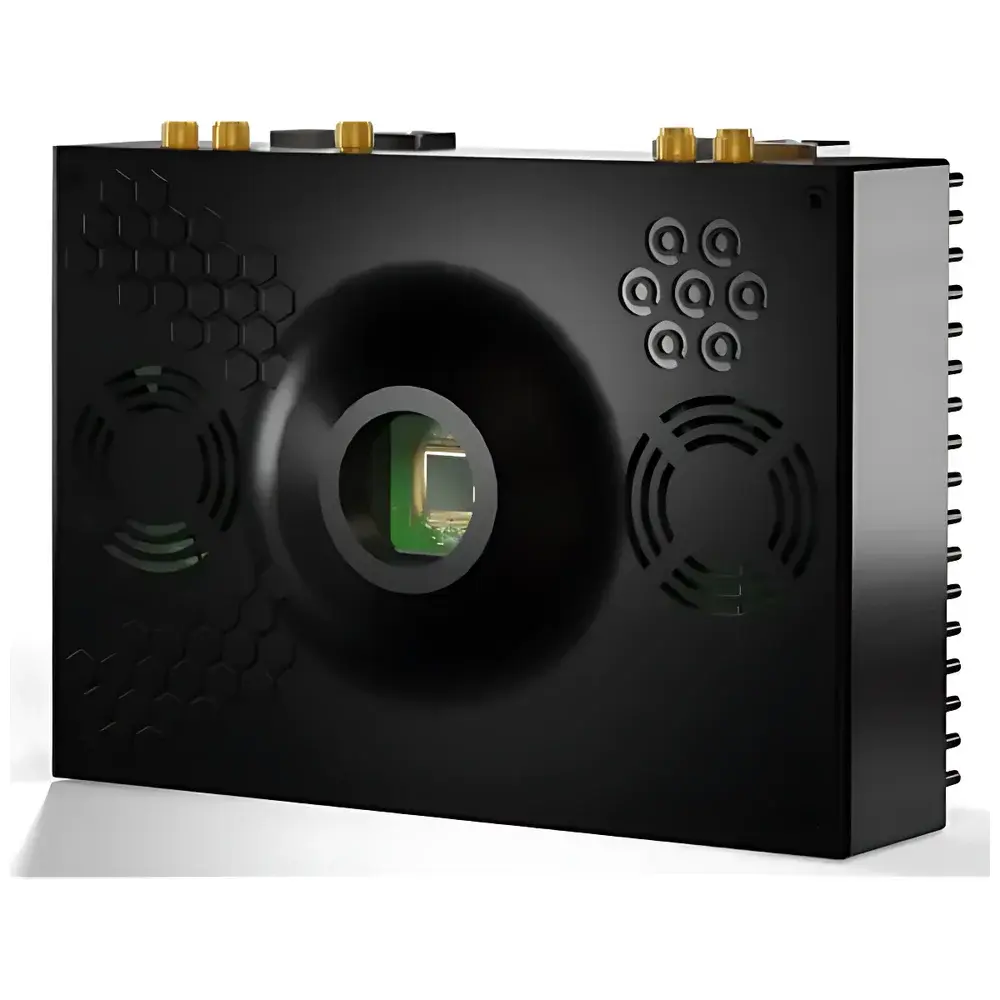
Auniontech SPAD512² High-Speed Single-Photon Imaging Camera
| Brand | Auniontech |
|---|---|
| Origin | Switzerland |
| Manufacturer Type | Authorized Distributor |
| Product Category | Imported Instrument |
| Model | SPAD512² |
| Pricing | Upon Request |
Overview
The Auniontech SPAD512² is a high-performance, large-format single-photon avalanche diode (SPAD) imaging camera developed from the EPFL (École Polytechnique Fédérale de Lausanne) SwissSPAD2 platform. Engineered for time-resolved photon counting at video rates, it implements a monolithic 512 × 512 pixel SPAD sensor fabricated in standard CMOS technology—enabling simultaneous spatial and temporal photon detection with picosecond-scale timing resolution. Unlike conventional scientific CMOS or CCD sensors, the SPAD512² operates in true photon-counting mode with zero readout noise, making it uniquely suited for ultra-low-light applications where signal integrity, temporal fidelity, and wide-field coverage are critical. Its core measurement principle relies on time-gated photon arrival registration, supporting both binary frame acquisition (up to 100 kfps) and multi-bit intensity imaging (up to 382 fps at 8-bit depth), as well as time-correlated single-photon counting (TCSPC) via programmable gate delay stepping (17 ps increments). This architecture supports quantitative fluorescence lifetime imaging (FLIM), time-of-flight (ToF) LiDAR, quantum optical correlation measurements, and high-speed transient event capture without motion blur or integration-time limitations.
Key Features
- 512 × 512 monolithic SPAD array with integrated per-pixel gating circuitry and 1-bit memory
- Peak photon detection efficiency (PDE) of 50% at 520 nm; dark count rate < 25 cps across the array
- Time-gated operation with sub-20 ps gate delay resolution (17 ps step size)
- Binary frame rate up to 100,000 fps; 8-bit grayscale frame rate up to 382 fps
- Native support for TCSPC-based lifetime imaging using phase-resolved gated accumulation
- USB 3.2 Gen 1 interface (dual-cable configuration for power + data); 5 V DC input only
- C/CS-mount optical interface and M4 mechanical mounting points for seamless integration into microscope, macro, or custom optical benches
- Two SMA I/O ports for external trigger synchronization, laser gating, or hardware-timed control
Sample Compatibility & Compliance
The SPAD512² is compatible with standard widefield fluorescence microscopy configurations—including epifluorescence, TIRF, and light-sheet modalities—as well as pulsed laser sources (e.g., picosecond diode lasers, Ti:Sapphire oscillators) operating between 400–900 nm. Its high PDE and low dark count enable reliable detection of weak, transient signals from biological fluorophores (e.g., GFP, mCherry, ATTO dyes), quantum dots, and NV centers. The system complies with CE marking requirements for laboratory instrumentation and meets electromagnetic compatibility (EMC) standards per EN 61326-1. While not certified for clinical use, its firmware architecture supports audit-trail logging and timestamped metadata embedding—facilitating GLP-compliant experimental documentation. Data export formats include HDF5, TIFF (with embedded timing metadata), and raw binary streams for downstream analysis in MATLAB, Python (NumPy/H5Py), or commercial FLIM software platforms.
Software & Data Management
The SPAD512² ships with Auniontech’s proprietary SPADView software—a cross-platform (Windows/macOS/Linux) GUI built on Qt and optimized for real-time visualization, parameter tuning, and acquisition scripting. Key capabilities include live histogramming of photon arrival times per pixel, region-of-interest (ROI)-based lifetime decay fitting, and synchronized multi-channel triggering. All acquisition parameters—including gate width, delay offset, frame duration, and binning mode—are remotely configurable via TCP/IP using a documented RESTful API. This enables full integration into automated workflows driven by LabVIEW, Python (via requests or socket libraries), or MATLAB instrument control toolboxes. Acquired datasets retain precise per-frame timestamps, hardware clock references, and sensor temperature logs—ensuring traceability and reproducibility required for peer-reviewed publications and method validation studies.
Applications
- Widefield FLIM: Enables video-rate fluorescence lifetime mapping without scanning—ideal for monitoring Ca²⁺ dynamics, metabolic state (NADH/FAD ratio), or protein-protein interactions in live cells and tissues.
- Quantum Imaging: Supports intensity correlation (g²) measurements, ghost imaging, and entanglement verification through time-tagged photon coincidence analysis.
- LiDAR & ToF Imaging: Delivers centimeter-level depth resolution at >100 kfps for autonomous navigation, industrial inspection, and non-line-of-sight (NLOS) reconstruction.
- Ultrafast Transient Capture: Records nanosecond-scale optical phenomena such as plasma formation, laser-induced breakdown, or photonic crystal cavity decay—without motion artifacts.
- Machine Vision under Extreme Low Light: Provides high-contrast, noise-free imaging for semiconductor wafer inspection, biometric authentication, or night-vision surveillance systems.
FAQ
What is the maximum usable frame rate for quantitative lifetime imaging?
For TCSPC-based FLIM, the practical frame rate depends on photon flux and required lifetime histogram resolution; typical operation ranges from 10–100 fps with 256–1024 time bins per pixel.
Does the camera support global shutter operation?
Yes—the entire 512 × 512 array is exposed and read out simultaneously in binary mode, eliminating rolling-shutter distortion.
Can I synchronize multiple SPAD512² units for stereo or multi-angle acquisition?
Yes—external trigger input/output via SMA ports allows hardware-level synchronization with jitter < 1 ns.
Is calibration data (PDE map, DCR map, timing skew) provided with the camera?
Yes—factory-measured per-pixel calibration files are included and can be loaded automatically in SPADView for quantitative correction.
What computing resources are required for real-time TCSPC processing?
A modern workstation with ≥32 GB RAM and an NVIDIA GPU (≥RTX 3080) is recommended for live histogram accumulation and pixel-wise biexponential fitting at >30 fps.




