
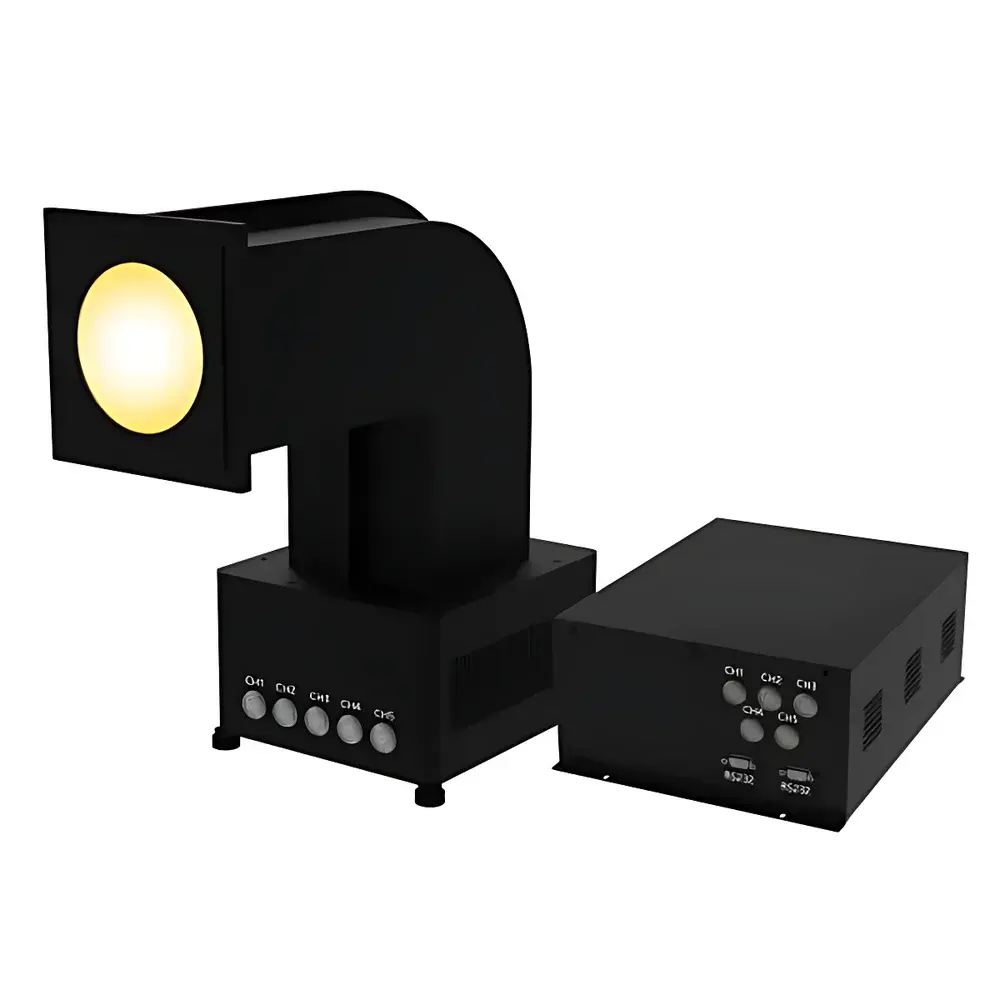
Auniontech SpectraTune™ Calibrated Uniform Light Source
| Brand | Auniontech |
|---|---|
| Model | SpectraTune-ULS90 |
| Type | Spectrally Tunable, Uniform Illumination Source for Sensor & Imaging Calibration |
| LED Channels | ≥30 |
| Spectral Range | 380–1000 nm |
| Color Temperature Range | 2000–20000 K |
| Illuminance Range | 1–15,000 lux |
| Output Uniformity (Ø90 mm) | ≥96% |
| Brightness Resolution | 12-bit per channel (4096 levels) |
| Drive | Linear Constant-Current |
| Flicker-Free Operation | Yes |
| Thermal Stability | ±1 °C via Semiconductor Cooling |
| Lifetime | >20,000 h |
| Software Control | GUI + API (DLL/SDK) |
| Compliance | Supports ASTM E308, ISO/CIE 15, USP <1058>, GLP/GMP-relevant audit trail capability |
Overview
The Auniontech SpectraTune™ Calibrated Uniform Light Source is an engineered optical calibration platform designed for high-fidelity radiometric and photometric characterization of imaging sensors, cameras, and optoelectronic detectors. Based on a multi-channel LED architecture with spectrally discrete emitters spanning 380–1000 nm, the system enables precise, programmable synthesis of spectral power distributions (SPDs) — not merely broad-band white light, but physically accurate, CIE-compliant illuminants traceable to NIST-traceable reference standards. Its core function is to serve as a primary calibration reference in controlled laboratory environments where spatial uniformity, temporal stability, and spectral fidelity are non-negotiable. Unlike conventional integrating sphere-based sources or filtered arc lamps, the SpectraTune-ULS90 achieves continuous SPD tuning without mechanical filters or moving parts, eliminating spectral discontinuities and intensity drift. The Ø90 mm output aperture delivers >96% spatial uniformity (per ISO 14524 and ASTM E2534), verified via calibrated CCD-based uniformity mapping, making it suitable for full-field sensor response mapping and lens shading correction.
Key Features
- ≥30 independently addressable LED channels with narrowband spectral peaks across 380–1000 nm — enabling high-resolution SPD reconstruction and custom illuminant synthesis
- 12-bit digital control (4096 steps) per channel with linear constant-current drivers — ensuring monotonic, repeatable intensity scaling and zero flicker (tested per IEEE 1789)
- Color temperature tunability from 2000 K (candlelight) to 20000 K (daylight blue sky), with real-time CIE 1931 chromaticity coordinate tracking
- Illuminance range of 1–15,000 lux at 30 cm working distance — adjustable via absolute radiometric calibration tables embedded in firmware
- Active semiconductor thermal management maintaining LED junction temperature within ±1 °C — critical for long-term spectral stability (<0.15% Δλ/°C typical)
- Compact, modular chassis (W×D×H: 280 × 220 × 145 mm) with integrated cooling and EMI-shielded electronics — optimized for cleanroom and metrology lab integration
- Comprehensive software suite supporting spectral recipe creation, batch calibration protocols, and automated measurement sequencing
Sample Compatibility & Compliance
The SpectraTune-ULS90 is compatible with all standard sensor form factors — including 1/4″ to 4/3″ CMOS/CCD image sensors, automotive ADAS camera modules, industrial line-scan arrays, and photodiode-based radiometers. It meets key international standards for optical calibration instrumentation: spectral irradiance accuracy conforms to CIE Publication 15:2018 and ASTM E308-22; uniformity performance satisfies ISO 14524 Annex D requirements for flat-field illumination; temporal stability complies with ISO 15739:2013 Annex B for low-frequency noise assessment. When used with optional NIST-traceable spectroradiometer feedback (e.g., Ocean Insight HDX or Konica Minolta CS-2000), the system supports GLP/GMP-aligned calibration workflows, including electronic signatures, version-controlled spectral recipes, and audit-trail logging compliant with FDA 21 CFR Part 11.
Software & Data Management
The SpectraTune Control Suite provides both graphical user interface (GUI) and programmatic access via native Windows DLL, Python bindings (PySpectraTune), and LabVIEW VIs. Users can import measured SPDs (CSV, .spdx), define custom illuminants using CIE-defined daylight (D-series), blackbody, or arbitrary spectra, and export calibrated irradiance maps in HDF5 or TIFF format. Real-time feedback integration allows closed-loop calibration: external spectroradiometers feed spectral error residuals into the control loop, triggering automatic LED channel recalibration. All spectral recipes are stored with metadata (date, operator ID, instrument serial, ambient temperature/humidity), supporting ISO/IEC 17025 documentation requirements. Firmware updates and calibration certificate archives are managed through secure, role-based local network access.
Applications
- Auto White Balance (AWB) algorithm validation across multiple illuminants (D65, A, F2, TL84)
- Quantum Efficiency (QE) mapping of scientific CMOS and sCMOS sensors under monochromatic and polychromatic excitation
- Lens Shading Correction (LSC) and vignetting analysis using full-aperture uniform illumination
- Spatial non-uniformity (NU) and photoresponse non-uniformity (PRNU) quantification per EMVA 1288
- Automotive camera validation per ISO 16505 and SAE J2869 test procedures
- RGB color filter array (CFA) response characterization and cross-talk analysis
- Photodiode responsivity calibration against reference detectors (e.g., Hamamatsu S1337 series)
- Simulated environmental lighting for computational photography R&D
FAQ
What spectral resolution does the SpectraTune-ULS90 achieve in practice?
The system reconstructs continuous SPDs using ≥30 discrete LED peaks. Measured full-width-at-half-maximum (FWHM) ranges from 12 nm (blue/violet) to 25 nm (NIR), enabling <5 nm effective resolution in interpolated mode when combined with high-resolution spectroradiometric verification.
Can the source be integrated into automated production test stations?
Yes — the SDK includes synchronous trigger I/O (TTL), Ethernet (TCP/IP) and USB 2.0 interfaces, supporting deterministic timing control with sub-millisecond latency for inline sensor burn-in and functional testing.
Is factory recalibration required, and how often?
Initial calibration is performed at time of manufacture using NIST-traceable spectroradiometry. Recalibration is recommended annually or after 5,000 operating hours, whichever occurs first, to maintain traceability per ISO/IEC 17025 Clause 6.5.
Does the system support CIE illuminant standards beyond D65?
Yes — built-in libraries include CIE Standard Illuminants A, C, D50, D55, D65, D75, F1–F12, and TL84, with interpolation and extrapolation capabilities for user-defined variants.
How is uniformity validated across the Ø90 mm output field?
Uniformity is mapped using a calibrated 16-bit scientific CMOS camera with f/1.4 lens and neutral density filters, following ISO 14524 Annex D methodology. Raw data is processed to report RMS deviation, peak-to-valley ratio, and edge falloff — all documented in the Certificate of Conformance shipped with each unit.





