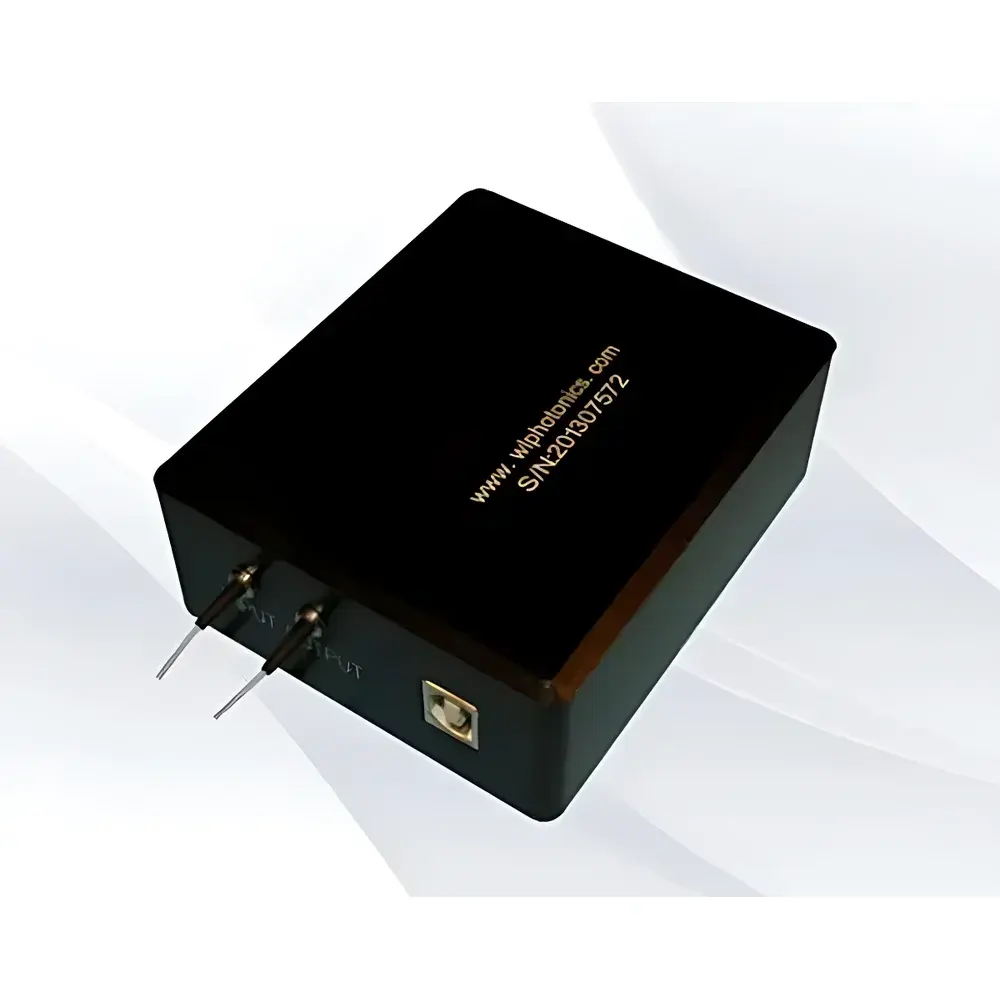
Auniontech WLTF-NM/NE Series 1000–1700 nm Narrowband Tunable Fiber-Optic Filter
| Brand | Auniontech |
|---|---|
| Model | WLTF-NM (Manual) / WLTF-NE (Motorized) |
| Wavelength Range | 1000–1700 nm |
| Tuning Range | Up to 200 nm (model-dependent) |
| FWHM Bandwidth | 0.10–1.90 nm (selectable) |
| Insertion Loss | ≤2.5 dB |
| Wavelength Resolution | 0.02 nm (manual), 0.01 nm (motorized) |
| Polarization Dependent Loss | ≤0.15 dB |
| Extinction Ratio | ≥20 dB |
| Return Loss | >45 dB |
| Optical Power Handling | 300 mW |
| Group Delay Ripple | <0.1 ps/nm |
| Weight | <0.5 kg |
| Interface | Manual micrometer or USB-controlled stepper motor with encoder-based closed-loop positioning |
Overview
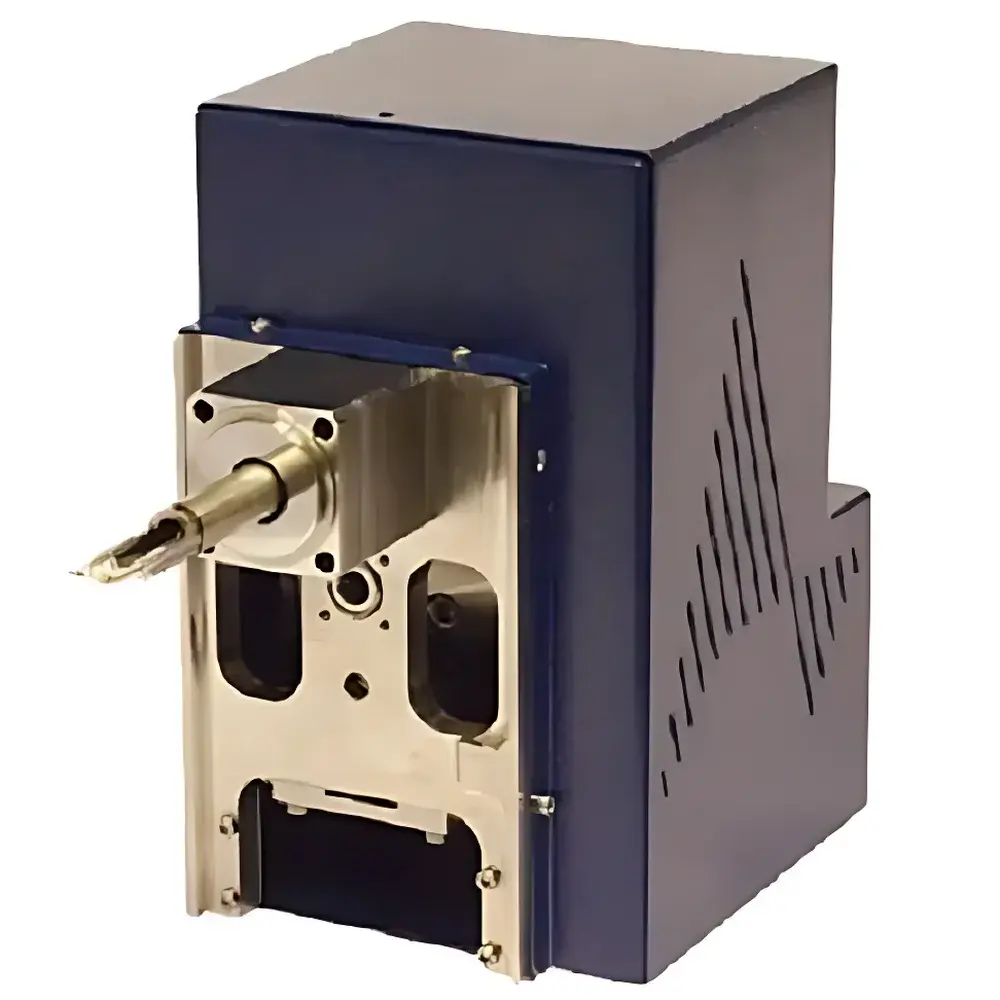
The Auniontech WLTF-NM and WLTF-NE Series are high-precision, free-space grating-based narrowband tunable fiber-optic filters engineered for spectral selection in the near-infrared (NIR) and short-wavelength infrared (SWIR) bands. Operating across a continuous wavelength range from 1000 nm to 1700 nm, these devices utilize a Gaussian-shaped transmission profile generated via optimized diffraction grating alignment and collimated beam optics. As two-port fiber-pigtailed components, they accept broadband input light—such as amplified spontaneous emission (ASE), supercontinuum sources, or multi-wavelength laser outputs—and isolate a single, user-defined narrow spectral slice at the output port while rejecting out-of-band content with high optical isolation. The core architecture ensures minimal modal distortion and preserves polarization fidelity, making the filter suitable for demanding applications in coherent detection, interferometric sensing, and high-resolution spectroscopy. Both manual (WLTF-NM) and motorized (WLTF-NE) variants are available, with the latter supporting USB-hosted control, real-time encoder feedback, and closed-loop wavelength positioning for traceable, repeatable tuning.
Key Features
- Gaussian-shaped transmission with selectable full-width at half-maximum (FWHM) bandwidths ranging from 0.10 nm to 1.90 nm—enabling optimization for resolution versus throughput trade-offs
- High wavelength repeatability (< ±0.01 nm for WLTF-NE; < ±0.02 nm for WLTF-NM) supported by precision micrometer or microstepper actuation with integrated optical encoder
- Low insertion loss (typ. 1.5 dB, max. 2.5 dB) and low polarization-dependent loss (PDL ≤ 0.15 dB) ensure minimal signal degradation in cascaded photonic systems
- Wide tuning coverage spanning X-, O-, S-, C-, and L-bands—compatible with standard telecom and research-grade fiber infrastructure (SMF-28 or PM fiber options)
- Robust mechanical design with <0.5 kg mass and compact footprint, facilitating integration into OEM modules, benchtop test setups, or field-deployable instrumentation
- Optical power handling up to 300 mW (CW), validated under ISO 11146-compliant thermal loading conditions
Sample Compatibility & Compliance
The WLTF-NM/NE series is designed for use with single-mode (SMF-28, HI1060, SM1950) and polarization-maintaining (PM) fiber pigtails, supporting FC/APC, FC/PC, or custom connectorization. All units comply with IEC 61300-2-38 (fiber optic interconnecting devices – tensile load testing) and IEC 61300-2-1 (vibration testing). Device-level calibration data—including measured FWHM, center wavelength accuracy, and PDL—are provided per unit and traceable to NIST-traceable reference spectrometers. For regulated environments, the motorized WLTF-NE supports audit-ready logging of all tuning events when operated via the supplied SDK, aligning with GLP/GMP documentation requirements and FDA 21 CFR Part 11 principles for electronic records and signatures.
Software & Data Management
Auniontech provides a cross-platform software development kit (SDK) supporting Windows, Linux, and macOS, with native APIs for Python, MATLAB, LabVIEW, and C/C++. The SDK enables programmable wavelength scanning, step-and-hold sequencing, real-time encoder position readback, and automated calibration curve application. All motorized units log timestamped tuning history—including commanded vs. actual wavelength, encoder counts, and error flags—to local CSV files or external SQL databases. Optional integration with third-party platforms such as Keysight PathWave or National Instruments TestStand is supported via standardized IVI drivers. Firmware updates preserve configuration memory and support secure signed image verification.
Applications
- Suppression of ASE noise in erbium- and thulium-doped fiber amplifiers (EDFA/TDFA), improving OSNR in optical communication testbeds
- Channel selection and characterization in dense wavelength division multiplexing (DWDM) system validation and component-level testing
- Wavelength-tunable source generation for FBG interrogation systems, enabling high-speed strain/temperature demodulation in structural health monitoring
- Spectral shaping of ultrashort pulses in nonlinear optics experiments, including dispersion compensation and pulse compression
- Calibration reference for optical spectrum analyzers (OSAs) and wavelength meters operating in the 1000–1700 nm range
- Seed source filtering in tunable fiber laser cavities requiring narrow linewidth and mode-hop-free tuning
FAQ
What wavelength bands does this filter cover?
It operates continuously from 1000 nm to 1700 nm, fully covering the X-band (1060±15 nm), O-band (1260–1360 nm), S-band (1460–1530 nm), C-band (1530–1565 nm), and L-band (1565–1625 nm), with extended reach into the U-band (1625–1675 nm) and beyond.
Can the filter be integrated into automated test systems?
Yes—the WLTF-NE series features USB 2.0 interface, encoder-based closed-loop control, and a documented command set compatible with SCPI-like syntax, enabling seamless integration into ATE platforms and Python-based automation frameworks.
Is polarization-maintaining (PM) fiber pigtail available?
Standard configurations use SMF-28; however, PM-fiber versions (e.g., PANDA or bow-tie) with aligned slow-axis coupling are available upon request and subject to custom calibration.
How is wavelength accuracy verified and maintained over time?
Each unit undergoes factory calibration using a metrology-grade optical spectrum analyzer referenced to NIST-traceable standards. Long-term stability is ensured by thermally stable kinematic mounts and zero-backlash drive mechanisms; recalibration services are offered annually or per ISO/IEC 17025-accredited laboratories.
Does the device support analog modulation or external trigger synchronization?
No—the WLTF-NM/NE is a passive spectral selection element with no built-in modulation capability. However, it can be synchronized with external equipment (e.g., pulse lasers or lock-in amplifiers) via TTL trigger signals routed through optional I/O expansion modules.
Related Products