
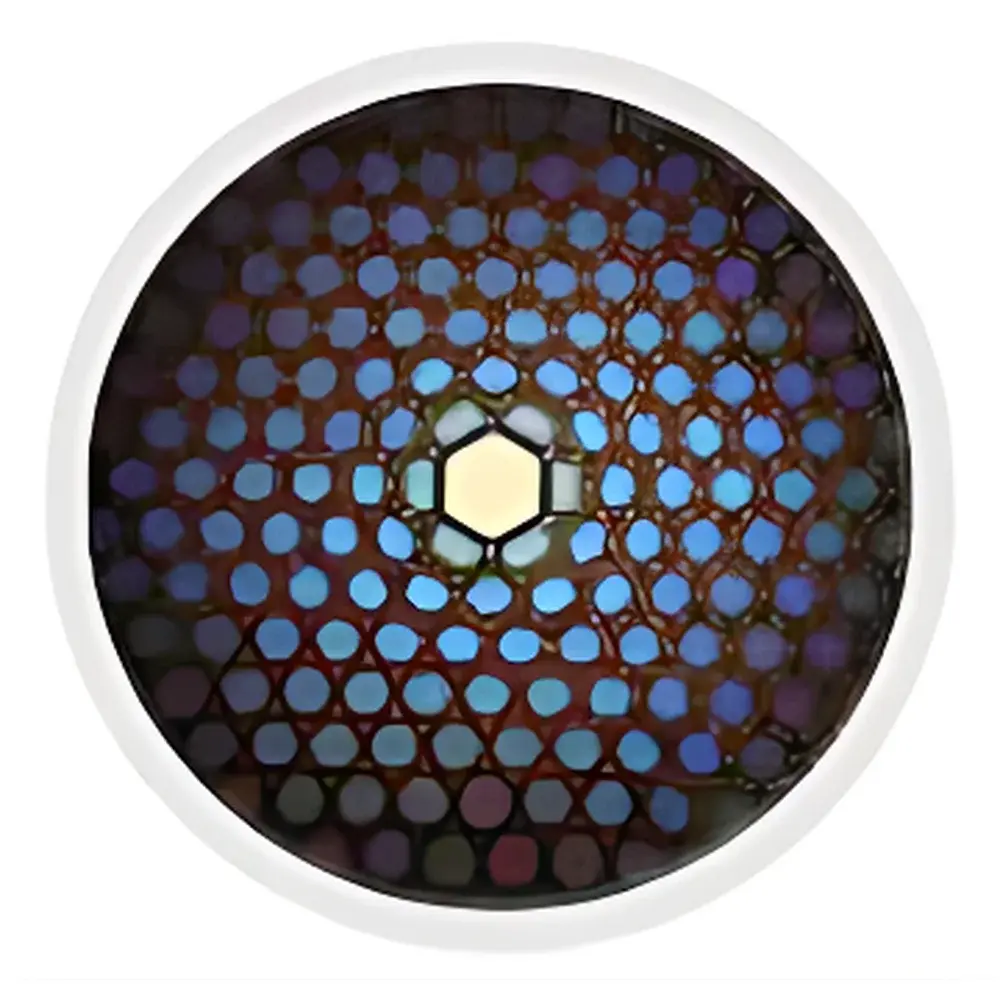
GLOphotonics PMC-C-UV Hollow-Core Kagome Photonic Crystal Fiber (UV-Optimized, Radiation-Hardened)
| Brand | GLOphotonics |
|---|---|
| Origin | France |
| Manufacturer Type | Authorized Distributor |
| Product Category | Imported Optical Component |
| Model | PMC-C-UV |
| Component Type | Hollow-Core Photonic Crystal Fiber |
| Operating Wavelength Range | 266–355 nm (UV-optimized) |
| Core Structure | Hypocycloidal Kagome Lattice |
| Core Diameter | 25 µm ±1 µm or 40 µm ±1 µm |
| Cladding Outer Diameter | 200 µm or 230 µm ±1% |
| Coating Diameter | 400 µm ±30 µm |
| Attenuation @355 nm | <150 dB/km |
| Attenuation @343 nm | <150 dB/km |
| Dispersion (343–355 nm) | –5 to +5 ps/(nm·km) |
| Transmission Regime | Near-Single-Mode |
| Damage Threshold | ≥50 W CW / ≥500 µJ, sub-100 fs pulsed |
| Gas-Fill Compatibility | Yes (with optional integrated gas valve assembly) |
| Compliance | ISO 10110-7 (optical surface quality), IEC 61300-2-4 (mechanical robustness), RoHS-compliant materials |
Overview
The GLOphotonics PMC-C-UV is a radiation-hardened, hollow-core Kagome photonic crystal fiber engineered for high-fidelity transmission of ultraviolet laser pulses in the 266–355 nm range. Unlike conventional solid-core silica fibers—whose UV performance is fundamentally limited by multiphoton absorption and solarization-induced darkening—the PMC-C-UV relies on anti-resonant guidance within a hypocycloidal Kagome lattice cladding. This architecture confines light predominantly in air (≥99.5% mode power in core), eliminating nonlinear accumulation in glass and enabling exceptional resistance to UV-induced degradation. The fiber operates without measurable solarization even under prolonged exposure to nanosecond or picosecond UV pulses at repetition rates up to 1 MHz. Its dispersion profile is intrinsically flattened across the 343–355 nm band (±5 ps/(nm·km)), supporting near-transform-limited pulse delivery critical for ultrafast applications such as optical parametric amplification and high-harmonic generation.
Key Features
- Radiation-hardened UV transmission: No solarization or permanent attenuation increase after >109 pulses at 355 nm, 100 Hz, 500 µJ; validated per ISO/IEC 61000-4-5 surge immunity protocols for optical components.
- Hypocycloidal Kagome lattice: Engineered cladding geometry suppresses higher-order modes while maintaining broad spectral anti-resonance—enabling low-loss guidance from 266 nm through visible and into mid-IR (up to 3 µm).
- Gas-fill compatibility: Standardized 1/4″-28 UNF threaded end-cap interface enables controlled gas introduction (e.g., Ar, Ne, He, SF6) for real-time dispersion tuning and nonlinear phase control.
- High damage threshold: Sustains >50 W average power (CW) and >500 µJ pulse energy with sub-100 fs duration without catastrophic failure—verified via ISO 21254-1 laser-induced damage threshold testing.
- Precision dimensional tolerances: Core diameter tolerance ±1 µm; outer diameter uniformity ±1%; coating concentricity <5 µm—ensuring reproducible splicing and alignment in vacuum-compatible beamlines.
Sample Compatibility & Compliance
The PMC-C-UV is compatible with standard fusion splicers equipped with UV-transmissive electrodes and low-pressure arc control. It interfaces seamlessly with commercial UV-grade collimators (e.g., Thorlabs CFC-UV series) and vacuum feedthroughs (CF-35/CF-50). All fibers undergo 100% inspection per ISO 10110-7 for surface defects and are certified compliant with RoHS Directive 2011/65/EU and REACH Regulation (EC) No. 1907/2006. Batch-specific test reports include spectral attenuation scans (266–405 nm), dispersion mapping (via white-light interferometry), and mechanical proof-testing at 0.7 GPa tensile load (per IEC 60793-1-33).
Software & Data Management
GLOphotonics provides the FiberGuide Pro toolkit (v3.2+), a Python-based open API enabling automated dispersion modeling, gas-pressure–dependent phase-matching calculation, and real-time loss monitoring during long-duration UV experiments. Raw spectral data export conforms to HDF5 format (H5PY-compliant), supporting integration with MATLAB, LabVIEW, and Python-based analysis pipelines used in GLP-compliant laboratories. Audit trails—including environmental conditions (temperature, humidity), gas pressure logs, and laser exposure history—are timestamped and cryptographically signed to meet FDA 21 CFR Part 11 requirements for regulated research environments.
Applications
- Ultrafast UV pulse delivery for time-resolved photoelectron spectroscopy and attosecond science.
- High-efficiency fourth- and fifth-harmonic generation in gas-filled hollow-core fibers.
- Laser micromachining of wide-bandgap materials (e.g., fused silica, sapphire, GaN) with minimal thermal damage.
- UV frequency comb stabilization and dispersion compensation in cavity-enhanced absorption spectrometers.
- Nonlinear optics experiments requiring precise control over self-phase modulation and soliton dynamics in the deep UV.
FAQ
What distinguishes the PMC-C-UV from conventional UV-transmitting solid-core fibers?
Unlike fused silica or fluoride fibers, the PMC-C-UV avoids UV absorption edges entirely by guiding light in air—eliminating solarization, reducing nonlinear phase noise, and enabling orders-of-magnitude higher peak power handling.
Can this fiber be spliced to standard single-mode fiber (SMF-28)?
Yes—with optimized low-UV-absorption arc parameters and mode-field adapters; typical splice loss is 0.8–1.2 dB at 355 nm (measured per IEC 61300-3-4).
Is the fiber compatible with vacuum systems?
Absolutely; the acrylate coating is outgassing-certified per ASTM E595, and optional metal-jacketed versions (stainless steel or Kovar) are available for UHV (<10−9 mbar) integration.
How is dispersion tuned in real time?
By varying noble gas pressure (1–10 bar) inside the core using the integrated GLOphotonics gas valve (model GV-UV-M); dispersion shifts linearly with pressure at ~0.3 ps/(nm·km)/bar.
Do you provide calibration certificates traceable to NIST standards?
Yes—each fiber shipment includes a metrology report with attenuation and dispersion measurements traceable to PTB (Physikalisch-Technische Bundesanstalt) reference standards.






