
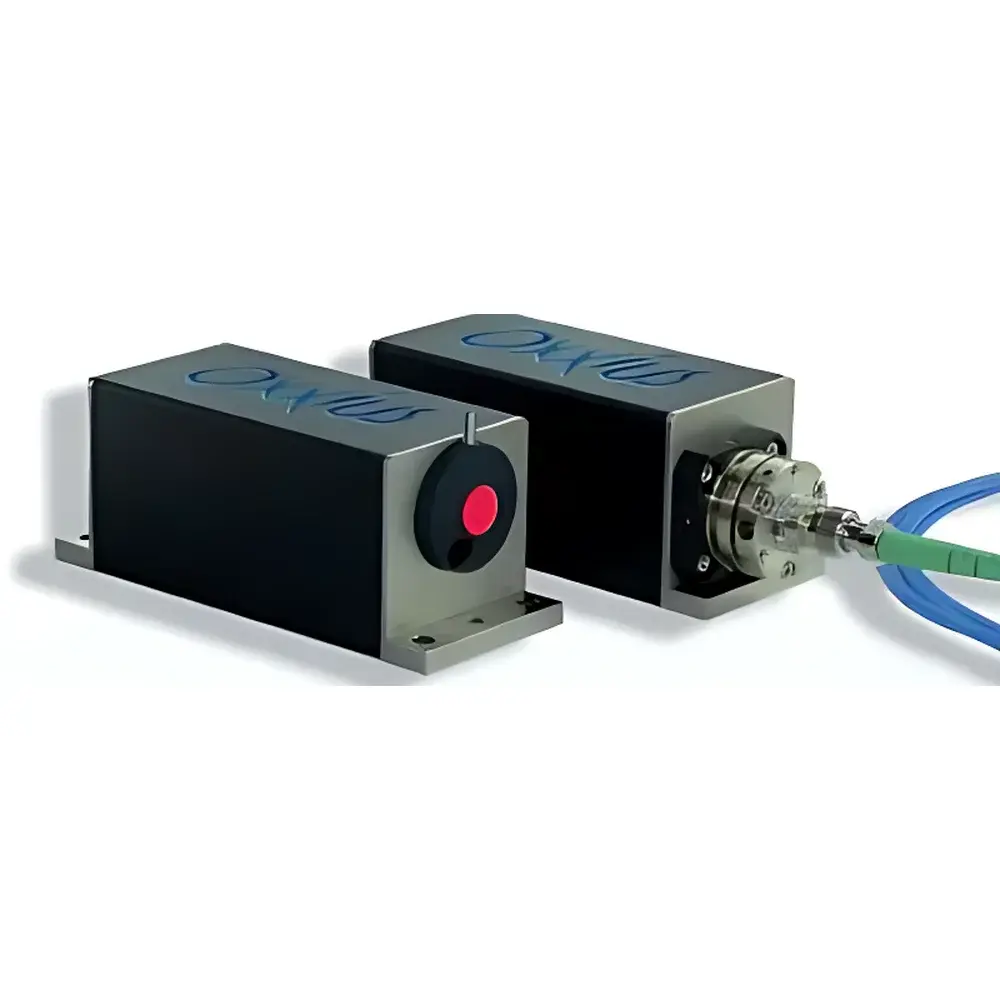
Oxxius LaserBoxx LBX-488 Continuous-Wave Diode-Pumped Solid-State Laser
| Origin | France |
|---|---|
| Manufacturer Type | Authorized Distributor |
| Origin Category | Imported |
| Model | LBX-488 |
| Wavelength | 488 nm ±2/−5 nm |
| Output Power Options | 50 / 100 / 150 / 200 mW (adjustable) |
| Beam Diameter | 1.2 mm (1/e², at 50 mm from aperture) |
| Beam Divergence | 0.6 mrad (1/e², full angle, far field) |
| Beam Quality | TEM₀₀, M² < 1.25 |
| Power Stability | ±0.5% p-p (over 8 h, ±3 °C) |
| Optical Noise | <0.5% rms (10 Hz – 2 MHz) |
| Polarization Ratio | >100:1 (vertical ±3°) |
| Pointing Stability | <5 µrad/°C |
| TTL Modulation Bandwidth | 20 MHz |
| Analog Modulation Bandwidth | 4 MHz |
| Operating Temperature | 10–50 °C |
| Operation Modes | APC, ACC, MAC |
| Interface Options | USB, RS232, Analog |
| Laser Head Dimensions | 100 × 40 × 40 mm |
| Weight | 300 g |
| Power Supply | 200 V AC |
| Optional Fiber Coupling | Polarization-Maintaining (PM), Single-Mode (SM), or Multi-Mode (MM) fiber |
| connectors | SMA905, FC/APC, FC/PC |
Overview
The Oxxius LaserBoxx LBX-488 is a compact, diode-pumped solid-state (DPSS) continuous-wave (CW) laser engineered for high-stability optical excitation in precision scientific and industrial applications. Operating at a nominal wavelength of 488 nm — within the blue spectral region critical for fluorophore excitation — this laser delivers exceptional beam fidelity and long-term power consistency. Its fundamental TEM₀₀ spatial mode (M² < 1.25) ensures diffraction-limited focusing essential for confocal microscopy, flow cytometry, and holographic data storage. The system employs active thermal management and proprietary cavity stabilization to achieve ±0.5% peak-to-peak power stability over 8 hours under ambient fluctuations of ±3 °C — a specification aligned with ISO 11554 and IEC 60825-1 compliance requirements for Class 3B laser safety certification. Designed for integration into OEM platforms and laboratory-grade instrumentation, the LBX-488 meets rigorous demands for reproducibility in quantitative fluorescence imaging and time-resolved photoluminescence spectroscopy.
Key Features
- Stable 488 nm CW output with factory-calibrated wavelength tolerance of +2/−5 nm — optimized for common fluorophores including FITC, Alexa Fluor 488, and GFP derivatives.
- Adjustable output power spanning 50 mW to 200 mW, supporting both low-noise single-cell detection and higher-throughput assay configurations.
- TEM₀₀ Gaussian beam profile with 1.2 mm 1/e² diameter and 0.6 mrad full-angle divergence — enabling efficient coupling into single-mode fibers and high-resolution scanning optics.
- Ultra-low intensity noise (<0.5% rms, 10 Hz–2 MHz bandwidth) critical for photon-counting applications and lock-in detection schemes.
- Dual modulation capability: TTL-compatible digital input up to 20 MHz and analog voltage control up to 4 MHz — facilitating synchronization with galvo scanners, AOMs, or pulsed acquisition systems.
- Three operational modes — Automatic Power Control (APC), Automatic Current Control (ACC), and Manual Analog Control (MAC) — providing flexibility for closed-loop feedback integration or open-loop OEM deployment.
- Compact laser head (100 × 40 × 40 mm, 300 g) with standardized USB/RS232/analog interfaces — simplifying integration into automated test benches and GLP-compliant analytical platforms.
Sample Compatibility & Compliance
The LBX-488 is routinely deployed in regulated environments requiring traceable performance documentation. Its optical output characteristics support alignment with ASTM E275 for fluorescence instrument calibration and ISO 17025-accredited measurement uncertainty budgets. When integrated into medical device or IVD platforms, the laser’s stable pointing (100:1, vertical orientation) ensure repeatable illumination geometry across thermal cycles — a key requirement for FDA 21 CFR Part 11–compliant data integrity in QC/QA workflows. Optional polarization-maintaining fiber coupling (FC/APC or SMA905) enables direct interfacing with spectrometers, interferometers, or microfluidic cytometers without realignment. All units ship with CE marking, RoHS compliance documentation, and full IEC 60825-1 laser safety classification reports.
Software & Data Management
Oxxius provides the Lasea software suite (Windows/Linux/macOS compatible) for remote configuration, real-time monitoring, and logging of laser parameters — including power history, temperature trends, and modulation status. Data export is supported in CSV and HDF5 formats, enabling seamless ingestion into Python-based analysis pipelines (e.g., SciPy, NumPy) or MATLAB environments. For enterprise integration, the device supports SCPI command sets over USB/RS232 and offers optional LabVIEW drivers and .NET SDKs. Audit trails generated via Lasea comply with ALCOA+ principles (Attributable, Legible, Contemporaneous, Original, Accurate) and may be configured to meet GLP/GMP electronic record retention requirements when deployed alongside validated IT infrastructure.
Applications
- Confocal and super-resolution fluorescence microscopy (e.g., STED, SIM) requiring diffraction-limited excitation and minimal thermal drift.
- Flow cytometry and cell sorting systems demanding high signal-to-noise ratios and precise pulse synchronization.
- Photoluminescence and time-resolved spectroscopy of semiconductors, perovskites, and quantum dots.
- Holographic data storage and optical trapping where beam quality and pointing stability directly impact grating fidelity and trap stiffness.
- Calibration sources for spectroradiometers and CCD/CMOS sensor characterization under standardized CIE illuminant conditions.
- OEM integration into portable Raman analyzers, DNA sequencers, and point-of-care diagnostic instruments.
FAQ
What is the typical warm-up time to achieve specified power stability?
The LBX-488 reaches thermal equilibrium and achieves ±0.5% power stability within 15 minutes of cold start under ambient conditions of 23 ±2 °C.
Can the laser be operated in constant current mode for lifetime testing?
Yes — ACC (Automatic Current Control) mode maintains fixed diode drive current, enabling accelerated aging studies and MTBF validation per Telcordia GR-468-CORE guidelines.
Is fiber coupling included as standard or optional?
Fiber coupling is an optional add-on; standard delivery includes free-space collimated output. PM-SM fiber packages include alignment verification reports and insertion loss characterization.
Does the unit support external triggering for gated acquisition?
TTL modulation input accepts standard 0–5 V logic signals and supports both analog and digital gating — compatible with NI PXI timing modules and Thorlabs T-Cube controllers.
What documentation is provided for regulatory submissions?
Each unit ships with a Factory Calibration Certificate, EU Declaration of Conformity, Laser Safety Report (IEC 60825-1), and RoHS/REACH compliance statements — all traceable to NIST-traceable standards.




