
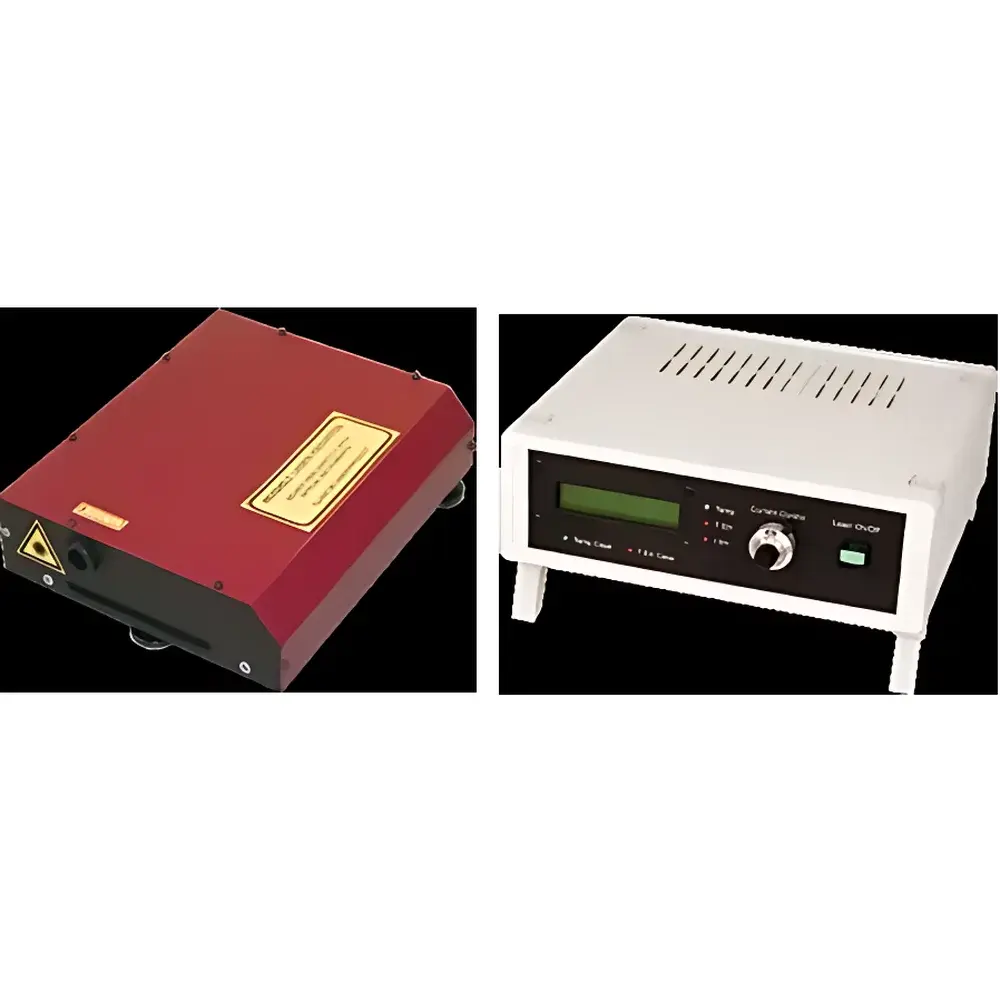
AVESTA EFO Series Femtosecond Fiber Laser
| Key | Origin: Russia |
|---|---|
| Manufacturer Type | Distributor |
| Product Category | Imported |
| Model | EFO Series |
| Core Technology | Mode-locked Er-doped fiber laser oscillator |
| Central Wavelength | 1560 nm (±10 nm) |
| Pulse Width | <80 fs to 250 fs |
| Average Output Power | 10–250 mW |
| Repetition Rate | 25–80 MHz (configurable up to 80 MHz) |
| Pulse Energy | 0.15–3.5 nJ |
| Polarization | Linear (vertical/horizontal) |
| Output Coupling | FC/APC fiber port (~1 mW reference), optional free-space |
| RF Sync Output | SMA, 200–300 mV into 50 Ω |
| Lock Status Monitor | SMA (3.5 V / 0 V) + LED indicator |
| Dimensions (Laser Head) | 180 × 210 × 50/70 mm |
| Dimensions (Power Supply) | 230 × 200 × 85/130 mm |
Overview
The AVESTA EFO Series is a family of turnkey, mode-locked erbium-doped fiber lasers engineered for robust, maintenance-free operation in demanding laboratory and industrial environments. Based on nonlinear polarization evolution (NPE) or semiconductor saturable absorber mirror (SESAM)-assisted passive mode-locking, these oscillators generate transform-limited femtosecond pulses directly from an all-fiber architecture—eliminating the need for periodic optical alignment or environmental stabilization. With central emission at 1560 nm ±10 nm—a wavelength optimized for compatibility with standard single-mode telecom fiber (SMF-28), low-dispersion propagation, and high-efficiency frequency conversion—the EFO platform serves as a foundational source for ultrafast photonics research. Its intrinsic stability (<0.5% RMS power fluctuation over 24 h), compact footprint, and integrated electronics enable seamless integration into larger systems such as optical parametric amplifiers (OPAs), terahertz time-domain spectrometers (THz-TDS), and multiphoton microscopy platforms.
Key Features
- Sub-80 fs pulse duration: Achieves pulse widths down to <80 fs (EFO-80/10 variant), supporting high temporal resolution in pump-probe spectroscopy and carrier dynamics studies.
- High repetition rate flexibility: Standard operation at 70 MHz; selectable configurations available from 25 MHz to 80 MHz—enabling optimization for signal-to-noise ratio (e.g., lock-in detection) or pulse energy scaling (e.g., seeding amplifier chains).
- All-fiber, alignment-free design: Monolithic cavity construction ensures mechanical and thermal stability, minimizing sensitivity to ambient vibration and temperature drift—critical for long-term unattended operation in shared core facilities.
- Integrated synchronization interface: Dedicated SMA RF output (200–300 mV into 50 Ω) provides jitter <100 fs rms relative to optical pulse train, facilitating precise timing control in multi-channel ultrafast experiments.
- Real-time status monitoring: Dual lock-state indicators—electrical (SMA TTL-level signal) and visual (front-panel LED)—allow immediate verification of mode-locked operation without oscilloscope dependency.
- Modular expandability: Optional second-harmonic generation (SHG) modules (e.g., EFOA-SH) deliver simultaneous 780 nm / 1560 nm output; broadband variants (EFOA-UB) support octave-spanning spectra from 1100–2000 nm for frequency comb applications.
Sample Compatibility & Compliance
The EFO Series is designed for use with standard SMF-28 or PM1550 fiber pigtails (FC/APC connectorized), ensuring compatibility with commercial isolators, modulators, wavelength division multiplexers (WDMs), and nonlinear crystals (e.g., PPLN, BBO). All units comply with IEC 60825-1:2014 Class 4 laser safety requirements when operated within specified enclosure configurations. The embedded control firmware supports audit-ready logging of operational parameters (pulse status, temperature, drive current) in accordance with GLP and ISO/IEC 17025 traceability frameworks. While not FDA-cleared as a medical device, the system meets essential electromagnetic compatibility (EMC) criteria per CISPR 11 Group 1, Class B and operates within EN 61326-1 limits for laboratory equipment.
Software & Data Management
No proprietary host software is required for basic operation—start-up, mode-locking acquisition, and parameter monitoring are managed via front-panel controls and hardware interlocks. For automated integration, RS-232 or USB-to-serial interfaces (optional) provide ASCII command access to laser status registers (lock state, internal temperature, pump diode current) and allow remote triggering of reset sequences. Logged data—including timestamped lock events and thermal history—is exportable as CSV for post-acquisition correlation with experimental triggers. The architecture supports synchronization with third-party DAQ systems (e.g., National Instruments PXI, Keysight U1051A) via TTL-compatible sync outputs, enabling compliance with 21 CFR Part 11 requirements when deployed in regulated QC/QA workflows involving ultrafast optical characterization.
Applications
- Supercontinuum generation: Pumping highly nonlinear photonic crystal fibers (PCFs) to produce octave-spanning white-light spectra for OCT and dual-comb spectroscopy.
- Terahertz generation and detection: Optical rectification in ZnTe or DAST crystals, paired with electro-optic sampling for time-resolved THz field mapping.
- Seed source for chirped-pulse amplifiers (CPA): Direct injection into Yb- or Er-doped fiber amplifiers (e.g., AVESTA YFOA series) for millijoule-level ultrashort pulse systems.
- Multiphoton fluorescence microscopy: Two-photon excitation of near-IR fluorophores (e.g., IR-125, Cy7) with reduced photodamage and deeper tissue penetration.
- Ultrafast transient absorption spectroscopy: Sub-100 fs time resolution for tracking photoinduced electron transfer, exciton dissociation, and lattice dynamics in perovskites and 2D materials.
- Optical frequency metrology: Use as a stabilized oscillator in f–2f interferometers for self-referenced optical frequency combs traceable to primary cesium standards.
- High-speed optical communications testing: Bit-error-rate (BER) evaluation of 400 Gb/s and 800 Gb/s coherent transceivers using precisely timed 1550 nm pulse trains.
FAQ
Is the EFO Series suitable for integration into a Class 100 cleanroom environment?
Yes—its fully enclosed, fanless laser head design (IP20-rated) and absence of open beam paths meet particulate control requirements for semiconductor metrology and photonic packaging applications.
Can the repetition rate be externally modulated or locked to a reference clock?
The base EFO model supports only fixed-frequency operation; however, the EFO-T/50 and EFOA-T/P variants offer optional PLL-based repetition rate locking to external RF references (10 MHz–100 MHz) with sub-100 mHz linewidth.
What is the typical warm-up time to achieve stable mode-locked output?
Less than 15 minutes from cold start, with full power and pulse width stabilization achieved within 30 minutes under ambient conditions (20–25 °C, non-condensing humidity).
Are OEM versions available with customized connectors, cooling, or control protocols?
Yes—AVESTA offers ODM support including custom fiber termination (e.g., angled physical contact, polarization-maintaining), conduction-cooled chassis, and Modbus/TCP or EtherCAT interface firmware extensions upon request.
Does the system include calibration documentation traceable to NIST or PTB standards?
Each unit ships with a factory calibration report listing measured pulse width (autocorrelator trace), average power (NIST-traceable thermopile sensor), and spectral centroid (calibrated OSA), valid for 12 months from date of shipment.






