
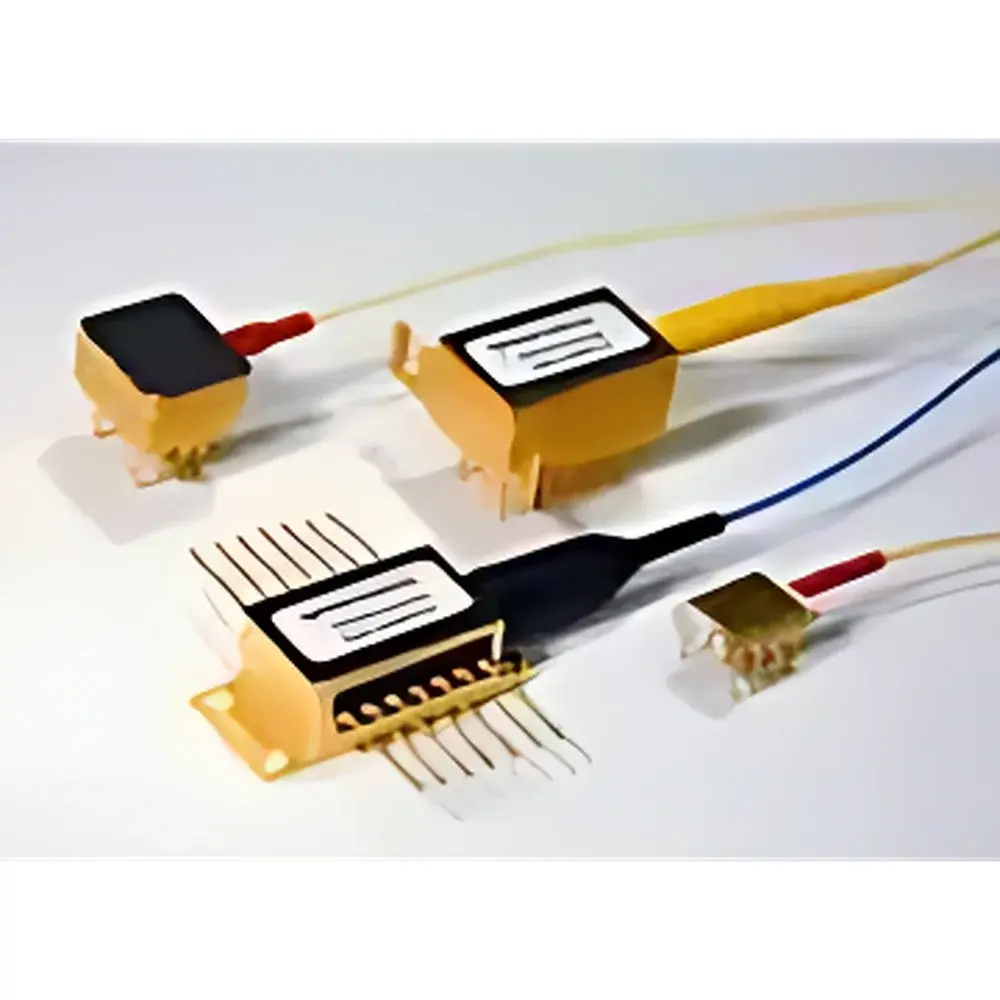
Qphotonics LP Series Superluminescent Diodes (SLDs)
| Brand | Qphotonics |
|---|---|
| Origin | USA |
| Manufacturer Type | Authorized Distributor |
| Product Origin | Imported |
| Model | LP Series |
| Light Source Type | Broadband Semiconductor Light Source |
| Wavelength Range | 405–1650 nm |
| Output Power Range | 0.2–300 mW (CW) |
| Spectral Bandwidth (FWHM) | 1–120 nm |
| Package Options | Butterfly, 14-Pin DIL, 9 mm TO, Mini-DIL, Chip-on-Carrier |
| Fiber Coupling | Single-mode, FC/APC optional |
| Integrated Components | Monitor Photodiode, Thermistor, TEC |
| Operating Mode | CW or Pulsed (10 ns rise/fall time) |
Overview
The Qphotonics LP Series Superluminescent Diodes (SLDs) are high-brightness, broadband semiconductor light sources engineered for applications demanding low temporal coherence, high spatial coherence, and stable spectral output. Unlike lasers, SLDs operate below lasing threshold—amplifying spontaneous emission via stimulated emission in a single-pass, waveguided active region—yielding Gaussian-like spatial mode profiles with broad optical spectra (typically 1–120 nm FWHM) and negligible coherence length (<100 µm). This physical principle makes them ideal for interferometric sensing, optical coherence tomography (OCT), fiber-optic gyroscopes (FOGs), and calibration of spectrometers and wavelength meters where narrow linewidth lasers introduce unwanted interference artifacts.
Key Features
- Wide wavelength coverage from 405 nm to 1650 nm across over 300 standard models—spanning visible, near-infrared (NIR), and short-wave infrared (SWIR) bands
- High spectral power density (>0.1 mW/nm typical) with excellent power stability (<±2% over 8 hours, temperature-controlled)
- Multiple hermetic packaging architectures: butterfly modules with integrated thermoelectric cooler (TEC), 14-pin dual-in-line (DIL), compact 9 mm TO cans, mini-DIL, and chip-on-carrier for OEM integration
- AR-coated double-heterostructure MOCVD epitaxy ensuring <0.5% facet reflectivity and suppression of residual laser modes
- Integrated monitoring photodiode and NTC thermistor enabling real-time feedback for closed-loop current and temperature control
- Single-mode fiber pigtail (SMF-28 or PM fiber options) with FC/APC connector; polarization-maintaining variants available upon request
- Fast electrical modulation capability: 10 ns rise/fall time supports gated OCT acquisition and time-resolved spectroscopy
Sample Compatibility & Compliance
The LP Series SLDs are compatible with standard optical breadboards, fiber-coupled collimators, free-space interferometers, and commercial OCT engine platforms. Devices conform to RoHS Directive 2011/65/EU and meet IEC 60825-1:2014 Class 1 or Class 3R laser safety requirements depending on output configuration. Butterfly-packaged units support operation within industrial temperature ranges (15–35 °C ambient) and comply with MIL-STD-883H mechanical shock/vibration specifications when mounted per datasheet guidelines. All units undergo 100% burn-in testing and spectral verification at wafer and module level. Traceable calibration data—including center wavelength, FWHM, output power, and ASE spectrum—are provided with each shipment per ISO/IEC 17025-accredited internal protocols.
Software & Data Management
Qphotonics provides vendor-agnostic driver libraries (C/C++, Python, LabVIEW) for seamless integration into automated test systems. The LP Series supports analog current modulation (0–10 V input) and digital TTL triggering. For traceability in regulated environments, users may log operational parameters—including drive current, TEC setpoint, photodiode monitor voltage, and timestamped power readings—via external DAQ systems. While the SLDs themselves do not embed firmware or network interfaces, their analog/digital I/O architecture enables full compliance with FDA 21 CFR Part 11 when paired with validated data acquisition software that enforces electronic signatures, audit trails, and role-based access control—commonly implemented in GLP/GMP-compliant OCT development labs and medical device manufacturing QA workflows.
Applications
- Medical Imaging: Core light source for time-domain and Fourier-domain OCT systems in ophthalmology, dermatology, and intravascular diagnostics
- Fiber Optic Sensing: Interrogation source for fiber Bragg grating (FBG) sensor arrays and distributed acoustic sensing (DAS) systems requiring low-coherence illumination
- Optical Metrology: Reference source for white-light interferometry, dispersion measurement, and chromatic confocal microscopy
- Spectroscopic Calibration: Wavelength and resolution validation for UV-Vis-NIR spectrophotometers and FTIR systems
- Quantum Optics Research: Pump source for parametric down-conversion in entangled photon pair generation experiments
- Telecom Component Testing: Broadband characterization of WDM filters, isolators, and circulators across C- and L-bands
FAQ
What distinguishes an SLD from a laser diode or LED?
SLDs combine the high brightness and directionality of laser diodes with the broad spectrum and low temporal coherence of LEDs—achieved by suppressing cavity resonance through anti-reflection coatings and tilted waveguides.
Can LP Series SLDs be operated in pulsed mode?
Yes—electrical pulse width modulation up to 100 MHz is supported; rise/fall times are typically ≤10 ns, enabling synchronization with high-speed line-scan cameras in swept-source OCT.
Is thermal stabilization mandatory for stable output?
For applications requiring long-term power stability (<±1%) or precise center wavelength control (e.g., OCT axial resolution), TEC-based temperature regulation is strongly recommended—especially for butterfly and DIL packages.
Are polarization-maintaining (PM) fiber outputs available?
Yes—PM fiber pigtails (e.g., Panda-type) can be specified at order entry; polarization extinction ratio exceeds 20 dB across most models.
Do you provide spectral characterization reports?
Each unit ships with a calibrated spectral scan (wavelength vs. intensity) acquired on a NIST-traceable OSA, along with measured FWHM, center wavelength, and total power—archived for 5 years per quality record retention policy.




