
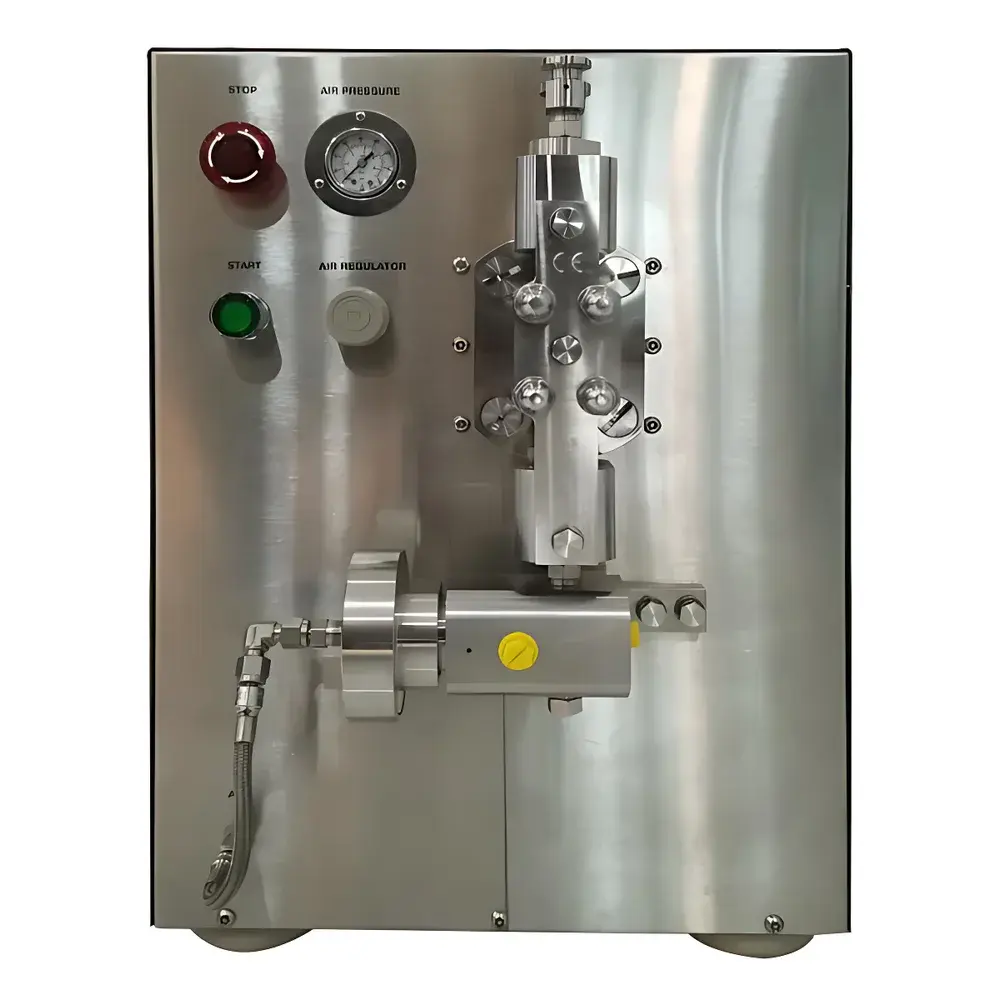
Avestin EmulsiFlex-C3 High-Pressure Homogenizer
| Brand | Avestin |
|---|---|
| Origin | Canada |
| Model | EF-C3 |
| Instrument Type | High-Pressure Homogenizer |
| Dimensions (W×D×H) | 530 mm × 460 mm × 760 mm |
| Processing Capacity | 0.07–3 L/h |
| Maximum Pressure | 30,000 psi |
| Minimum Sample Volume | 7 mL |
| Sterilization | Autoclavable & SIP-Compatible (Steam-in-Place) |
| Construction | Metal-to-Metal & Metal-to-Ceramic Seals, O-Ring-Free Fluid Path |
Overview
The Avestin EmulsiFlex-C3 is a precision-engineered high-pressure homogenizer designed for laboratory-scale nanoscale particle size reduction and dispersion stabilization of sensitive biopharmaceutical formulations. Operating on the principle of controlled turbulent flow, cavitation, and shear-induced disruption within a precisely engineered homogenizing valve, the EF-C3 delivers reproducible sub-100 nm particle size distributions in liposomes, nanoemulsions, polymeric nanoparticles, and colloidal suspensions. Its fully metallic fluid path—comprising stainless steel and ceramic components with zero elastomeric seals—ensures chemical compatibility, minimal extractables, and intrinsic suitability for GMP-compliant process development and clinical-grade manufacturing support. The system is validated for repeated autoclaving (121 °C, 20 min) and steam-in-place (SIP) sterilization, meeting core requirements for aseptic processing environments under FDA 21 CFR Part 11 and EU Annex 1 frameworks.
Key Features
- Maximum operating pressure of 30,000 psi (207 MPa), continuously adjustable across the full range via digital pressure control—enabling precise optimization of particle size and polydispersity index (PDI) without hardware modification.
- O-ring-free, all-metal fluid path: contact surfaces consist exclusively of hardened stainless steel and wear-resistant ceramic; eliminates leachables, swelling, or degradation associated with elastomeric seals during repeated sterilization cycles.
- Integrated inline extrusion module compatible with certified track-etched polycarbonate membranes (50 nm, 100 nm, 200 nm, and 400 nm pore sizes), allowing simultaneous homogenization and size fractionation—critical for liposome manufacturing where encapsulation efficiency must be preserved post-processing.
- Low thermal load design: adiabatic temperature rise < 8 °C per pass at nominal throughput, minimizing protein denaturation and lipid phase transition risks in thermolabile formulations.
- Minimal sample requirement of 7 mL with near-zero dead volume; enables efficient process screening using scarce or expensive active pharmaceutical ingredients (APIs) or biological actives.
- Embedded safety architecture including dual redundant pressure transducers, real-time thermal monitoring of hydraulic oil, and automatic circuit cutoff upon overpressure, overtemperature, or flow interruption events.
Sample Compatibility & Compliance
The EmulsiFlex-C3 accommodates aqueous, organic, and mixed-phase formulations—including phospholipid dispersions, polymer solutions (e.g., PLGA, PEG-PLA), protein suspensions, viral vectors, and mRNA-LNPs—without compromising structural integrity. All wetted parts conform to ASTM F899-22 (standard specification for wrought stainless steels for surgical instruments) and USP Class VI biocompatibility testing. The system supports full traceability through audit-trail-enabled operation logs and complies with GLP/GMP documentation standards. Validation packages—including IQ/OQ protocols aligned with ISO 13485 and FDA guidance on process validation—are available upon request.
Software & Data Management
The EF-C3 operates via an embedded industrial PLC with a 7-inch capacitive touchscreen HMI. All critical parameters—including pressure setpoint, actual pressure, inlet/outlet temperatures, total processed volume, and cycle count—are logged at 1 Hz resolution and exportable in CSV format. Audit trails meet FDA 21 CFR Part 11 requirements, featuring electronic signatures, user-level access control (admin/operator), and immutable timestamped records. Optional integration with LIMS or MES systems is supported via Modbus TCP or OPC UA protocols.
Applications
- Liposome and lipid nanoparticle (LNP) formulation development for mRNA delivery and small-molecule encapsulation.
- Nanoemulsion production for parenteral nutrition, vaccine adjuvants, and topical delivery systems.
- Cell disruption for intracellular protein recovery under non-denaturing conditions.
- Preparation of uniform colloidal silica, quantum dots, and metal-organic frameworks (MOFs) for diagnostic and catalytic applications.
- Process transfer from lab-scale (EF-C3) to pilot-scale (EmulsiFlex-C5/C7) and commercial production systems—ensuring linear scalability based on constant specific energy input (kJ/L).
FAQ
Is the EF-C3 suitable for sterile manufacturing environments?
Yes—the entire fluid path is autoclavable and SIP-compatible, and all materials comply with ISO 10993-5 cytotoxicity and USP extractables testing.
Can the system be qualified for GMP use?
Yes—Avestin provides IQ/OQ documentation templates, and the instrument meets key elements of Annex 15 (EU GMP) and FDA Process Validation Guidance.
What maintenance intervals are recommended?
Valve inspection every 200 hours of operation; ceramic seat replacement typically required after ≥1,500 hours depending on abrasive load. No scheduled lubrication of the fluid path is necessary.
Does the inline extrusion module affect encapsulation efficiency?
No—validated studies demonstrate >95% retention of encapsulated payload (e.g., calcein, doxorubicin) following combined homogenization/extrusion, due to laminar flow dynamics and absence of high-shear recirculation zones.
Is remote monitoring supported?
Yes—via optional Ethernet interface with secure HTTPS-based web server for real-time parameter viewing and historical log retrieval.
Related Products



