
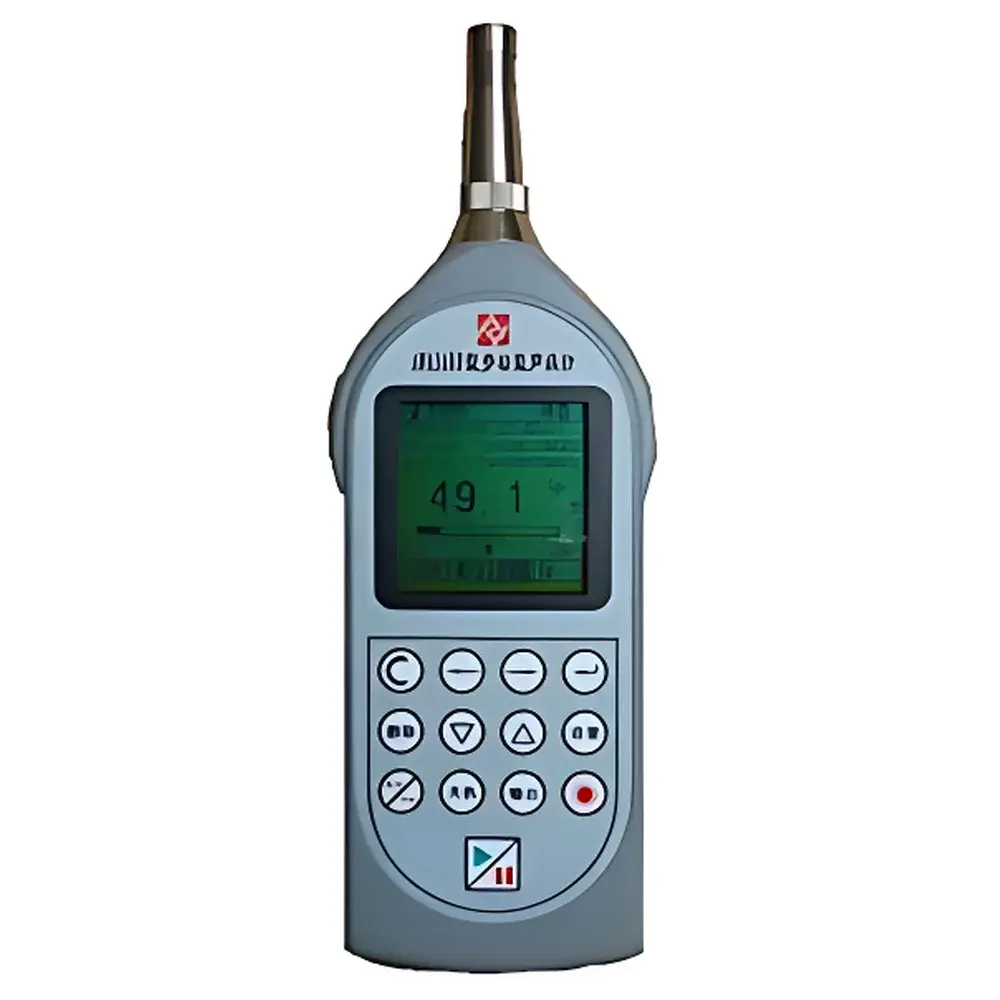
AWA5680 Multi-Function Sound Level Meter
| [Origin | Jiangsu, China |
|---|---|
| Model | AWA5680 |
| Compliance | GB/T 3785.1–2010 Class 2, IEC 61672–1:2013 Class 2 |
| Frequency Range | 20 Hz – 12.5 kHz |
| Measurement Range | Up to 140 dB (customizable) |
| Dynamic Range | 100 dB (linear, auto-ranging) |
| Self-Noise | <23 dB(A), <27 dB(C), <30 dB(Z) |
| Frequency Weightings | A, C, Z |
| Time Weightings | F, S, I |
| Display | 128×128 dot-matrix LCD with LED backlight |
| Data Storage | 2048 integrated results / 1024 statistical sets / 40 × 24-h monitoring sessions |
| Sampling Rate | 32 kHz |
| Operating Temperature | −10 °C to +50 °C |
| Power | 4× LR6 alkaline batteries (≥40 h) or 5 V DC external supply |
| Dimensions | 240 × 80 × 30 mm |
| Mass | 0.37 kg |
| Interfaces | AC/DC output, RS-232C, optional AH40 thermal printer & AWA8570 GSM module] |
Overview
The AWA5680 Multi-Function Sound Level Meter is a compact, handheld acoustic measurement instrument engineered for high-fidelity environmental and occupational noise assessment. It employs digital detection technology—patented for stable amplitude response across its full dynamic range—enabling continuous measurement without manual range switching. Designed in accordance with international electroacoustic standards, the AWA5680 operates on the principle of time-domain pressure sampling followed by real-time digital signal processing (DSP) to compute weighted sound pressure levels (SPL), statistical distributions, and energy-integrated metrics. Its architecture supports simultaneous acquisition of multiple acoustic parameters—including Leq, Lmax, Lmin, LxN, SEL, and E—making it suitable for regulatory compliance monitoring, industrial hygiene evaluation, product noise certification, and long-term ambient noise studies.
Key Features
- 100 dB linear dynamic range ensures seamless operation across low-background and high-noise environments without gain adjustment or range toggling.
- High-resolution 128×128 dot-matrix LCD with LED backlight displays up to ten real-time acoustic metrics simultaneously—or dynamic bar graphs, statistical histograms, and 24-hour distribution plots.
- Modular firmware architecture supports field-upgradable functionality: basic integrating mode, statistical analysis (including percentile LxN and standard deviation), 24-hour automated logging, and airport noise event analysis (e.g., effective perceived noise level, EPNL-compatible data tagging).
- Robust power management: 4× LR6 alkaline cells deliver ≥40 hours of continuous operation; optional rechargeable battery pack and 5 V DC external input enable extended deployment in fixed-location monitoring scenarios.
- Integrated clock with ±5 min/month accuracy and internal backup battery maintains timestamp integrity during power interruption—critical for audit-ready data chains under GLP or ISO 14001 frameworks.
- Expandable connectivity via RS-232C serial interface; compatible with AH40 thermal printer for on-site hardcopy reporting and AWA8570 GSM module for SMS-based remote data transmission to mobile devices or central servers.
Sample Compatibility & Compliance
The AWA5680 is calibrated and verified against traceable acoustic reference standards and conforms to Class 2 specifications per both GB/T 3785.1–2010 and IEC 61672–1:2013. Its frequency response (20 Hz–12.5 kHz) meets requirements for general-purpose environmental noise surveys, workplace exposure assessments per ISO 9612, and industrial equipment noise testing per ISO 3744 and ISO 3746. The instrument supports A-, C-, and Z-frequency weightings and F-, S-, and I-time weightings, enabling compliance with OSHA 1910.95, EU Directive 2003/10/EC, and national emission limits defined in China’s Environmental Noise Emission Standards (GB 12348). Optional GPS integration (internal mounting) allows geotagged measurements for spatial noise mapping applications compliant with ISO 1996–2.
Software & Data Management
Data export is supported via RS-232C to PC-based analysis platforms using manufacturer-provided software (e.g., AWA6228+ suite), which enables post-processing of stored datasets—including spectral averaging, octave-band analysis, and custom report generation. All measurement records include embedded metadata: date/time stamp, instrument ID, configuration flags (weighting, time constant, integration duration), and operator-defined site tags. Audit trails are preserved through immutable internal logging; no parameter modification is permitted after data capture without explicit annotation—supporting traceability requirements under ISO/IEC 17025 and FDA 21 CFR Part 11 when used in regulated quality assurance workflows. Stored data formats adhere to ANSI S1.4–2014 Annex C conventions for interoperability with third-party acoustic databases.
Applications
- Environmental noise monitoring: roadside traffic noise, construction site emissions, community noise mapping, and wind turbine acoustic impact studies.
- Occupational health & safety: personal noise exposure assessment (LEX,8h), hearing conservation program validation, and machine guarding verification per ANSI S12.13.
- Product development & compliance testing: HVAC system noise characterization, automotive component NVH screening, and consumer electronics acoustic signature profiling.
- Infrastructure acoustics: railway noise modeling inputs, airport ground operations monitoring, and building façade insulation verification per ISO 140-3.
- Educational use: undergraduate acoustics laboratories, field methodology training, and hands-on instruction in metrological uncertainty estimation.
FAQ
Does the AWA5680 support calibration traceability to national standards?
Yes. Each unit ships with a factory calibration certificate traceable to the National Institute of Metrology (NIM) of China. Field recalibration can be performed using Class 1 pistonphones (e.g., Brüel & Kjær 4231) or sound calibrators compliant with IEC 60942.
Can the instrument operate continuously for unattended 24-hour monitoring?
Yes. The built-in scheduler supports autonomous hourly measurements over 24 hours, with user-selectable sample durations (1–59 minutes per cycle) and automatic storage of all results—including timestamps, Leq, Lmax, and statistical percentiles.
Is the AWA5680 suitable for outdoor use in extreme temperatures?
It is rated for operation between −10 °C and +50 °C. For prolonged exposure below 0 °C, lithium-based primary cells are recommended to maintain voltage stability; condensation mitigation is advised during rapid temperature transitions.
What data security measures are implemented for stored measurement records?
All internal memory is write-protected after acquisition. No record can be altered or deleted without resetting the entire memory buffer—a design feature intended to preserve evidentiary integrity in regulatory submissions.
Are firmware updates available, and how are they applied?
Firmware upgrades are distributed via USB-to-RS232 adapter and executed using the AWA Configuration Utility. Updates retain existing calibration coefficients and user settings unless explicitly reset.







