AZ 3D-Disdrometer Video Raindrop Spectrometer
| Brand | AZ (Beijing Aozuo) |
|---|---|
| Origin | Germany |
| Manufacturer | AZ Instrument Co., Ltd. |
| Model | 3D-Disdrometer |
| Measurement Area | 200 cm² |
| Sample Volume | 1 L |
| Particle Diameter Range | 0.08–40 mm |
| Fall Velocity Range | 0.2–20 m/s |
| Rainfall Intensity Range | 0.001–>1000 mm/h |
| Resolution (Diameter) | ±0.05 mm for particles <1.2 mm |
| 3D Trajectory Detection | Yes |
| Operating Temperature | −40°C to +50°C |
| Humidity Range | 0–100% RH |
| Power Supply Options | 24 VAC/DC (1 A) or 85–264 VAC / 120–370 VDC (0.2 A @ 230 VAC) |
| Heating Function | Integrated camera heater |
| Communication Interface | RS-485, full/half-duplex, ASCII protocol, 1200–115200 baud |
| Output Standards | SYNOP Table 4680/4677, METAR Table 4678 |
| Weight | 7.5 kg |
| Mounting Tube Diameter | 48–70 mm |
Overview
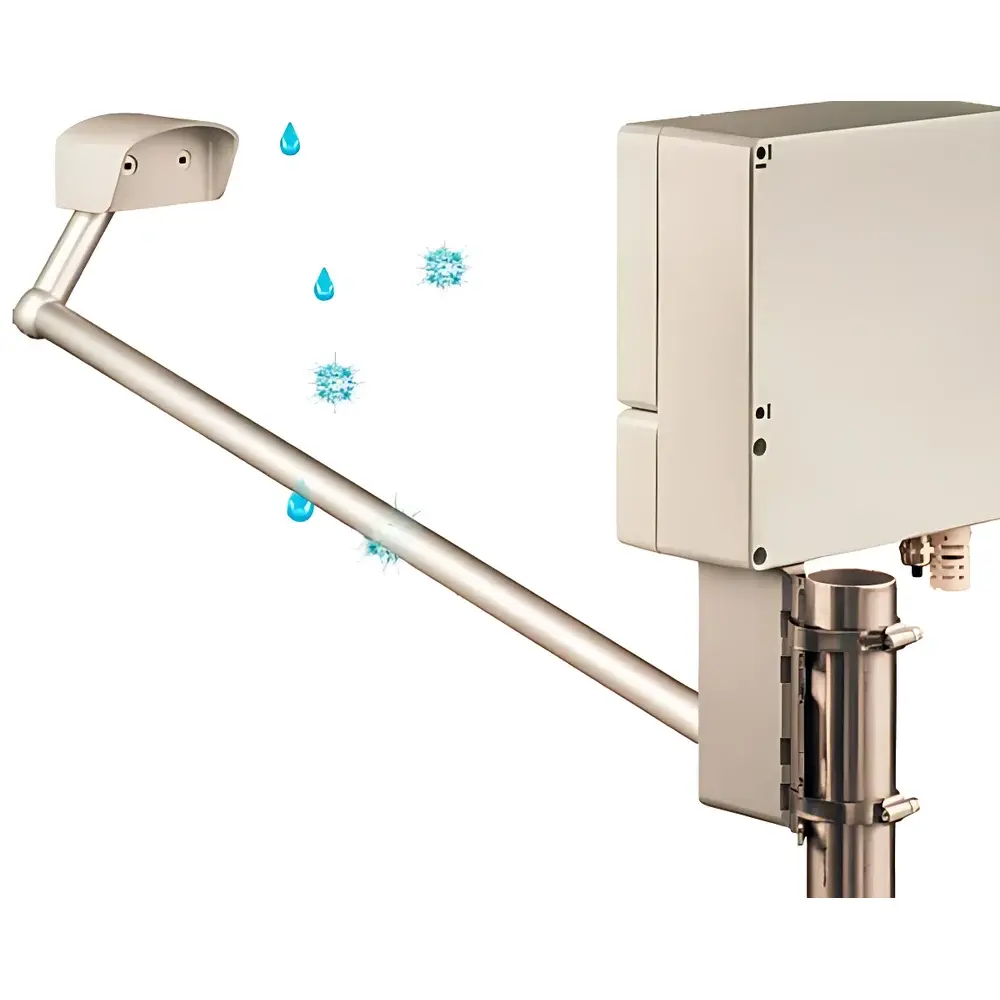
The AZ 3D-Disdrometer is a high-fidelity video-based precipitation particle spectrometer engineered for quantitative microphysical characterization of rainfall and snowfall in operational and research-grade meteorological environments. Unlike traditional optical disdrometers relying on single-axis laser beam interruption or acoustic detection, this instrument employs synchronized stereo imaging—two high-speed CMOS cameras operating under pulsed 850 nm infrared LED illumination—to reconstruct the full 3D trajectory, size, shape, and terminal velocity of individual hydrometeors in real time. The system captures volumetric precipitation data within a precisely defined 200 cm² sampling area and 1 L measurement volume, enabling statistically robust drop size distribution (DSD) derivation with minimal sampling bias. Its core architecture integrates advanced particle segmentation algorithms trained on optical contrast, motion vector coherence, and morphological persistence across successive frames—allowing reliable discrimination between genuine hydrometeors and non-meteorological contaminants including dust, insects, spider silk, and leaf fragments. Crucially, the 3D vector reconstruction capability enables correction for wind-induced drift, significantly improving accuracy in high-wind conditions where conventional vertical-only sensors suffer from undercatch and misclassification.
Key Features
- True 3D hydrometeor tracking: Simultaneous acquisition of X/Y/Z position, velocity vector magnitude and direction, and aspect ratio for each detected particle
- High-resolution sizing: ±0.05 mm diameter accuracy for particles <1.2 mm—exceeding the resolution limit of standard laser disdrometers
- Integrated camera heating: Maintains optical clarity and sensor stability during freezing-rain or high-humidity conditions
- Ruggedized outdoor enclosure: IP65-rated housing with thermal management, rated for continuous operation from −40°C to +50°C
- Dual power configuration support: Field-deployable 24 VAC/DC option (1 A) or mains-compatible 85–264 VAC input (0.2 A @ 230 VAC)
- Standardized meteorological output: Native compliance with WMO SYNOP Tables 4677, 4680 and METAR Table 4678 codes
Sample Compatibility & Compliance
The AZ 3D-Disdrometer is validated for detection of liquid and solid-phase precipitation across the full operational spectrum: drizzle (0.08–0.5 mm), rain (0.5–5 mm), graupel (2–8 mm), and wet/dry snow aggregates (up to 40 mm equivalent spherical diameter). Its classification matrix supports 440 discrete bins (22 diameter classes × 20 velocity classes), fully customizable per user-defined DSD analysis requirements. The instrument meets IEC 60529 (IP65), EN 61326-1 (EMC for industrial environments), and EN 61000-6-2/6-3 standards. Data integrity protocols align with GLP principles, and optional audit-trail logging satisfies traceability requirements for regulatory meteorological networks compliant with WMO Guide to Instruments and Methods of Observation (CIMO Guide, Chapter 6).
Software & Data Management
The included AZ-DisdoSoft v4.x suite operates in both standalone and client-server configurations, supporting remote monitoring via TCP/IP over LAN or cellular backhaul. It provides real-time visualization of up to 30 concurrent parameters—including Z-R relationship plots with live radar calibration overlays, time-series histograms of Dm (median volume diameter), Nw (intercept parameter), and Λ (slope parameter)—all exportable in CSV, ASCII, and native Excel (.xlsx) formats. Data structures follow CF-1.8 (Climate and Forecast) metadata conventions, facilitating ingestion into WRF, COSMO, or CLM post-processing pipelines. Graphical interfaces support calendar-based navigation, hierarchical project trees, and printer-ready PDF report generation with embedded timestamps and instrument calibration metadata.
Applications
- Meteorological observatories requiring WMO-compliant DSD data for nowcasting and model validation
- Airport weather stations performing automated METAR/SPECI coding and icing hazard assessment
- Hydrological research on rainfall-runoff response modeling and urban drainage design
- Transportation safety systems integrating real-time precipitation intensity and type for adaptive road signage and rail signaling
- Atmospheric physics studies investigating warm-rain processes, coalescence efficiency, and drop breakup dynamics
- Calibration reference for ground-based radar reflectivity (Z) and attenuation (A) retrieval algorithms
FAQ
What is the minimum detectable rainfall intensity?
The system reliably detects intensities down to 0.001 mm/h, enabled by extended integration time and low-noise IR imaging under sub-millimeter particle conditions.
Does the instrument require regular optical cleaning or recalibration?
No scheduled recalibration is required; factory calibration is traceable to NIST-traceable dimensional standards. The heated optics minimize condensation and particulate accumulation—field maintenance intervals exceed 12 months under typical deployment conditions.
Can the 3D-Disdrometer distinguish between rain and melting snow?
Yes. By analyzing fall velocity–size relationships, aspect ratio evolution, and temporal fragmentation signatures, the software classifies mixed-phase events with >92% accuracy against collocated PARSIVEL2 and 2D-video disdrometer benchmarks.
Is RS-485 the only communication interface?
RS-485 is the primary fieldbus interface. Optional Ethernet (TCP/IP) and 4G LTE modules are available as factory-configured add-ons for cloud-integrated deployments.
How is wind-induced particle drift compensated in the 3D reconstruction?
Stereo triangulation computes full 3D displacement vectors frame-to-frame; horizontal components are used to compute drift-corrected vertical flux density, ensuring accurate rain rate estimation even at crosswind speeds exceeding 15 m/s.