
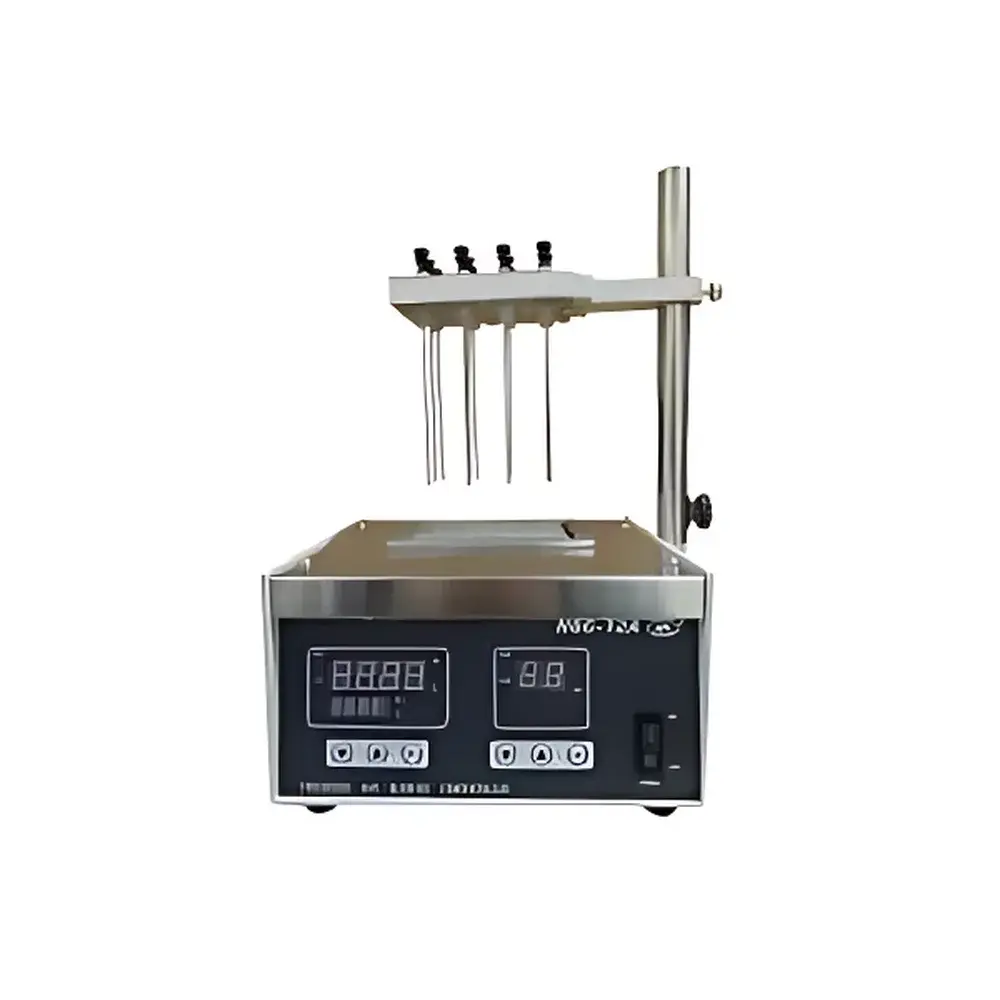
HGC-12A Dry-Block Nitrogen Evaporator
| Origin | Shandong, China |
|---|---|
| Manufacturer Type | Distributor |
| Origin Category | Domestic (China) |
| Model | HGC-12A |
| Price Range | USD 420 – 1,400 (est.) |
| Heating Method | Dry-block heating |
| Temperature Range | Ambient to 150 °C |
| Temperature Stability | ±1 °C |
| Sample Tube Diameter Compatibility | 10–20 mm |
| Gas Flow Rate | 0–5 L/min |
| Sample Capacity | 12 positions |
| Heating Power | 150 W |
| Dimensions (W×D×H) | 260 × 200 × 400 mm |
| Weight | 4.5 kg |
| Power Supply | 220 V, 50 Hz |
| Maximum Gas Inlet Pressure | 200 kPa |
| Temperature Control | 4-digit LED display, PID algorithm, overheat protection, PTC heating element |
| Construction Materials | 316 stainless steel gas manifolds & needle guides, anodized aluminum heating block, optional plastic-coated surfaces |
Overview
The HGC-12A Dry-Block Nitrogen Evaporator is a precision-engineered sample concentration system designed for controlled, inert-gas-assisted solvent removal in analytical laboratories. It operates on the principle of gentle nitrogen gas sweeping across the surface of liquid samples contained in open tubes, accelerating solvent evaporation while minimizing analyte degradation, oxidation, or thermal decomposition. Unlike water bath-based concentrators, the HGC-12A employs a solid aluminum heating block with integrated PTC (Positive Temperature Coefficient) heating elements, delivering rapid thermal response, uniform heat distribution, and enhanced safety through self-limiting temperature behavior. Its ambient-to-150 °C operational range supports a broad spectrum of solvents—from volatile ethyl acetate and dichloromethane to higher-boiling-point acetonitrile and methanol—making it suitable for preparatory steps in GC, HPLC, LC-MS, and immunoassay workflows. The instrument is engineered for reproducibility in regulated environments where consistent endpoint definition, minimal cross-contamination risk, and trace-level analyte recovery are critical.
Key Features
- Dry-block heating architecture with anodized aluminum heating block ensures rapid thermal equilibration, no water maintenance, and reduced contamination risk compared to water bath alternatives.
- PID-controlled digital temperature regulation with dual 4-digit LED display provides real-time setpoint and actual block temperature readouts; ±1 °C stability across the full 20–150 °C working range.
- Adjustable gas manifold assembly with individually height-adjustable stainless steel (316) gas needles enables precise alignment with diverse tube geometries (10–20 mm OD) and accommodates varying sample volumes.
- Modular 12-position configuration allows simultaneous processing of standard 12 × 16 mm or 12 × 18 mm test tubes; interchangeable heating blocks (φ15 mm, φ17 mm, φ21 mm) available for customized tube fitment.
- Gas flow control via integrated needle valve (0–5 L/min range) with pressure rating up to 200 kPa ensures compatibility with standard laboratory nitrogen generators or compressed gas cylinders equipped with pressure-reducing regulators.
- Robust construction includes 316 stainless steel gas pathways, corrosion-resistant surface treatments, and automatic overheat cutoff—meeting essential safety requirements for unattended operation under GLP-compliant protocols.
Sample Compatibility & Compliance
The HGC-12A accommodates a wide range of sample matrices without requiring derivatization or phase-transfer steps. It is routinely deployed in workflows compliant with EPA Method 505, 525.3, and 8081B; AOAC Official Methods of Analysis (e.g., 2007.01 for pesticide residues); and ISO 17025-accredited testing laboratories. All wetted components contacting nitrogen stream or sample vapors—gas manifolds, needle guides, and support fixtures—are fabricated from 316 stainless steel, ensuring resistance to halogenated solvents and acidic/basic extracts. The absence of water reservoirs eliminates microbial growth concerns and simplifies cleaning validation. While the device itself does not carry CE, UKCA, or FDA 510(k) certification, its design adheres to IEC 61010-1 safety standards for laboratory electrical equipment, and its operational parameters align with internal SOPs supporting 21 CFR Part 11 data integrity principles when paired with validated electronic logbooks.
Software & Data Management
The HGC-12A operates as a standalone benchtop instrument with no embedded microprocessor or digital interface. Temperature setpoints and gas flow are manually adjusted using front-panel controls and analog valves—intentionally omitting software dependencies to maximize reliability, reduce calibration complexity, and avoid cybersecurity vulnerabilities associated with connected lab devices. For laboratories requiring audit-ready records, integration with external environmental monitoring systems (e.g., Vaisala viewLinc or DeltaTrak) is feasible via optional PT100 probe outputs (available upon request). All operating parameters—including duration, set temperature, observed stability, and gas pressure—are documented manually in laboratory notebooks or LIMS-integrated electronic worksheets, supporting full traceability per ISO/IEC 17025 clause 7.5.1.
Applications
- Agricultural residue analysis: Concentration of QuEChERS extracts from fruits, vegetables, cereals, and plant tissues prior to GC-ECD or LC-MS/MS quantification.
- Environmental monitoring: Pre-concentration of SPE eluates from drinking water, wastewater, and soil leachates targeting PAHs, PCBs, organochlorine pesticides, and phenolic compounds.
- Pharmaceutical quality control: Solvent exchange and volume reduction of dissolution samples, stability-indicating assay preparations, and herbal extract clean-up prior to HPLC-DAD analysis.
- Clinical toxicology: Rapid nitrogen blow-down of plasma, serum, and urine samples following protein precipitation or liquid–liquid extraction for amphetamine, opioid, or benzodiazepine screening.
- Food safety testing: Final concentration step in multi-residue methods for veterinary drug residues (e.g., clenbuterol, dioxins) in milk, honey, and alcoholic beverages.
FAQ
Is the HGC-12A compatible with corrosive solvents such as hydrochloric acid or trifluoroacetic acid?
No. While 316 stainless steel offers improved corrosion resistance versus 304, prolonged exposure to strong mineral acids or halogenated acids may degrade gas pathway integrity. Use only with organic solvents, aqueous buffers, or mildly acidic/basic extracts.
Can I use this instrument under a fume hood?
Yes. The HGC-12A generates no internal exhaust; nitrogen purge gases must be vented externally. Operation within a certified fume hood is recommended when handling volatile or hazardous solvents.
Does the unit include a nitrogen gas regulator or supply?
No. A laboratory-grade nitrogen regulator with fine metering capability (0–5 L/min scale) and inlet pressure compatibility up to 200 kPa must be provided separately.
What maintenance is required for long-term accuracy?
Annual verification of temperature uniformity across all 12 positions using NIST-traceable thermocouples is recommended. Visual inspection of needle tips and gas manifold seals should occur before each batch run.
Is there a version with USB or Ethernet connectivity?
Not available. The HGC-12A is intentionally designed as an analog, non-networked instrument to ensure operational continuity, simplify qualification (IQ/OQ), and eliminate firmware update dependencies.



