
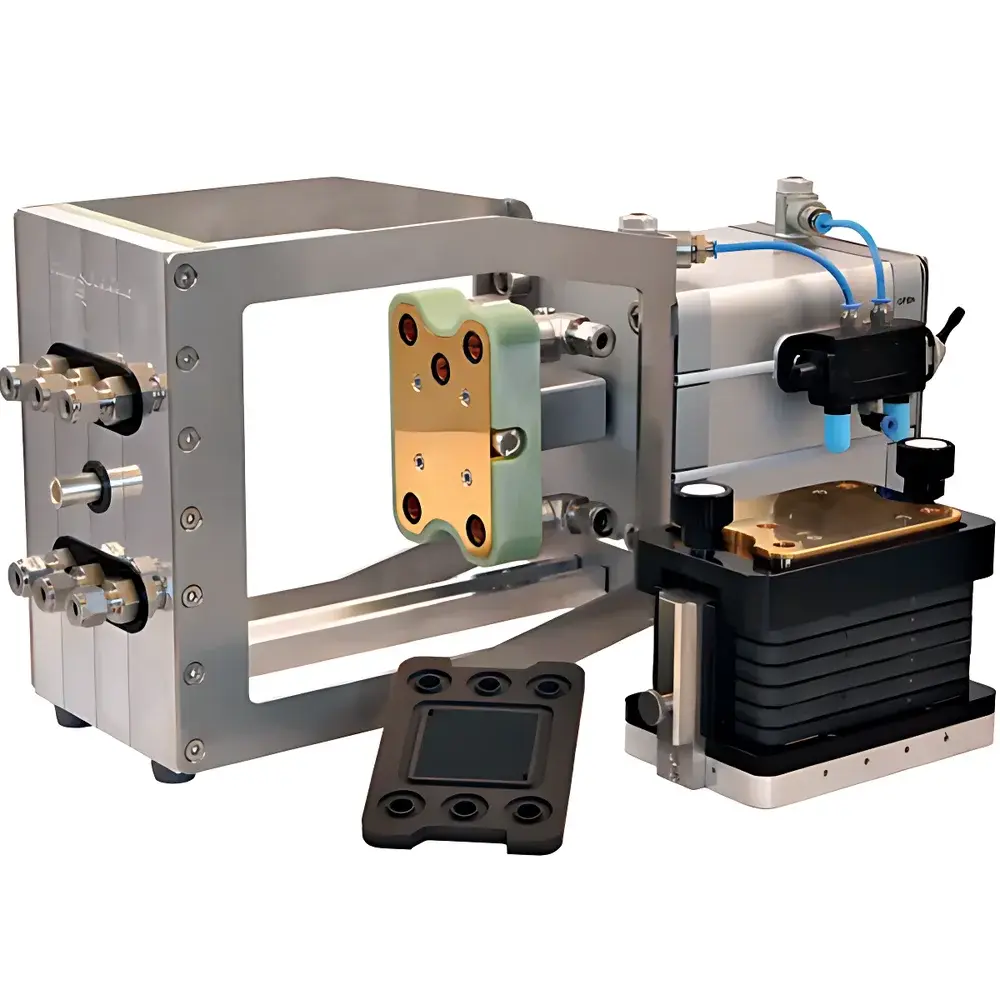
Baltic FuelCells QCF-125 PEM Fuel Cell Stack Test Fixture
| Brand | Baltic FuelCells |
|---|---|
| Origin | Germany |
| Model | QCF-125 |
| Active Area per Cell | 25 cm² |
| Max. Number of Cells | 5 |
| Temperature Range | up to 140 °C |
| Contact Pressure | up to 6.28 kN (2.5 N/mm², equivalent to 8 bar) |
| Gas Inlet/Outlet Port Diameter | Ø 8 mm |
| Pneumatic Control Port Diameter | Ø 4 mm |
| Electrical Interface | 1 mm sensor wire socket, 8 mm load current terminal |
| Stack Thickness Adjustment Range | up to 0.9 mm per MEA |
| Dimensions (L×W×H) | 465 × 175 × 242 mm |
| Net Weight | 13.5 kg |
Overview
The Baltic FuelCells QCF-125 PEM Fuel Cell Stack Test Fixture is an engineered mechanical test platform designed for controlled, repeatable evaluation of proton exchange membrane (PEM) fuel cell stacks comprising up to five individual cells. It operates on a modular clamping principle utilizing a pneumatically actuated piston system to apply uniform, continuously adjustable compressive force across the active area of each cell (25 cm²), ensuring consistent interfacial contact resistance and thermal/mechanical boundary conditions—critical parameters in electrochemical performance validation. Unlike generic compression frames, the QCF-125 integrates dedicated through-stack instrumentation pathways for real-time, per-cell voltage and temperature monitoring, enabling spatially resolved diagnostics during polarization, impedance, or durability testing. Its design supports both research-grade component screening (e.g., membranes, catalyst-coated membranes [CCMs], gas diffusion layers [GDLs], and flow field plates) and pre-qualification of stack assembly protocols under realistic operating temperatures (up to 140 °C) and gas pressure regimes.
Key Features
- Pneumatically driven clamping mechanism with continuous pressure adjustment (0–8 bar equivalent, max. 6.28 kN total force) ensures high reproducibility of contact pressure across all cells.
- Modular stack architecture accommodates 2–5 single cells; each cell features independent voltage and temperature sensing via integrated 1 mm-diameter sensor wiring ports.
- Interchangeable flow field configurations—including U-type and Z-type gas distribution patterns—allow systematic investigation of reactant transport effects without disassembly.
- Tool-free cell fixture mounting and alignment; no rewiring or re-plumbing required when swapping MEAs, GDLs, or flow plates—minimizing setup time and cross-contamination risk.
- Adjustable stack thickness compensation (up to 0.9 mm per MEA layer) accommodates variations in component tolerances and degradation-induced dimensional changes.
- Robust aluminum frame (465 × 175 × 242 mm, 13.5 kg net weight) with standardized Ø 8 mm fuel/oxidant ports and Ø 4 mm pneumatic control interface for seamless integration into existing test benches.
Sample Compatibility & Compliance
The QCF-125 is compatible with standard 25 cm² PEM fuel cell components, including Nafion-based membranes, Pt/C and PtCo catalyst layers, carbon paper or cloth GDLs, and machined or stamped graphite bipolar plates. Its mechanical design conforms to widely adopted laboratory-scale stack testing conventions defined in ASTM D7279 and ISO 14687-2 for fuel cell component qualification. While the fixture itself does not include integrated heating/cooling, its thermal interface is engineered for direct coupling with external thermostatic circulators (e.g., Huber or LAUDA units), supporting operation within the full 20–140 °C range required for accelerated stress testing (AST) protocols. All electrical and pneumatic interfaces comply with IEC 61000-6-3 (EMC) and ISO 8573-1 (compressed air purity Class 2) specifications.
Software & Data Management
The QCF-125 operates as a hardware-integrated subsystem—not a standalone instrument—and is intended for use with third-party electrochemical workstations (e.g., BioLogic VSP-300, Gamry Interface 5000E) and data acquisition systems. Its per-cell voltage and temperature signals are routed via shielded 1 mm sensor terminals to external DAQ modules supporting IEEE 1451.2 or Modbus RTU protocols. When paired with compliant test software (e.g., EC-Lab, Framework, or custom LabVIEW applications), the fixture enables synchronized acquisition of spatially resolved polarization curves, EIS spectra, and thermal transients—essential for root-cause analysis of localized failure modes such as flooding, drying, or catalyst degradation. Audit-trail-capable systems may log clamping pressure setpoints, gas flow rates, and thermal setpoints alongside electrochemical data to satisfy GLP and internal QA documentation requirements.
Applications
- Comparative evaluation of membrane conductivity and hydrogen crossover under variable humidity and temperature gradients.
- Diagnostics of interfacial contact resistance (ICR) evolution during cyclic compression/decompression tests.
- Screening of novel GDL architectures for water management efficiency in low-humidity operation.
- Validation of MEA manufacturing consistency across pilot-line batches using per-cell voltage deviation metrics.
- Accelerated lifetime testing (ALT) of stack subcomponents under controlled thermal-mechanical stress profiles.
- Development and calibration of physics-based stack models requiring experimentally derived spatial voltage distributions.
FAQ
Does the QCF-125 include integrated temperature control?
No—the fixture provides thermal interface surfaces compatible with external heated/cooled plates or circulating fluid manifolds, but does not contain built-in heaters or chillers.
Can the QCF-125 be used with non-PEM fuel cell types (e.g., SOFC or DMFC)?
It is mechanically optimized for low-temperature PEM configurations (25 cm², graphite flow fields, <140 °C). Use with high-temperature or corrosive electrolyte systems requires validation of material compatibility and sealing integrity.
Is pressure calibration traceable to national standards?
The pneumatic actuation system accepts calibrated pressure transducers (e.g., Druck DPI 141); end-users are responsible for periodic verification against ISO/IEC 17025-accredited calibration services.
What safety certifications does the fixture carry?
As a mechanical test fixture without embedded electronics or power supplies, it falls outside CE/UL scope for active equipment—but complies with EN 842-1 (mechanical press safety principles) when installed with appropriate guarding and pressure relief provisions.
Are replacement gaskets and sealing components available as spare parts?
Yes—Baltic FuelCells supplies fluorosilicone and EPDM gasket kits matched to the 25 cm² active area geometry, along with torque-spec fasteners and alignment pins for long-term maintenance.





