
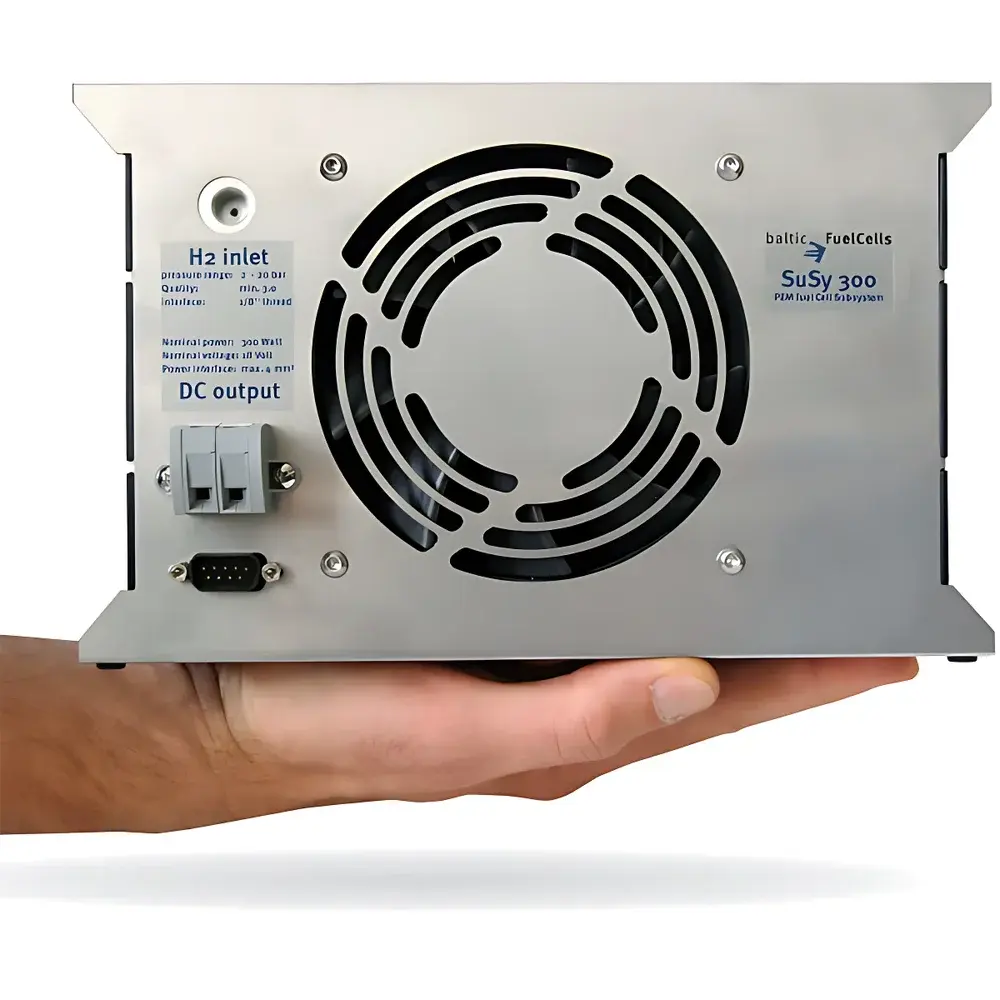
Baltic FuelCells SuSy300 300W Proton Exchange Membrane Fuel Cell Subsystem
| Brand | Baltic FuelCells |
|---|---|
| Origin | Germany |
| Model | SuSy300 |
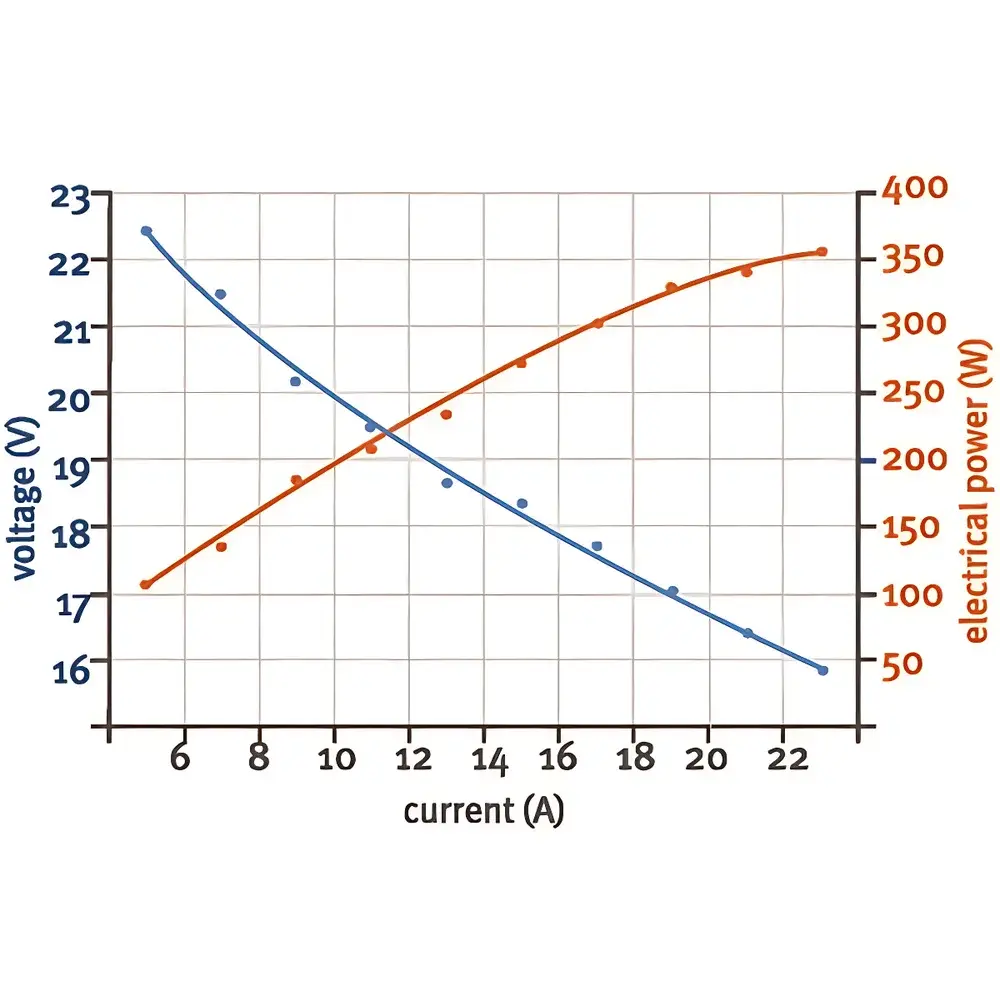
| Output Power | 300 W (nominal) |
| DC Voltage Range | 16–21 V |
| Rated Current | 18 A |
| System Efficiency | 45% @ 300 W |
| Fuel | 99.9% H₂ + ambient air |
| H₂ Inlet Pressure | 2–20 bar |
| Startup Time | <3 s |
| Safety Monitoring | Integrated H₂ pressure & temperature sensors |
| Gas Port | 1/8" internal thread |
| Control Interface | SUB-D9 connector, RS-232 protocol |
| Dimensions | 244 × 155 × 180 mm |
| Weight | 3.9 kg |
Overview
The Baltic FuelCells SuSy300 is a fully integrated proton exchange membrane (PEM) fuel cell subsystem engineered for rapid deployment in laboratory-scale R&D, prototype validation, and pre-commercial system integration. Unlike standalone fuel cell stacks requiring external balance-of-plant (BoP) components, the SuSy300 embeds critical subsystems—including humidification management, thermal regulation, gas distribution, and digital control logic—within a compact, self-contained mechanical housing. Its operation is based on electrochemical oxidation of high-purity hydrogen at the anode and reduction of oxygen from ambient air at the cathode, generating direct current with water as the sole byproduct. Designed to meet the stringent demands of electrochemical instrumentation users—including university research labs, national energy institutes, and industrial power-system developers—the SuSy300 delivers reproducible 300 W nominal output under controlled ambient conditions (23 ± 2 °C, 40–60% RH), enabling reliable benchmarking of stack performance, catalyst durability, and system-level efficiency metrics.
Key Features
- Pre-integrated PEM fuel cell core with proprietary membrane-electrode assembly (MEA), optimized for long-term stability under cyclic load conditions.
- Onboard microcontroller-based system controller with real-time monitoring of voltage, current, stack temperature, inlet H₂ pressure, and cathode airflow rate.
- Passive thermal management architecture with aluminum heat-sink design and convection-enhanced cooling—no external coolant loop or pump required.
- Plug-and-play gas interface: standardized 1/8″ NPT internal thread ports for H₂ supply and air intake, compatible with common lab-grade regulators and mass flow controllers.
- RS-232 serial communication via SUB-D9 connector supports ASCII command protocol for remote start/stop, setpoint adjustment, and diagnostic data streaming.
- Comprehensive safety layer including redundant H₂ pressure transducers, thermistors at critical thermal nodes, and automatic shutdown on overpressure (>21 bar), overtemperature (>85 °C), or open-circuit fault detection.
Sample Compatibility & Compliance
The SuSy300 operates exclusively with ultra-high-purity hydrogen (≥99.9% vol., ISO 8573-1 Class 1.1.1 for particulates, moisture, and oil) and ambient air (filtered to ISO 8573-1 Class 4). It is not rated for reformate gas, CO-containing feeds, or alternative fuels. The subsystem complies with IEC 62282-1 (Fuel cell technologies – Part 1: Safety), IEC 62282-6-1 (Micro fuel cell power systems), and EN 61000-6-3 (EMC emission limits for industrial environments). All electrical interfaces conform to SELV (Safety Extra-Low Voltage) requirements per IEC 61000-6-2. While not certified for continuous unattended operation under IEC 62443, its firmware architecture supports audit-ready logging essential for GLP-compliant electrochemical testing workflows.
Software & Data Management
The SuSy300 communicates via ASCII-based RS-232 commands (9600 baud, 8N1), enabling seamless integration with LabVIEW, Python (pySerial), MATLAB, or custom SCADA platforms. Standard telemetry includes timestamped records of VDC, IDC, Tstack, PH2_in, and status flags (e.g., “READY”, “FAULT_03”). Optional firmware upgrade enables CSV-formatted log export with configurable sampling intervals (100 ms–10 s). Data files include embedded metadata (firmware version, serial number, UTC timestamp), supporting traceability per ISO/IEC 17025 clause 7.7. No cloud connectivity or proprietary software is required—raw serial output satisfies FDA 21 CFR Part 11 requirements when captured using validated acquisition software with electronic signature and audit trail functionality.
Applications
- Accelerated lifetime testing of MEAs and gas diffusion layers (GDLs) under realistic dynamic load profiles.
- Validation platform for power electronics designers developing DC-DC converters, MPPT algorithms, and hybrid energy management systems.
- Teaching module for electrochemistry and sustainable energy courses—demonstrating Faraday efficiency, polarization curve analysis, and thermal cross-coupling effects.
- Bench-scale evaluation of hydrogen purity impact on voltage decay rates and impedance spectroscopy signatures (EIS).
- Reference subsystem for ISO 14687-2 compliance verification of hydrogen fuel quality prior to full-stack qualification.
FAQ
Can the SuSy300 operate with hydrogen blends containing CO or CO₂?
No. The integrated PEM stack requires ≥99.9% H₂ purity. Even trace CO (<10 ppm) causes irreversible anode catalyst poisoning. Reformate or syngas operation is unsupported.
Is external humidification required?
No. The subsystem uses internally recirculated product water for membrane hydration. External humidifiers are unnecessary and may disrupt system balance.
What is the recommended maintenance interval?
No scheduled maintenance is required within the first 2,000 operational hours. Visual inspection of gas fittings and periodic validation of sensor calibration (annually) are advised per ISO/IEC 17025.
Does the SuSy300 support analog voltage/current output for PLC integration?
Not natively. Analog outputs require external signal conditioning modules interfaced via the RS-232 telemetry stream.
Can multiple SuSy300 units be paralleled for higher power output?
Parallel operation is not supported out-of-the-box. Independent control and load-sharing logic must be implemented externally using master-slave coordination protocols.



