
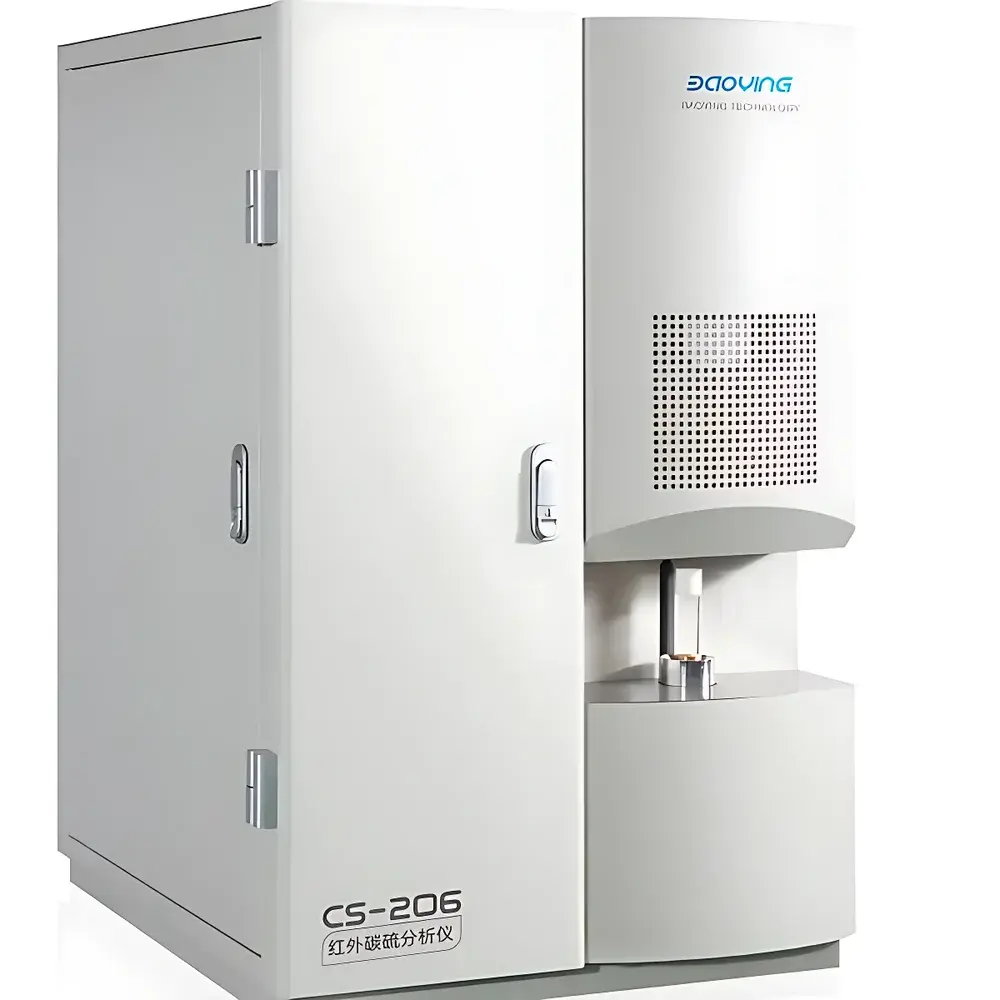
Baoying CS206 High-Frequency Infrared Carbon-Sulfur Analyzer
| Brand | Baoying |
|---|---|
| Origin | Shanghai, China |
| Manufacturer Type | Direct Manufacturer |
| Country of Origin | China |
| Model | CS206 |
| Price Range | USD 14,000 – 42,000 (FOB Shanghai) |
| Measurement Principle | Non-Dispersive Infrared (NDIR) Absorption |
| Heating System | 3.5 kW High-Frequency Induction Furnace |
| Measurement Range | C: 0.0001–10 wt% |
| S | 0.0001–5 wt% (extendable to 99.99 wt% for both elements) |
| Sensitivity | 0.01 ppm |
| Precision | C: ±1.0 ppm or RSD ≤ 0.5% |
| S | ±1.0 ppm or RSD ≤ 1.0% (per certified reference materials per ISO/IEC 17025 validation protocols) |
| Analysis Time | 20–40 s per sample |
| Gas Flow Control | High-Accuracy Mass Flow Controller (MFC) |
| Combustion Atmosphere | Purified Oxygen Supply with Optional Oxygen Purification Module |
| Sample Handling | Automated Ash Removal & Multi-Stage Filtration |
| Optional Accessories | Physical Water Removal Unit, Constant-Temperature Furnace Head, Multi-Point Oxygen Injection |
Overview
The Baoying CS206 High-Frequency Infrared Carbon-Sulfur Analyzer is a dual-channel elemental combustion analyzer engineered for precise, simultaneous quantification of total carbon (C) and sulfur (S) in solid metallic, ceramic, and inorganic matrix samples. It operates on the principle of high-frequency induction combustion followed by non-dispersive infrared (NDIR) spectroscopic detection—complying with internationally recognized methodologies including ASTM E1019, ISO 15350, and GB/T 20123. During analysis, a precisely weighed sample is introduced into a quartz combustion crucible and subjected to rapid, uniform heating under controlled oxygen flow within a 3.5 kW high-frequency induction furnace. This ensures complete oxidation of carbon and sulfur to CO2 and SO2, respectively. The resulting gases pass through integrated multi-stage filtration, catalytic water removal, and optional physical desiccation before entering dedicated NDIR cells calibrated for each analyte. Signal intensities are linearly correlated to concentration via Beer-Lambert law-based algorithms, enabling trace-level detection down to 0.01 ppm with robust inter-laboratory reproducibility.
Key Features
- Simultaneous dual-element determination of carbon and sulfur in a single 20–40 second analysis cycle
- High-frequency induction furnace with constant-temperature furnace head design for thermal stability and minimized crucible degradation
- Precision mass flow controller (MFC) regulating oxygen delivery at ±0.2% full-scale accuracy for consistent combustion efficiency
- Dedicated NDIR optical cells with temperature-stabilized detectors and long-life IR sources ensuring >10,000-hour operational reliability
- Automated post-combustion cleaning sequence: mechanical ash ejection, ceramic filter regeneration, and multi-stage particulate capture
- Modular gas conditioning: standard catalytic water removal; optional physical desiccant module and oxygen purification unit for ultra-low background applications
- Multi-point oxygen injection architecture enhancing combustion completeness across heterogeneous and refractory samples
Sample Compatibility & Compliance
The CS206 supports a broad spectrum of sample types—including ferrous and non-ferrous metals (steels, cast irons, superalloys), ores, slags, ceramics, and geological standards—within weight ranges of 0.1–1.0 g (adjustable via calibration curve scaling). Its measurement uncertainty is validated against NIST SRMs (e.g., SRM 1261a, 1262c) and CRM-certified reference materials under ISO/IEC 17025-accredited laboratory conditions. The system meets functional requirements for GLP and GMP environments: audit-trail-enabled software, user-access controls, electronic signature support (aligned with FDA 21 CFR Part 11 principles), and full traceability of calibration history, maintenance logs, and raw spectral data archives.
Software & Data Management
Baoying Analytical Suite v4.2 provides intuitive instrument control, real-time spectral visualization, and automated peak integration using second-derivative baseline correction. All quantitative results are linked to calibration curves stored with metadata (date, operator, reference material ID, uncertainty budget). Raw absorbance spectra, gas flow profiles, and furnace temperature ramps are saved in vendor-neutral HDF5 format for third-party reprocessing. Data export supports CSV, XML, and LIMS-compatible ASTM E1382-compliant formats. Remote diagnostics, firmware updates, and method validation reports are accessible via encrypted HTTPS interface compliant with TLS 1.2+ security protocols.
Applications
- Quality control of low-carbon steels and high-purity nickel alloys where carbon residuals below 10 ppm impact weldability and creep resistance
- Trace sulfur monitoring in catalyst supports and battery cathode precursors to prevent poisoning of electrochemical interfaces
- Verification of desulfurization efficiency in metallurgical slag processing and coal ash characterization
- Reference material certification laboratories requiring RSD ≤ 0.5% for carbon and ≤ 1.0% for sulfur across multi-day repeatability studies
- Research on carbide/sulfide phase evolution during heat treatment, enabled by rapid turnaround and high dynamic range (0.0001–99.99 wt%)
FAQ
What standards does the CS206 comply with for regulatory reporting?
The analyzer conforms to ASTM E1019, ISO 15350, JIS G 1211, and GB/T 20123. Full validation documentation—including linearity, LOD/LOQ, intermediate precision, and robustness testing—is provided per ISO/IEC 17025 Annex A.2 requirements.
Can the CS206 analyze powders or pressed pellets?
Yes—samples may be introduced as fine powders, chips, or pressed pellets (using graphite or tungsten additives if required). The high-frequency furnace ensures uniform ignition regardless of physical form.
Is method transfer possible from legacy LECO or ELTRA instruments?
Calibration curves and spectral processing parameters are fully exportable. Cross-platform validation kits (including matched CRMs and procedural SOPs) are available upon request.
How often does the NDIR detector require recalibration?
Under routine operation with daily system suitability checks, detector recalibration is recommended every 6 months or after 2,000 analyses—whichever occurs first—as verified by zero-gas and span-gas verification protocols.
What maintenance is required for the high-frequency generator?
The solid-state RF generator requires no periodic tuning. Annual inspection includes cooling system integrity check, capacitor bank leakage test, and impedance matching verification using built-in diagnostic routines.





